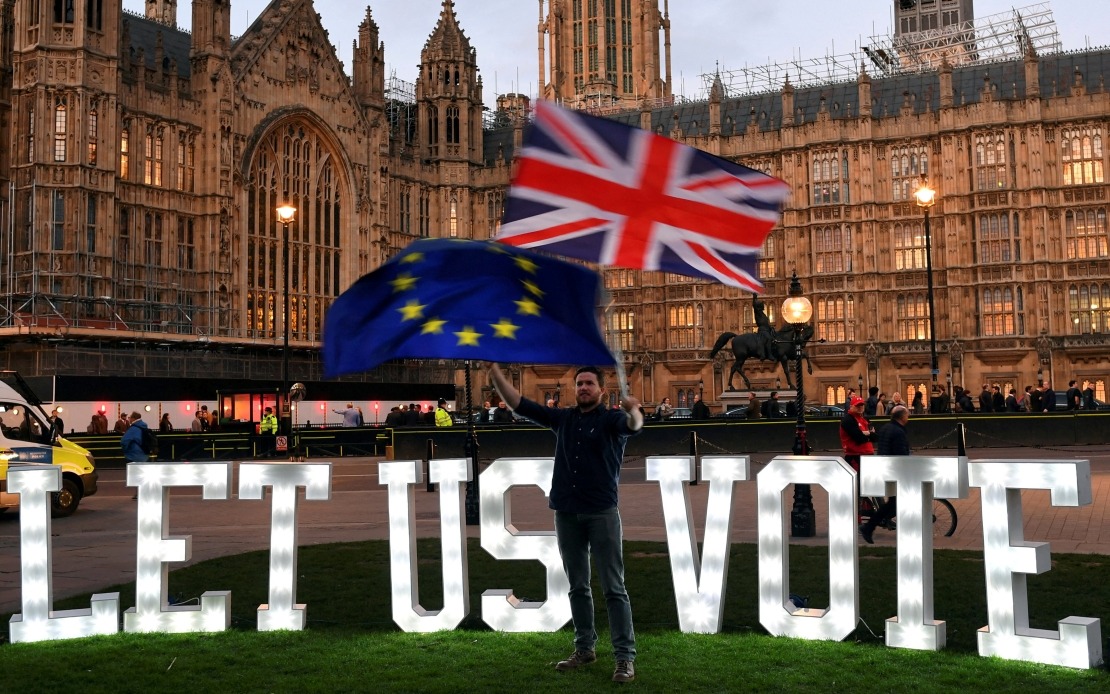
Britain's return to the European Union fold appears unlikely regardless of who leads the next government, according to Richard Balfe, a veteran Conservative peer in the House of Lords. Speaking to Russian news agency RIA Novosti, Balfe expressed scepticism about any serious Westminster effort to reverse Brexit, even as the Labour Party enters a leadership transition that will reshape the political landscape at Westminster.
Balfe's assessment arrives at a symbolically charged moment. June 23 marked a decade since British voters delivered their shock decision to leave the EU, with 52 per cent backing the departure in what became one of the most consequential referendums in modern British history. That vote eventually led to the country's formal exit on January 31, 2020, concluding nearly half a century of EU membership that had defined Britain's economic and political position in Europe.
When asked directly whether a new government might attempt to undo Brexit, Balfe acknowledged the theoretical possibility before immediately deflating it. "Yes, but in a rather halfhearted way," he told the Russian news service. "Ultimately, they will fail [to re-enter the EU]." The qualifier about half-heartedness reveals his view that even if a future administration entertained such thoughts, the political will and strategic commitment would prove insufficient to overcome the considerable obstacles to rejoining.
Balfe's prognostication extends beyond mere institutional inertia. He contends that Britain's political trajectory under new stewardship will involve continued uncertainty and reactive policymaking rather than decisive strategic repositioning toward Europe. The incoming government, he suggests, will "muddle along," a distinctly British phrase capturing the sense of muddling through without clear direction or masterplan.
More intriguingly, Balfe identifies an alternative gravitational pull on British policy: alignment with Washington. Rather than pivoting back toward Brussels, he expects Britain will increasingly orient itself toward American interests and leadership. This observation touches on a genuine fault line in British geopolitics since Brexit—the tension between developing a more autonomous foreign policy and defaulting to the transatlantic partnership that has dominated postwar British strategy.
The timing of Balfe's comments coincides with significant political upheaval at Downing Street. Prime Minister Keir Starmer announced his resignation as leader of the ruling Labour Party on Monday, though he will remain as prime minister until a successor emerges. The election process to choose his replacement begins July 9 and must conclude before Parliament returns in September, compressing what would normally be a more extended leadership contest into just weeks. This domestic turbulence underscores the political fragility that might make ambitious EU negotiations a lower priority.
The practical machinery of Brexit remains firmly entrenched in British law and administrative practice. The transition period that temporarily maintained EU frameworks expired on December 31, 2020, when a two-month adjustment window ended. What followed on January 1, 2021, was the formal activation of a trade and cooperation agreement governing UK-EU relations—a framework that introduced new friction and complexity into commerce between Britain and its nearest neighbours. Businesses report persistent complications around customs procedures, regulatory divergence, and bureaucratic requirements that did not exist during the 47 years of EU membership.
These practical impediments have exacted a significant economic price. The Financial Times documented how Britain's standing as a major international trade hub has contracted measurably since departure, with investment flows into British companies notably constrained compared to the pre-Brexit environment. Restoring the previous regulatory alignment and institutional framework would require not merely political will but genuine economic sacrifice and years of negotiation that no incoming government has shown appetite for undertaking.
For Southeast Asian observers and policymakers, Britain's Brexit trajectory offers instructive lessons about the long-term consequences of exiting established multilateral frameworks. The UK's experience demonstrates how departing from integrated economic and regulatory systems imposes persistent costs measured not just in immediately lost trade but in reduced attractiveness to foreign investors who value stability, predictable market access, and harmonised standards. These considerations matter acutely for nations considering their own positions within regional integration projects.
Balfe's assessment, grounded in insider knowledge of Westminster machinery and Conservative thinking, suggests that the question of potential EU reaccession has effectively been settled not through formal deliberation but through the weight of accumulated costs, political polarisation, and the emergence of competing strategic priorities. While younger voters and certain business constituencies periodically revive the question, no governing coalition has emerged capable of mounting a serious reentry campaign.
The broader implication extends beyond Britain's bilateral relationship with Brussels. As Westminster grapples with leadership transition and economic pressures, the appetite for revisiting fundamental strategic choices—let alone overturning a decision that has metastasised across the nation's entire institutional apparatus—appears minimal. Balfe's forecast likely captures reality: Britain will continue its post-Brexit path, marked by incremental adjustment rather than dramatic reversal, even as new Labour leadership settles into power.

