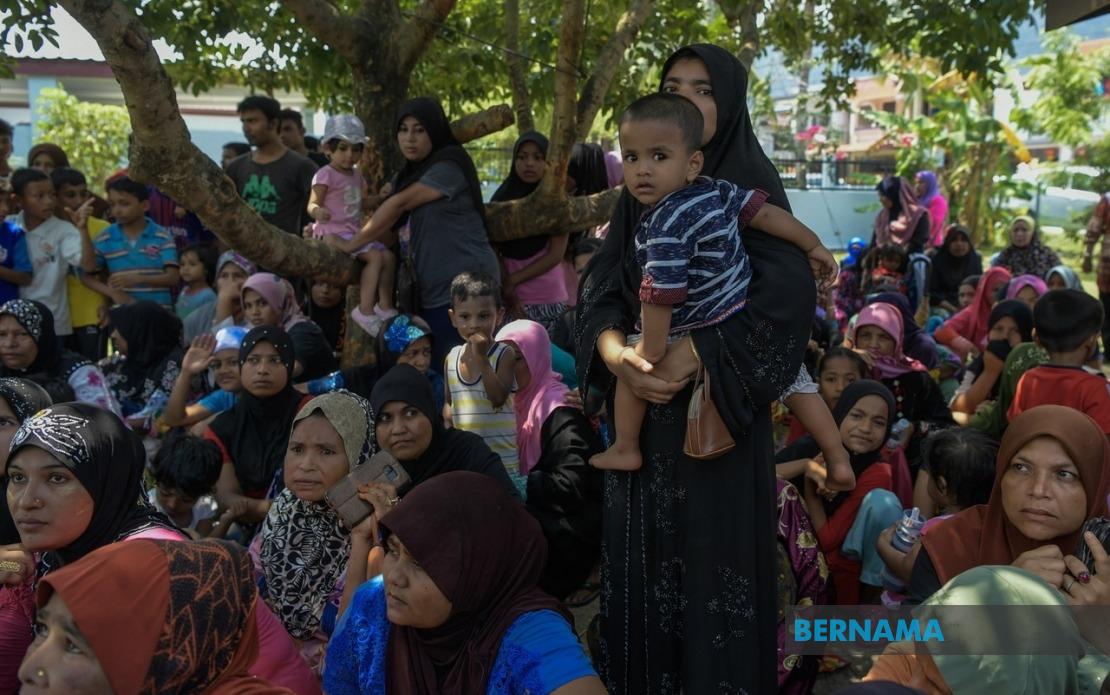
The Malaysian government has moved to dispel widespread misconceptions about the legal status of United Nations High Commissioner for Refugees documentation, with Economy Minister Datuk Akmal Nasrullah Mohd Nasir emphasising that such cards confer neither citizenship rights nor exemption from the nation's laws. Speaking during the Global Supply Crisis Briefing on July 13, Akmal Nasrullah underscored that individuals holding UNHCR identification remain fully subject to Malaysian legal jurisdiction, and those suspected of committing offences will face investigation and prosecution like any other person within the country's borders.
The clarification comes as the Home Ministry brought refugee management concerns to the National Economic Action Council meeting chaired by Prime Minister Datuk Seri Anwar Ibrahim. The escalating public anxiety surrounding refugee documentation has centred on questions about whether such cards might exempt holders from local law enforcement, a misconception that officials now explicitly reject. Akmal Nasrullah stressed that the UNHCR card serves purely as a registration mechanism for humanitarian purposes and carries no judicial privilege or protective status under Malaysian law.
The Home Ministry has outlined an expanded framework for managing refugee populations more rigorously. Through the Immigration Department, authorities are rolling out the Refugee Registration Document Programme, which incorporates biometric data collection, comprehensive security screening, monitoring mechanisms and targeted enforcement operations. This systematic approach aims to establish clearer accountability structures while maintaining humanitarian obligations to vulnerable populations seeking sanctuary in Malaysia.
Enforcement efforts are being substantially strengthened across multiple fronts. Immigration authorities plan to intensify integrated operations targeting human smuggling networks, trafficking syndicates, fraudulent document schemes and clandestine border crossings. The government has recognised that tighter security measures are essential to protect both migrant communities from exploitation and local populations from associated risks. Technology will play an increasingly central role in these efforts, with data analytics and surveillance systems being deployed to detect potential threats and guide operational decisions.
Financial resources have been mobilised to support this security apparatus. The government has allocated RM1.2 billion across various agencies specifically designated for border control projects and security infrastructure. This substantial investment reflects the administration's commitment to overhauling frontier management systems and enforcement capabilities. Beyond immediate police and immigration functions, the allocation demonstrates a whole-of-government approach recognising that effective border control requires sustained financial commitment.
The Malaysian Border Control and Protection Agency is experiencing accelerated expansion of its operational scope and capacity. Officials are moving to consolidate and streamline border management functions under a unified command structure, eliminating duplicative efforts and enhancing coordination between security agencies. This institutional restructuring seeks to create a more efficient and responsive system capable of handling the complexities of modern transnational movement across Malaysian land and maritime borders.
For Malaysian readers, these developments signal a government commitment to asserting full sovereign control over immigration and security matters while distinguishing between humanitarian obligations and legal accountability. The emphasis on clarifying UNHCR documentation reflects sensitivity to public opinion regarding refugee populations, particularly amid concerns about community safety and law enforcement efficacy. By explicitly rejecting the notion that humanitarian status conveys legal immunity, authorities are attempting to restore public confidence in the rule of law.
The broader context involves Malaysia's position as a major transit and destination country for regional displacement. The nation hosts significant refugee populations, particularly from Myanmar, Syria and Pakistan, creating complex humanitarian and security management challenges. The government's reinforced messaging around legal accountability appears designed to balance international humanitarian commitments with domestic law-and-order imperatives, seeking to satisfy both UNHCR expectations and Malaysian citizen concerns about security and migrant management.
Regional implications are considerable. Southeast Asian nations collectively grapple with managing refugee flows and preventing human trafficking exploitation. Malaysia's approach, emphasising strengthened documentation and enforcement while rejecting immunity claims, could influence how other regional governments calibrate their own refugee policies. The RM1.2 billion investment and agency restructuring also signal serious resource commitment, potentially raising expectations among neighbouring states regarding security cooperation and burden-sharing on displacement issues.
The discussion at the MTEN meeting also touched on broader economic governance challenges including food security and manufacturing resilience amid global supply disruptions. However, the refugee management clarification dominated official messaging, suggesting the government views this issue as politically salient and requiring proactive communication. The Prime Minister's personal attendance underscored the administration's prioritisation of these matters within its broader economic and security agenda.
Moving forward, implementation of the Refugee Registration Document Programme will be critical to demonstrating that the government can enforce its stated policies. Public perception will likely depend on whether integrated enforcement operations yield tangible results in disrupting trafficking networks and preventing document fraud. The government's investment in data analytics and monitoring technology should theoretically enable more effective risk identification, though success will require sustained institutional commitment and adequate training of security personnel across multiple agencies engaged in border management and enforcement functions.

