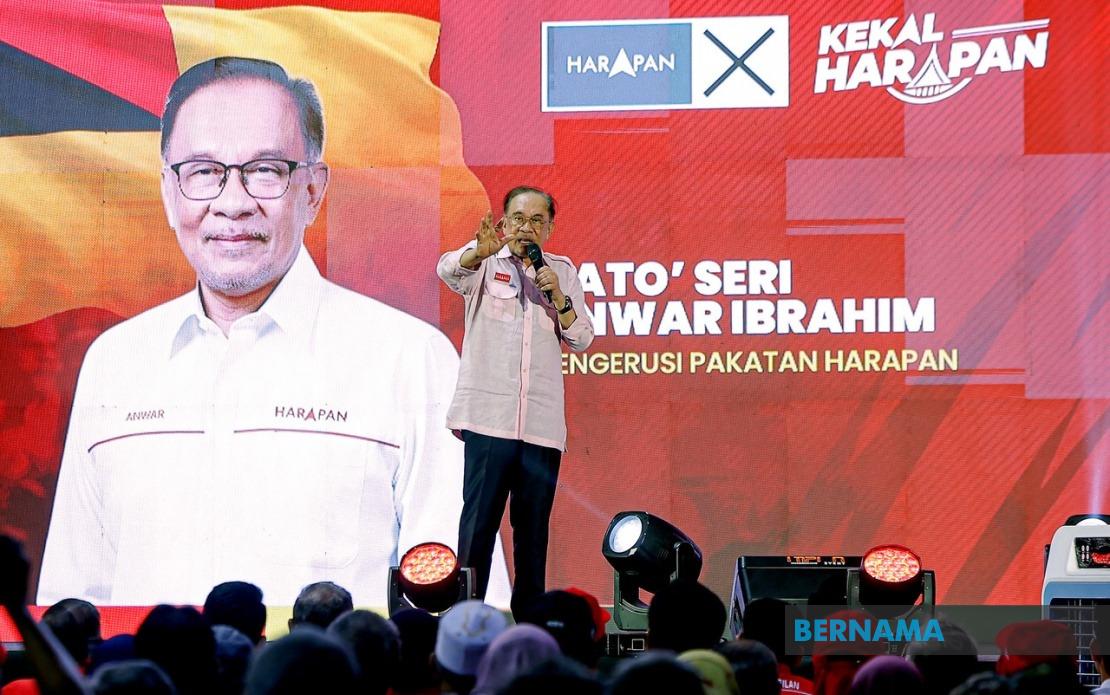
Prime Minister Datuk Seri Anwar Ibrahim has moved to reassure the nation that the Unity Government continues to function effectively at the federal level, maintaining the political and economic stability necessary for Malaysia's continued growth trajectory. Speaking in Seremban on July 22, Anwar emphasised that despite electoral competition among coalition members at the state level, the partnership between federal government parties remains cohesive and committed to national development objectives.
The prime minister's comments underscore a deliberate distinction between the Unity Government's operations at the federal and state tiers. While individual coalition parties naturally contest elections and vie for control of state governments, Anwar made clear that such rivalries do not destabilise the overarching federal compact that holds the government together. This separation of concerns reflects a pragmatic political arrangement designed to allow coalition partners to pursue their own electoral interests without undermining the broader stability required for national governance.
Anwar highlighted the functional efficacy of the cabinet system as evidence of the government's operational strength. Regular cabinet meetings, chaired by the prime minister and bringing together key figures including Minister of Agriculture and Food Security Datuk Seri Mohamad Sabu, Transport Minister Anthony Loke, and Deputy Prime Minister Datuk Seri Dr Ahmad Zahid Hamidi, proceed smoothly and systematically. The consistency of these meetings and the orderly conduct of government business signal to both domestic stakeholders and international observers that ministerial coordination remains effective.
The maintenance of cabinet discipline and inter-ministerial cooperation carries significant implications for Malaysia's economic outlook. Foreign investors scrutinise political stability closely when evaluating commitment to long-term projects and capital deployment. Any perception of government fragility or coalition breakdown typically triggers heightened caution among multinational corporations and financial institutions. By publicly affirming the federal government's cohesion, Anwar seeks to reinforce investor confidence and prevent capital flight or project postponements driven by political anxiety.
The timing of Anwar's statements appears strategic, coming as it does in a context where Malaysia faces sustained economic pressures and competition for foreign direct investment from other Southeast Asian nations. Singapore, Indonesia, and Vietnam continue to invest heavily in improving their business environments and attracting multinational enterprises. Malaysia's ability to offer a reliable, predictable political environment therefore becomes a competitive asset that must be actively maintained and promoted.
The challenge facing the Unity Government centres on managing the inherent tensions within a multi-party coalition that must function effectively at the federal level while allowing constituent parties to compete vigorously in state elections. This balancing act requires sophisticated political maturity from coalition leaders, who must reassure their base that they are not subordinating state-level ambitions to federal considerations, while simultaneously ensuring that state-level contests do not spiral into destructive federal-level conflicts. Anwar's framing addresses this tension by treating federal stability as a shared interest transcending factional advantage.
Recent Malaysian political history demonstrates the risks of coalition instability. The collapse of previous government arrangements, including the Pakatan Harapan coalition in 2020, showed how apparently secure political compacts can fragment when underlying tensions accumulate or when parties calculate that their interests are better served by repositioning themselves. Anwar's public defence of the current Unity Government's stability may therefore reflect awareness of such historical precedents and determination to prevent similar deterioration.
The regional dimension also merits consideration. Stability within Malaysian politics influences not only economic performance but also Malaysia's standing within ASEAN and broader Asia-Pacific geopolitics. Political uncertainty in the region's largest economy by nominal GDP and a key member of ASEAN naturally receives attention from other governments and international observers. A clear signal that Malaysia's federal government remains functional and stable contributes to regional confidence in Malaysia's continued engagement with multilateral institutions and regional partnerships.
Looking forward, the continued viability of the Unity Government at the federal level will depend on coalition members' willingness to compartmentalise their competitive instincts. This requires ongoing communication, negotiation of power-sharing arrangements, and mutual forbearance when individual parties suffer state-level setbacks. The test will intensify as the next general election approaches, when electoral pressures mount and coalition members face demands from their supporters for more aggressive positioning.
Anwar's public positioning of federal stability as a paramount concern reflects his understanding that Malaysia's development trajectory depends on sustained investor confidence and government effectiveness. By repeatedly affirming the government's coherence and operational capacity, the prime minister seeks to foreclose speculation about coalition breakdown while signalling to coalition partners that federal integrity remains non-negotiable. Whether this messaging suffices to maintain the delicate balance between federal unity and state-level electoral competition will test the political leadership's capacity for strategic thinking and coalition management in the coming years.

