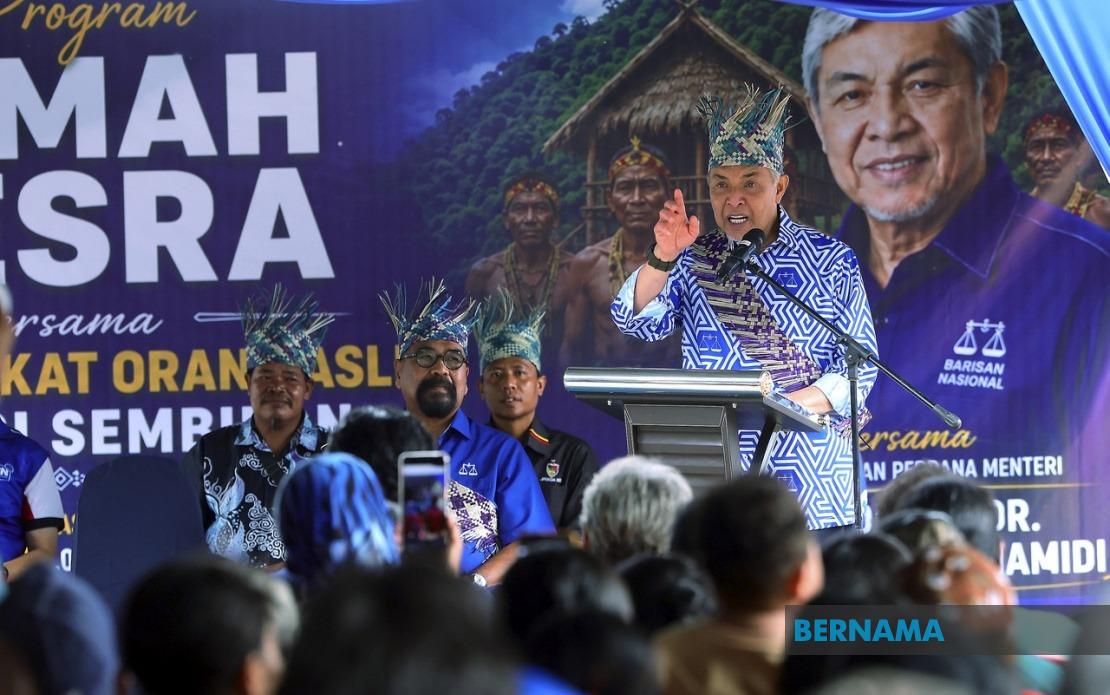
The leadership of Malaysia's ruling coalition has moved to dispel concerns about political fractures, with Barisan Nasional chairman Datuk Seri Dr Ahmad Zahid Hamidi declaring that Unity Government partners remain committed to governing together until the end of the current federal term. Speaking at a grassroots event in Negeri Sembilan, the Deputy Prime Minister sought to reassure supporters and observers that the alliance forged between BN and Pakatan Harapan remains solid, anchored by foundational agreements that transcend electoral fortunes at the state level.
Ahmad Zahid's statement carries particular weight given the approaching Negeri Sembilan state election, scheduled for August 1, which represents a potential flashpoint for coalition tensions. By emphasising that the federal government's stability will not hinge on state-level outcomes, the BN chairman has attempted to create clear separation between national governance arrangements and regional political competitions. This demarcation strategy is critical for a coalition that has weathered scepticism about its durability since its formation in late 2022, with many observers questioning whether ideologically diverse partners could maintain unity through successive electoral challenges.
The Deputy Prime Minister further underlined the soundness of his relationship with Prime Minister Datuk Seri Anwar Ibrahim, characterising their dynamic as cordial and professionally functional. This personal affirmation carries significance beyond mere courtesy, as the Zahid-Anwar partnership forms the bedrock upon which the broader coalition structure rests. Any deterioration in their working relationship would almost certainly reverberate through coalition ranks and potentially destabilise the government's ability to pass legislation and execute policy. Ahmad Zahid's public confirmation that no friction exists between the two principals suggests that internal mechanisms for managing disputes between BN and PKR—the Prime Minister's party—remain effective.
The context of Negeri Sembilan's electoral significance adds nuance to these assurances. The state represents contested territory where BN historically maintained dominance, yet faces challenges from Pakatan Harapan and other opposition elements. A disappointing result for BN could theoretically embolden dissident voices within the coalition to question whether the partnership structure adequately serves its interests, particularly if the party perceives itself as the junior partner bearing greater electoral risk. By preemptively stating that state outcomes will not alter federal arrangements, Ahmad Zahid has attempted to neutralise such narratives before they gain traction.
The Deputy Prime Minister's remarks also reflect the coalition's broader strategic calculation regarding governance priorities. He explicitly identified national-level coordination and issue resolution as the administration's focus area, positioning state elections as secondary considerations that warrant attention without compromising federal stability. This framing is designed to communicate to both coalition partners and the electorate that the government prioritises substantive work over electoral positioning. For Malaysian voters concerned about economic management, infrastructure development, and policy coherence during a complex economic period, this messaging aims to project confidence and continuity.
Behind Ahmad Zahid's statements lies an implicit acknowledgment of the structural vulnerabilities that have historically plagued multi-party Malaysian coalitions. Previous federal governments have frequently fractured when component parties perceived electoral losses as evidence that the coalition arrangement no longer served their interests. The explicit reaffirmation of commitment, therefore, serves as a stabilising signal—both internally to coalition members and externally to financial markets, international observers, and the broader business community that depend on political predictability. In Malaysia's context, where business confidence has proven sensitive to perceived governance instability, such reassurances carry economic implications beyond their purely political dimensions.
The attendance of local BN candidates at the Jelebu event, including Jalaluddin Alias as the Pertang state seat contender and Siow Kong Choon for Chennah, underscored how the Deputy Prime Minister's message filters down through party structures. Local campaigners can present the federal leadership's unity as foundation upon which state-level candidates build their appeals, allowing them to contest on substantive records rather than becoming trapped in narratives about coalition dysfunction. This integration of messaging across governmental levels represents a hallmark of effective political communication in Malaysian federalism.
For Southeast Asian observers tracking Malaysia's political evolution, Ahmad Zahid's reaffirmation carries broader implications regarding coalition stability in the region. Malaysia's experiment with bringing together ideologically diverse parties to manage ethnic and religious plurality while maintaining democratic governance has attracted regional attention. Demonstrating that such coalitions can weather electoral setbacks without fragmenting—as Ahmad Zahid claims the Unity Government will—would provide a counternarrative to persistent scepticism about multi-party administrations in the region. Conversely, any subsequent rupture would vindicate critics who argue that personal antagonisms and narrow partisanship inevitably corrode institutional commitments in Southeast Asian political contexts.
The Deputy Prime Minister's emphasis on the absence of fundamental disagreements on national issues represents another strand in the coalition's stabilisation strategy. By suggesting that partners harbour no significant disputes on core policy matters, Ahmad Zahid implies that philosophical coherence rather than mere tactical necessity binds the alliance. This framing is particularly important for PKR and its Pakatan Harapan allies, whose supporters often harbour reservations about alliance with BN parties that they associated with previous governance eras. Portraying the partnership as substantive rather than expedient aims to retain support among voters who view the coalition sceptically but continue to back the government primarily because they oppose alternative arrangements.
The Negeri Sembilan election itself, with voting scheduled for July 28 for early ballots and August 1 for general voting, will provide the first concrete test of whether the Deputy Prime Minister's assurances reflect genuine coalition consensus or represent aspirational messaging. If BN performs unexpectedly poorly, internal pressures may emerge regardless of preemptive declarations. Conversely, a strong showing would vindicate the coalition's strategy and likely strengthen Ahmad Zahid's hand in managing any subsequent intracoalition tensions. The coming weeks will therefore illuminate whether the unity that Ahmad Zahid emphasises represents institutional reality or represents optimistic projection of what coalition leaders hope to achieve through disciplined messaging and coordinated campaign efforts.

