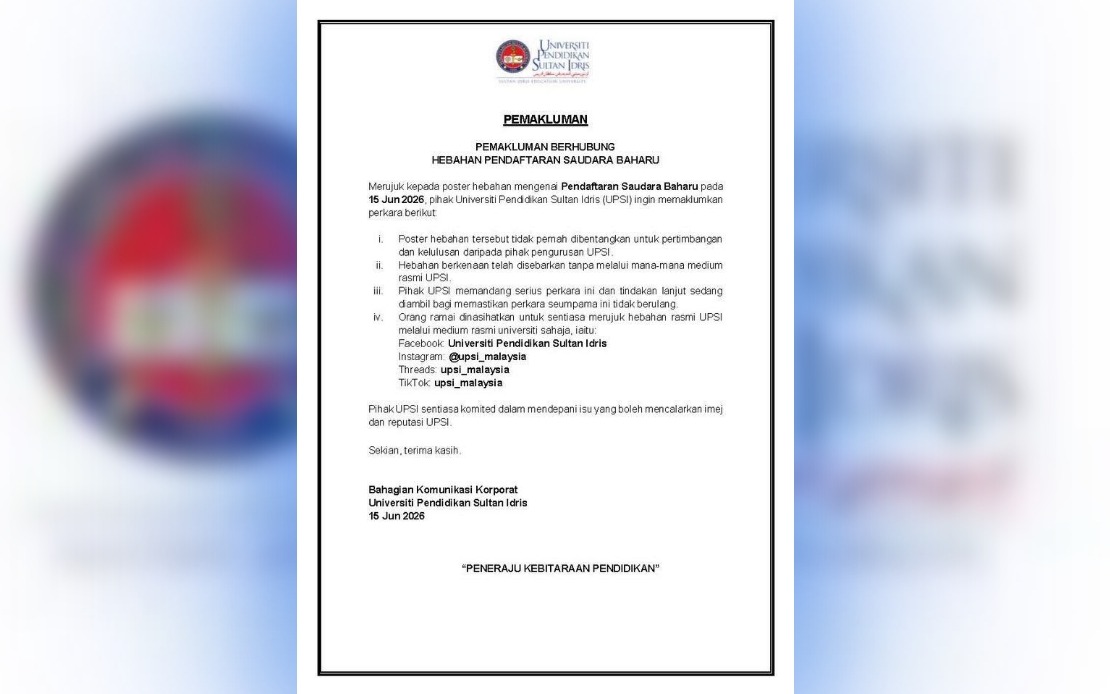
Universiti Pendidikan Sultan Idris (UPSI) has moved to clarify its position regarding a poster about registering 'saudara baharu'—individuals newly converted to Islam—that recently circulated widely across social media platforms. The institution emphasised through official communications that it bore no responsibility for the document and took the matter with considerable seriousness.
The poster in question, dated June 15, never underwent formal institutional review or received approval from UPSI's administrative hierarchy, according to the university's statement released through its social media accounts. The document's distribution also bypassed all official university communication channels, further distancing the institution from the viral material. This clarification came as the poster gained traction online, potentially creating confusion among the public about UPSI's position on religious conversion and institutional endorsement.
UPSI's response underscores growing concerns across Malaysian public institutions about unauthorised content being attributed to them or appearing to originate from their networks. The university framed its denial not merely as a procedural matter but as a substantive commitment to maintaining institutional integrity. The statement reflected an institutional anxiety about reputational damage in an era where social media can rapidly amplify misinformation or misleading content.
The institution pledged to implement enhanced measures to prevent future incidents of this nature. UPSI committed to working more rigorously with its internal systems to ensure that any materials circulating under its name or appearing to represent its position receive appropriate vetting and authorisation before dissemination. This signals a broader recognition within Malaysian universities that social media literacy and control mechanisms require constant updating.
Public institutions in Malaysia have increasingly confronted challenges around unofficial content circulation, particularly when such material involves sensitive topics including religious matters, institutional policies, or administrative procedures. The UPSI case exemplifies how rapidly unverified information can spread, potentially creating misunderstandings about institutional positions and generating unnecessary public debate.
UPSI's emphasis on directing the public toward official announcement channels reflects a deliberate strategy to rebuild trust and establish clear information hierarchies. By repeatedly directing stakeholders to verified institutional sources, the university attempted to regain control over its narrative and minimise further spread of unauthorised material. This approach has become standard practice among Malaysian public sector organisations seeking to manage their public communications effectively.
The incident also raises broader questions about religious sensitivity in Malaysian educational institutions. Universities operating within Malaysia's pluralistic society must navigate complex terrain when addressing matters related to religious conversion, interfaith engagement, and institutional chaplaincy services. UPSI's swift denial and commitment to stricter content controls suggest the institution recognises these sensitivities acutely.
For Malaysian universities and public institutions more broadly, this episode underscores the importance of proactive communication strategies and robust internal approval mechanisms. As social media continues fragmenting information landscapes and enabling rapid viral spread, institutions require more sophisticated approaches to content verification and authentication. UPSI's response—though reactive rather than preventive—demonstrates institutional awareness of these challenges.
The case also reflects wider concerns about misinformation and impersonation in digital spaces where organisational boundaries have become increasingly porous. Fraudsters, pranksters, or well-meaning but unauthorised individuals can relatively easily create materials that appear institutional, exploit existing networks, and generate confusion. Malaysian institutions increasingly face pressure to develop technological and procedural solutions to authenticate official communications.
Stakeholders seeking accurate information about UPSI's policies, programmes, and announcements are now encouraged to consult only verified institutional sources rather than relying on materials circulating on social media platforms. This recommendation, while straightforward, highlights the challenge facing educational institutions in the digital age: maintaining credibility and information control when communication pathways have multiplied exponentially.

