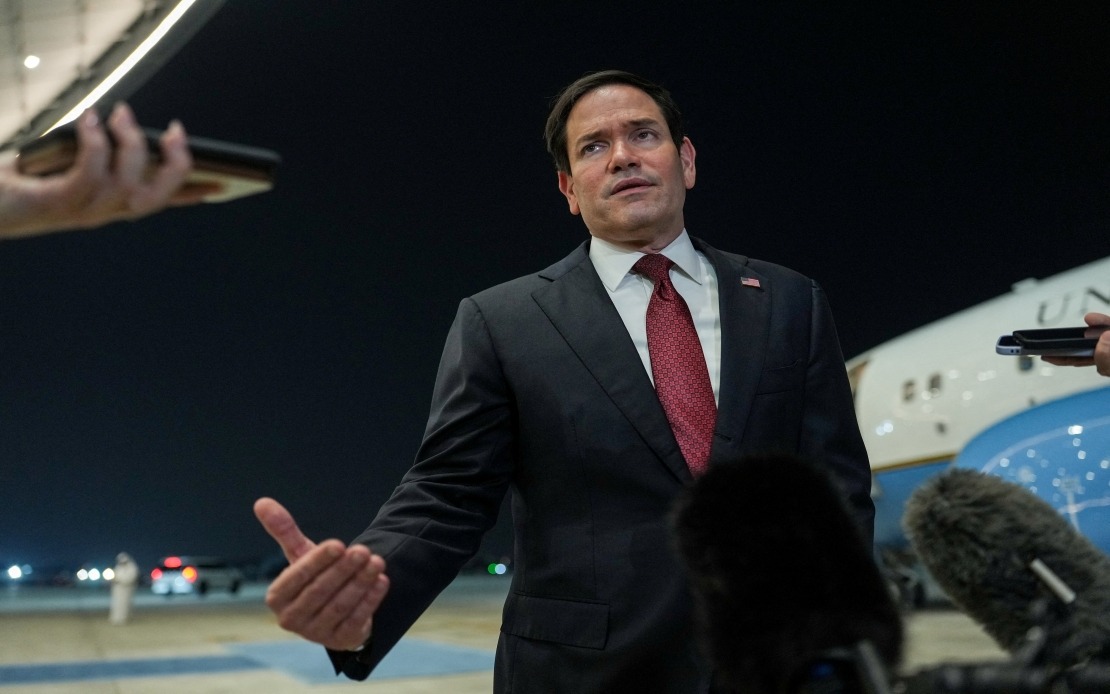
United States Secretary of State Marco Rubio moved to quell speculation about American financial commitments to Iran reconstruction on Tuesday, explicitly stating that Washington will not be channeling government money into such efforts. Speaking to reporters, Rubio characterised discussions about a potential reconstruction fund as preliminary and distant, emphasising that any such initiative would operate independently of official US resources. His comments came as diplomatic momentum appears to be building following recent talks between the two nations in Switzerland, which have produced tangible agreements on military de-escalation.
Rubio's carefully worded remarks suggest that while private American investment in Iran could theoretically emerge as part of broader normalisation efforts, the Trump administration is drawing a firm line on direct government participation. The distinction matters significantly for both domestic American politics and international perceptions of US engagement with Iran. By separating the government position from potential private sector activity, Rubio appears to be preserving flexibility for future economic engagement while maintaining domestic political cover against accusations of funding Iran through taxpayer money. This rhetorical positioning reflects the sensitive nature of Iran policy in American discourse, where concerns about financing entities linked to Islamic Revolutionary Guard Corps activities remain prominent among policymakers and the public.
The context for Rubio's statement emerges from recent reports suggesting that a USD300 billion reconstruction fund might be under discussion as part of broader US-Iran negotiations. President Donald Trump had dismissed such reports last week, suggesting scepticism within the administration about large-scale financial commitments. Rubio's remarks reinforce this administration line while simultaneously acknowledging that some form of economic engagement could accompany political and security agreements. The secretary of state framed any reconstruction initiative as contingent on Iran demonstrating progress on security matters that remain unresolved between the nations, creating a pathway toward economic normalisation without prematurely committing resources.
The broader diplomatic framework has shifted dramatically following intensive talks held in Burgenstock, Switzerland, on Sunday. A US delegation led by negotiator Vance met with Iran's parliamentary speaker Mohammad Bagher Ghalibaf, with Qatar and Pakistan serving as mediators in what represents a significant diplomatic engagement. Both delegations subsequently announced measurable progress, signalling that despite deep historical tensions, structured dialogue appears capable of producing incremental agreements. This diplomatic channel stands in contrast to the confrontational rhetoric that has often characterised US-Iran relations, suggesting that the current administration views negotiated resolution as preferable to continued military posturing.
Most significantly, Iran and the US recently signed a remotely executed memorandum establishing terms for ending the military conflict that commenced on February 28. This agreement represents a watershed moment in their fraught relationship, establishing concrete mechanisms for de-escalation that transcend mere political statements. The document specifies timelines for American naval blockade relief and Iranian commitments to restore shipping through the strategically vital Strait of Hormuz, addressing immediate grievances from both sides. These practical arrangements suggest that negotiators have moved beyond rhetorical positions to substantive commitments with measurable implementation schedules.
The nuclear dimension of the standoff remains unresolved but appears to be following a structured pathway toward resolution. Under the emerging framework, Iran commits not to pursue nuclear weapons acquisition, with the nuclear programme itself to be addressed through separate negotiations. This bifurcation allows both sides to address immediate security and military concerns while deferring the technically complex and politically sensitive nuclear issue to specialist negotiators. The 60-day timeline for nuclear negotiations establishes clear expectations and prevents indefinite procrastination on this essential component of any comprehensive normalisation accord.
For Southeast Asian observers, these developments carry particular significance given the region's dependence on stable shipping through critical waterways and the broader implications for global energy markets. The Strait of Hormuz closure or disruption would directly impact oil prices and maritime commerce patterns affecting economies throughout the Asia-Pacific region. Malaysia, with its substantial petroleum imports and role as a major maritime hub, has a direct stake in resolution of US-Iran tensions. Any stabilisation of this conflict reduces volatility in the energy markets on which ASEAN economies depend, potentially contributing to more predictable business environments across the region.
Rubio's distinction between government and private investment also reflects broader economic realities. The Iranian economy remains heavily sanctioned and relatively isolated from international capital markets, meaning that most foreign investment would require either sanctions relief or exemptions. The secretary of state's commentary suggests that while government budgets may be off limits, the door remains theoretically open to commercial entities willing to engage with Iran as restrictions gradually ease. This differentiation allows the administration to pursue normalisation without appearing to capitulate to those who view any engagement with Iran as fundamentally objectionable.
The timing of these negotiations coincides with broader shifts in Middle Eastern geopolitics. Recent regional developments have created windows of opportunity for diplomatic resolution that might not have existed previously. Qatar and Pakistan's roles as intermediaries suggest that regional actors view successful US-Iran de-escalation as beneficial to their own interests and regional stability. The involvement of these two Muslim-majority nations also provides political legitimacy to the negotiation process that might be lacking if the talks were purely bilateral.
Moving forward, the reconstruction fund discussion will likely remain subordinate to achieving concrete security and nuclear agreements. Rubio's comments suggest that American policymakers are determined to avoid repeating what they view as the mistakes of previous negotiations, where sanctions relief was provided without corresponding behavioural changes from Iran. By insisting that economic benefits be tied to measurable security progress, the Trump administration is attempting to create incentive structures that reward compliance rather than simply transferring resources upfront. This approach, whether ultimately successful, reflects a fundamentally transactional view of diplomacy that prioritises verifiable commitments over trust-based agreements.
The months ahead will prove crucial in determining whether current diplomatic momentum translates into lasting agreements. The nuclear negotiations proceeding on a compressed timeline will reveal whether both sides are genuinely committed to resolving their deepest differences. If successful, such agreements could indeed create space for the kind of economic normalisation that Rubio carefully outlined—not through government funding, but through the gradual reintegration of Iran into the international economic system. The road remains uncertain, but the fact that substantive negotiations are occurring and producing documented progress represents a significant departure from recent patterns of escalation and confrontation.

