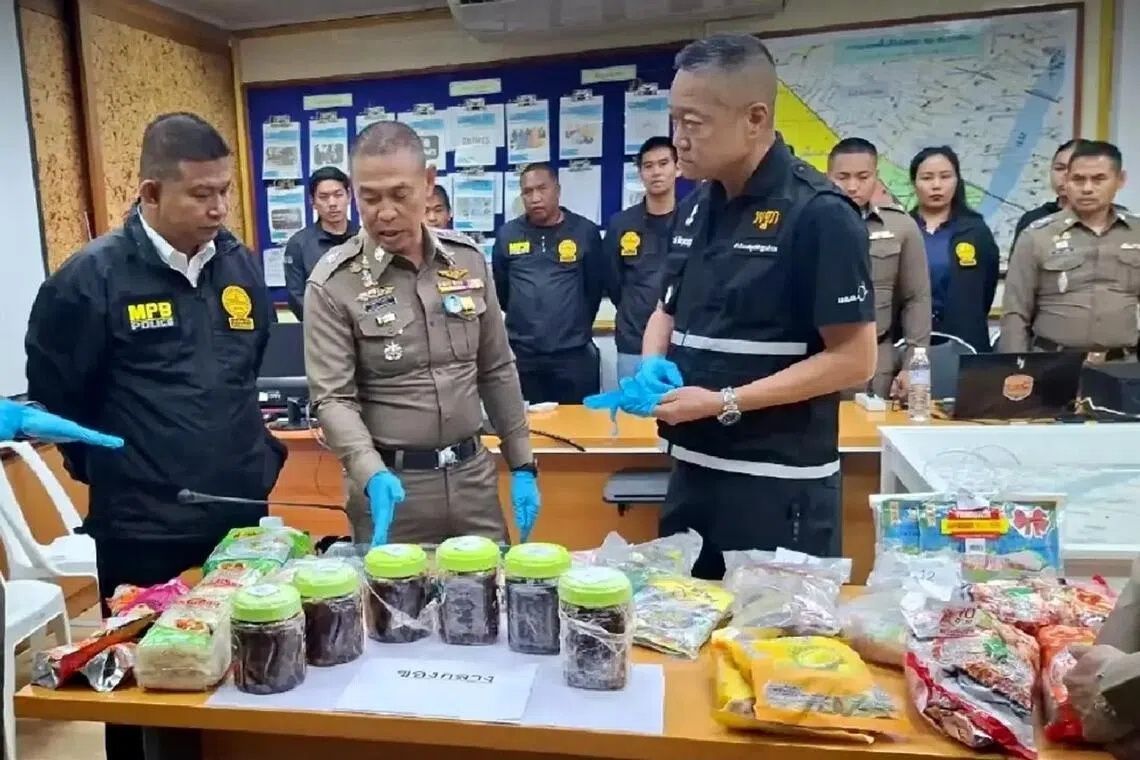
Thai authorities have uncovered a sophisticated transnational drug smuggling operation orchestrated by Vietnamese nationals who used the Kingdom as a crucial transit hub to deliver crystal methamphetamine to Japan. Police Lieutenant-General Siam Boonsom, Commissioner of the Metropolitan Police Bureau, publicly disclosed details of the investigation on July 17, revealing how the network had attempted to exploit unsuspecting couriers and layered logistics to evade detection across Southeast Asia's increasingly complex drug trade routes.
The breakthrough came through an alert courier who contacted Bangkok police on July 13 after noticing that sealed jars of tamarind paste destined for Tokyo felt unusually heavy for their supposed contents. This seemingly routine observation triggered a full investigation that would expose an international smuggling network spanning Vietnam, Thailand, and Japan. When authorities examined the containers, they discovered six foil-wrapped packages concealed within the jars, which laboratory analysis confirmed contained approximately 2.1 kilograms of crystal methamphetamine, a drug commonly referred to as ice in regional markets.
The case illuminates a troubling trend in Southeast Asian drug trafficking: criminal organisations increasingly recruiting ordinary people—often migrants or those facing financial hardship—to unknowingly transport illicit substances across borders. Police determined that the network had specifically targeted individuals willing to carry goods internationally, exploiting their financial vulnerability and lack of awareness about the packages they were moving. This recruitment strategy allows traffickers to maintain plausible deniability and create psychological distance between themselves and the actual contraband movement.
The operational structure revealed by investigators demonstrates sophisticated compartmentalisation designed to frustrate law enforcement efforts. Vietnamese nationals based in Thailand allegedly received instructions from a senior figure operating from Hanoi, who maintained strategic distance from day-to-day activities. The network employed anonymous Facebook accounts to hire motorcycle couriers to collect packages from safe houses occupied by Vietnamese residents throughout Thailand. These riders then passed the goods to separate Thai couriers hired specifically for international transport, creating multiple disconnected layers that would theoretically prevent investigators from tracing shipments back to the command structure.
Financial tracking ultimately proved the network's undoing. Police discovered that operational expenses and payments were funneled through a bank account registered to Sompong, a Thai national arrested in connection with the conspiracy. Vietnamese members of the network systematically withdrew cash amounts between 20,000 and 50,000 baht from this account before promptly returning to Vietnam, a pattern authorities believe was intended to minimise individual exposure to arrest risk and obscure the financial trail. This rotating withdrawal system suggests the network was acutely aware of Thai law enforcement's capacity to monitor banking activities, yet underestimated the significance of the pattern itself.
The investigation has identified at least four individuals warranting arrest: Sompong and three Vietnamese nationals allegedly involved in financial management, social media coordination, and operational direction. Sompong has categorically denied involvement in the trafficking operation, though his bank account's central role in processing payments suggests either direct participation or deliberate complicity. Investigators are also examining the potential involvement of Sompong's girlfriend, who may have possessed knowledge of the scheme, though she has not been formally charged at this stage.
This case reflects broader challenges facing Thailand's role as a geographical crossroads between major drug-producing regions and consuming markets. The Kingdom's extensive transport infrastructure, relatively porous border controls, and large migrant worker populations create inherent vulnerabilities that international criminal syndicates exploit with increasing sophistication. The use of Thailand as a transit point rather than a final destination means Bangkok police often function as custodians of other nations' drug problems, interceding smugglers bound for markets in Japan, Australia, and beyond.
The tamarind jar methodology is not unprecedented in regional smuggling operations. Traffickers routinely exploit legitimate international food trade to conceal narcotics, selecting products with sufficiently dense composition to mask the weight differences that might otherwise alert handlers. The selection of tamarind paste—a common ingredient in Japanese cuisine—indicates the network possessed detailed knowledge of supply chains and cultural trade patterns, suggesting prior successful operations using similar methods.
For Malaysian readers, this case carries particular resonance given the nation's own challenges with transnational drug networks and its position within Southeast Asia's trafficking corridors. The Vietnamese-led operation's methodology of recruiting Thai nationals for the final transportation leg underscores how organised crime franchises criminal activity across borders, compartmentalising risk while maintaining profit margins. Malaysia's own law enforcement agencies face similar threats from networks that exploit the region's connectivity for methamphetamine and fentanyl distribution.
The broader implications extend beyond individual arrests. The network's reliance on digital communication platforms, particularly anonymous social media accounts, illustrates how criminal organisations have adapted to surveillance pressures. Thai and regional law enforcement continue developing capabilities to monitor such platforms, yet the ease with which accounts can be created and abandoned means traffickers maintain operational advantages in speed and flexibility. This cat-and-mouse dynamic will likely intensify as drug trafficking remains one of Southeast Asia's most resilient organised crime sectors.
The investigation into this Vietnamese-led network also raises questions about the effectiveness of existing international cooperation mechanisms. While the case demonstrates Thai authorities' investigative capacity, successful prosecution would require coordination with Vietnamese and Japanese counterparts to build comprehensive charges. Regional drug enforcement frameworks, including mechanisms under ASEAN cooperation agreements, face ongoing strain from political tensions and varying enforcement priorities among member states.

