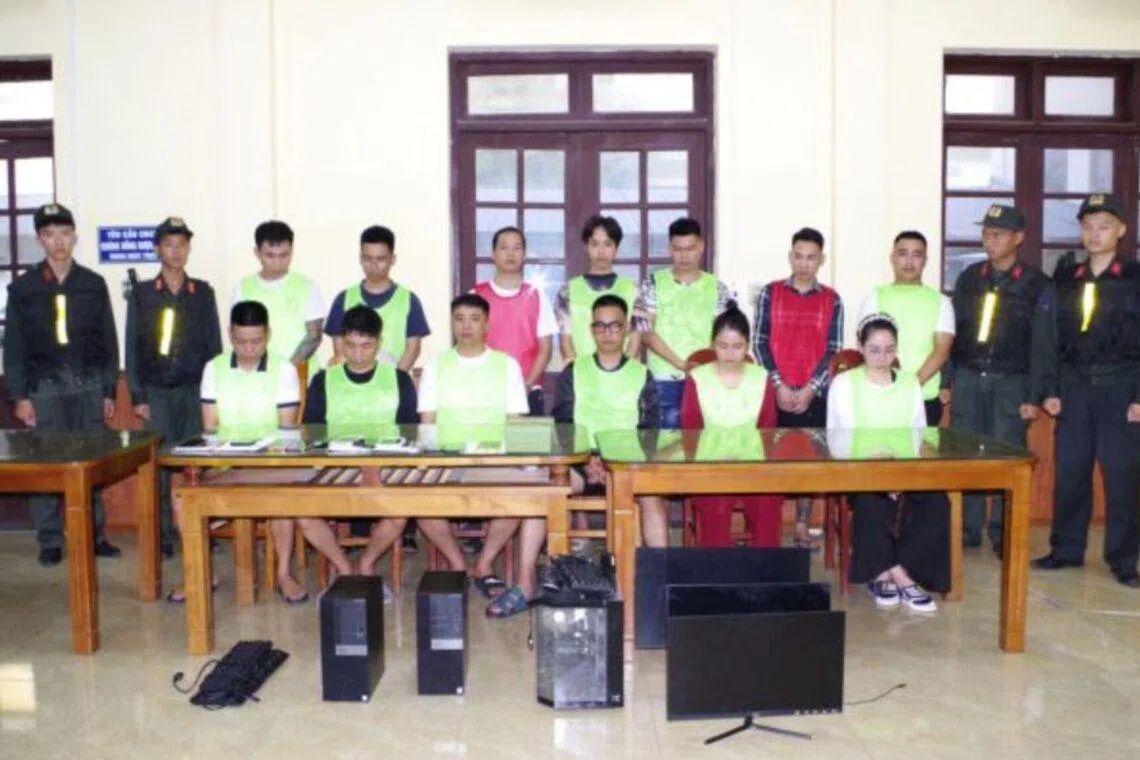
Police in Vietnam's northern Ninh Binh province have successfully dismantled a sophisticated transnational cybercrime ring, leading to the arrest of 12 suspects involved in defrauding victims of more than 250 billion dong—equivalent to RM39.2 million. The operation, which authorities say operated across multiple countries with Cambodia serving as a key operational base, exemplifies the growing complexity of cross-border digital fraud networks targeting Southeast Asia.
Investigators identified Nguyen Van Cuong, aged 28, and Nguyen Van Phuong, aged 34, as the principal architects of the scheme. The network operated with distinct hierarchical structures and clearly assigned roles, suggesting a professionally organised criminal enterprise rather than opportunistic scammers. Officers conducting extensive raids recovered substantial quantities of evidence and assets, including large sums of cash, vehicles, mobile devices, computers, falsified identification documents, jewellery, and comprehensive operational records that provided investigators with crucial insights into the gang's modus operandi.
What set this criminal organisation apart was its multifaceted approach to gaining victim confidence. Members engaged in elaborate impersonation tactics, posing variously as law enforcement officers, judicial officials, bank representatives, and tax authorities. This strategy capitalised on the inherent trust people place in state institutions and financial entities, making victims more inclined to comply with requests for payment or personal information. The sophistication extended to the creation of counterfeit digital infrastructure designed to mirror legitimate government portals and established commercial platforms, further deceiving targets into believing they were interacting with authentic services.
The fraud schemes employed by the network demonstrated considerable creative variation, allowing operators to target different victim demographics and exploit multiple vulnerability points. Fabricated job advertisements for part-time employment attracted individuals seeking supplementary income, who were subsequently manipulated into making payments under various pretexts. Investment scams promised substantial returns through exposure to financial instruments, securities portfolios, and cryptocurrency opportunities—sectors where many Southeast Asian citizens possess limited expertise and are therefore susceptible to unrealistic profit claims. Romance scams, a particularly damaging variant, leveraged emotional manipulation to convince victims to send money to supposed romantic interests. Additionally, members hijacked legitimate social media accounts and exploited established networks of friends and family connections to solicit loans under false circumstances.
One particularly intricate scenario involved fraudsters impersonating military personnel who contacted retail establishments and trading companies with proposals for substantial bulk purchases. After establishing apparent credibility through this initial contact, the scammers convinced business owners to procure additional merchandise on their account and remit deposits or prepayments to designated bank accounts controlled by the criminals. This supply-chain exploitation proved highly effective because it exploited normal commercial relationships and standard business procedures, making the requests appear legitimate to financially-focused proprietors.
According to police statements, the criminal network had operated successfully since October 2024, successfully defrauding approximately 500 victims before their apprehension. The scale of victimisation across Vietnam suggests that detection and investigation capabilities in the country have improved, though it also raises questions about how long similar operations might persist before identification. The 250 billion dong figure represents not merely a financial loss but a profound breach of trust affecting hundreds of individuals and families, many of whom likely experienced substantial psychological and financial consequences.
Legal proceedings have been initiated against the arrested individuals, with six suspects formally charged with fraudulent appropriation of property and held in temporary detention pending trial. The remaining six suspects are subject to ongoing investigative procedures as authorities gather additional evidence and determine appropriate charges. This differentiated approach suggests investigators are still establishing the precise roles and degrees of culpability among network members, with some individuals potentially occupying more peripheral positions than others.
The investigation remains in its active phase, with police working to identify and apprehend additional individuals involved in the operation. Investigators have identified that the network was larger than initially apparent, with unknown numbers of participants potentially still at large or in Cambodia beyond immediate Vietnamese jurisdiction. This complicates prosecution efforts and suggests the need for international cooperation mechanisms to address the transnational dimensions of the criminal enterprise.
Authorities have commenced asset seizure and freezing procedures targeting bank accounts, vehicles, and other valuables discovered during raids. These measures aim to recover portions of the stolen funds and channel them back to defrauded victims through the judicial system. The economic recovery component of the investigation reflects recognition that law enforcement success must ultimately translate into tangible restitution for those harmed by the fraudsters' actions.
The operation highlights vulnerabilities in Southeast Asia's digital landscape and the sophisticated nature of contemporary organised cybercrime. Vietnamese authorities have demonstrated capacity to dismantle major networks, but the incident underscores the need for continued regional cooperation, public awareness campaigns, and international coordination with neighbours including Cambodia. For Malaysian readers and businesses, the case serves as a cautionary reminder of how criminal networks operate across borders and the importance of implementing robust verification protocols before conducting financial transactions or providing personal information online.

