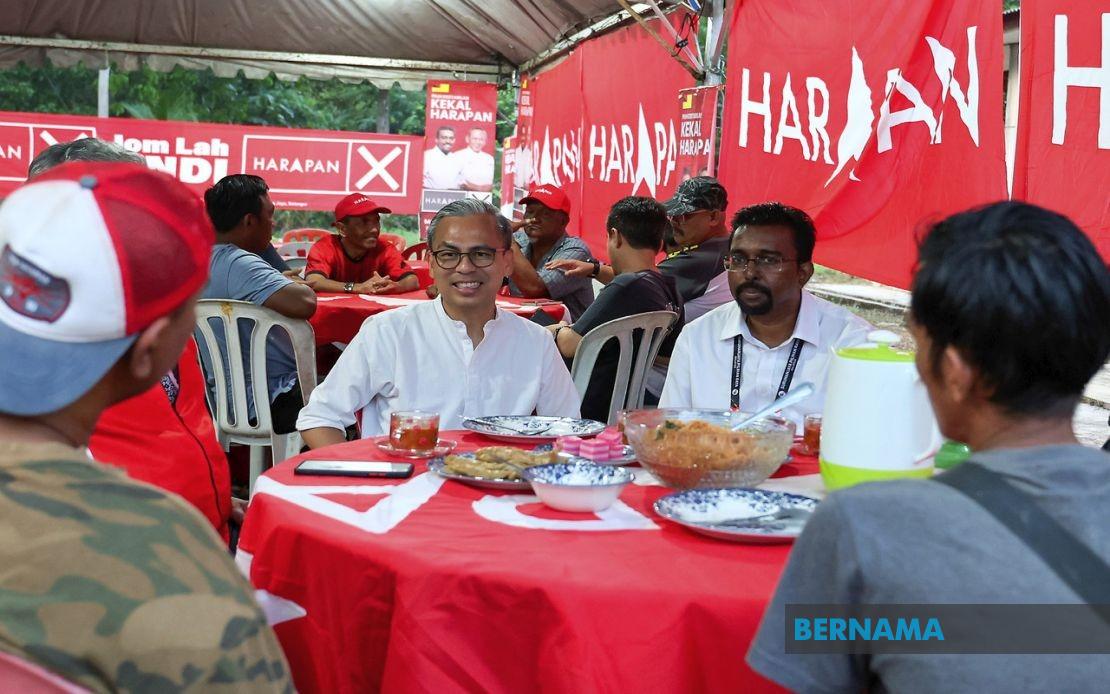
The real arbiters of Saturday's Negeri Sembilan state election are the people casting their ballots, not political analysts or opinion surveys, according to Pakatan Harapan Communications director Datuk Seri Fahmi Fadzil. Speaking at a community gathering in Jempol on July 28, the Communications Minister pushed back against recent predictions about the 16th Negeri Sembilan state election, reframing such forecasts not as reliable indicators but as incentives for PH's candidates to intensify their ground efforts and connect more effectively with undecided voters.
Fahmi's remarks were a direct response to commentary by Dr Ong Kian Ming, the former Bangi MP, who had offered analysis of potential battlegrounds across several Negeri Sembilan constituencies. Rather than dismissing the predictions outright, Fahmi adopted a strategic stance, suggesting that his coalition should treat such assessments as motivation to strengthen engagement with voters still weighing their options. He emphasised that PH's focus must remain on persuading fence-sitters to back the coalition, regardless of what pre-election models might suggest about the likely distribution of seats.
The Communications Minister drew on his own political journey to illustrate the unpredictability of electoral outcomes. During the 2018 general election that brought PH to power nationally, he recalled, virtually every available survey had suggested he would be defeated in the Lembah Pantai parliamentary contest. The actual result proved those predictions decisively wrong, with Fahmi retaining his seat comfortably. That experience, he indicated, had taught him to place little faith in pre-election analysis and to trust instead in the tangible connections campaigns build with voters through consistent, direct engagement.
According to Fahmi, current feedback from Negeri Sembilan voters reflects a favourable sentiment toward the Pakatan Harapan state government. Fence-sitters in particular, he suggested, appear open to the coalition's message, though he cautioned that voter sentiment alone does not guarantee electoral success. The actual outcome depends entirely on how many of those positively inclined voters turn out on polling day and follow through with their support at the ballot box. This emphasis on voter mobilisation underscores a key challenge facing PH as it heads into the weekend election: converting favourable public mood into actual electoral machinery and participation.
On the substance of PH's campaign platform in Negeri Sembilan, Fahmi highlighted several state government initiatives that have resonated with residents. The administration's entrepreneur development incentive schemes, assistance targeted at newly married couples, and laptop support for students have all generated appreciative feedback, he noted. These tangible, domestically focused programmes appear to form the backbone of PH's messaging in the state, positioning the coalition as responsive to the practical needs of ordinary Negeri Sembilan families. Such ground-level initiatives, Fahmi implied, matter more to voters than any external expert analysis.
As the campaign entered its final seventy-two hours before polling, Fahmi issued a stern warning about the proliferation of misleading content on social media platforms, particularly WhatsApp. He characterised the closing phase of elections as a period when irresponsible actors intensify efforts to sow confusion through false information, selective quotations taken out of context, and recycled video footage presented as recent developments. Such tactics are designed to erode voter confidence in candidates and parties, and to create last-minute uncertainty that might suppress turnout or shift votes.
Fahmi provided a concrete example of the kind of disinformation circulating during the campaign: an older video of Prime Minister Datuk Seri Anwar Ibrahim, recorded when he was in opposition, had been circulated with the false implication that it contained recent critical remarks about the armed forces. This deliberate misrepresentation—presenting dated material as current commentary—exemplifies the specific challenge voters face in the digital information environment. Selective editing and false context are particularly insidious because they contain genuine elements but distort their meaning and timing, making them harder to identify as falsehoods at first glance.
To counter such tactics, Fahmi advised voters to apply a simple verification principle: if information is not reported by established mainstream news outlets and official government channels, it warrants scepticism. He specifically named credible sources including Berita Harian, TV3, RTM, Bernama, and Awani as trustworthy reference points. By directing voters toward institutional media with editorial standards and accountability mechanisms, Fahmi essentially argued that the proliferation of unverified social media content makes traditional news gatekeepers more valuable, not less. The implication is that media literacy and source verification become critical voter skills, particularly in the campaign's final hours when the volume and intensity of messaging peaks.
Fahmi's dual message—confidence in voter judgment combined with warnings about information manipulation—reflects a broader strategic calculation. By emphasising that voters, not predictions, decide elections, he positioned PH as respectful of democratic choice while also inoculating the coalition against adverse poll numbers that might circulate. Simultaneously, by flagging the disinformation challenge, he sought to frame any last-minute unfavourable developments as potentially the result of malicious false narratives rather than genuine shifts in voter sentiment. This framing preserves PH's flexibility to respond to Saturday's results, whatever they may be.
The Negeri Sembilan state election represents a significant test for Pakatan Harapan at the state level, particularly given the coalition's mixed performance in recent state contests across Malaysia. The outcome will carry implications beyond Negeri Sembilan, serving as a barometer of the coalition's support trajectory and effectiveness at the state governance level. For voters in the state, Fahmi's emphasis on their decisive role carries particular weight: they will determine not only the composition of the Negeri Sembilan state assembly, but also, indirectly, whether PH can sustain its political momentum heading toward the next general election cycle.
The warning against misinformation also reflects a broader Malaysian political reality. As digital platforms have become primary channels for campaign messaging, concerns about the quality and veracity of information in the electoral sphere have grown correspondingly. Fahmi's call for voter vigilance acknowledges this shift while placing responsibility on citizens to be critical consumers of campaign content. For Malaysian readers, this emphasis on verification and scepticism toward unattributed social media claims has applications far beyond the Negeri Sembilan election, serving as a reminder of the importance of information literacy in an era of rapid digital communication.

