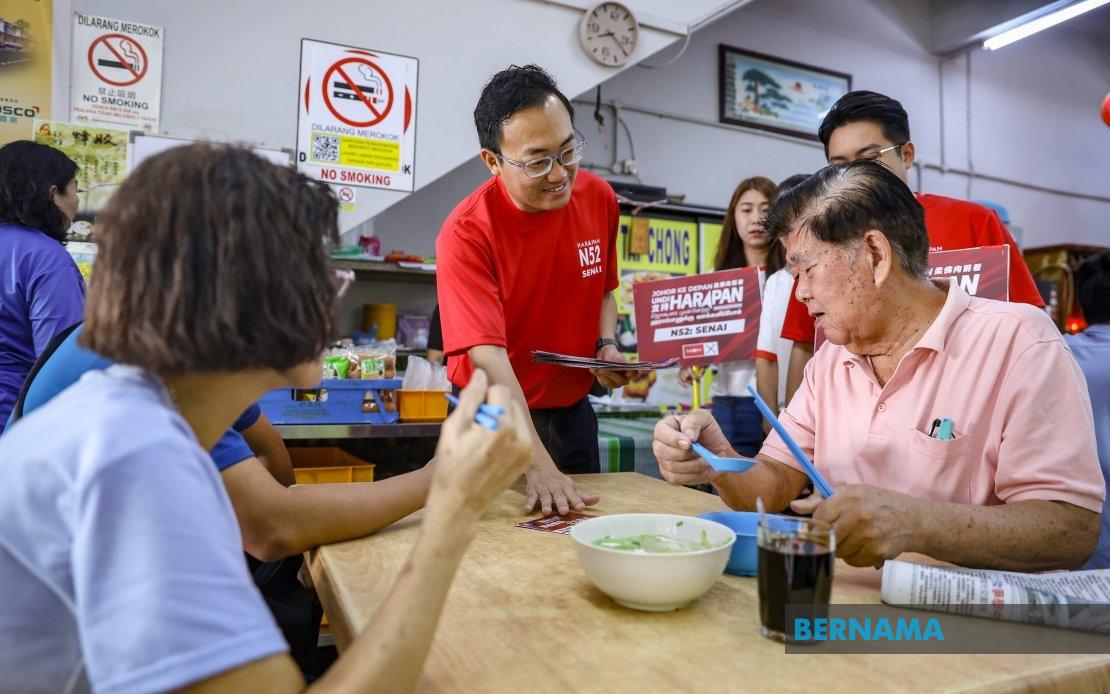
Incumbent assemblyman Wong Bor Yang is putting his track record of community development at the centre of his re-election bid for the Senai state seat in the 16th Johor election, betting that voters will reward proven performance over campaign rhetoric. The Pakatan Harapan candidate, speaking in the Kulai district, emphasised that his previous term was built on substantive work rather than a learning curve, a pitch aimed at distinguishing himself from political newcomers entering the three-cornered contest scheduled for July 11.
Wong's campaign narrative pivots on the notion that administrative experience across Malaysia's shifting political landscape has equipped him with practical problem-solving abilities. His professional journey traces a deliberate arc through different institutional vantage points: he worked as a special officer in the Kulai Member of Parliament's office beginning in 2014, then moved into local government as a councillor in 2018, and subsequently won election as a state assemblyman. This progression, Wong suggests, has exposed him to governance challenges from multiple angles—from the opposition perspective, then as part of government machinery—granting him insights that single-phase politicians may lack.
The former journalist, a graduate of Shih Hsin University in Taiwan, has structured his campaign around tangible outcomes in infrastructure and public amenities. Most prominently, he highlights his efforts addressing chronic flash flooding that has plagued several neighbourhoods within Senai. During his previous term, Wong pressed government agencies through state assembly debates and formal petitions, eventually securing state government approval for RM1 million to upgrade the drainage system in Taman Aman and direct flows into Sungai Skudai. Beyond that, his collaboration with Kulai MP Teo Nie Ching unlocked an additional RM3 million for drainage improvements in Peladang Kulai Besar and Saleng, removing both areas from the district's flash flood vulnerability list.
Beyond engineering solutions, Wong has invested political capital in cultural and recreational infrastructure. He converted a shuttered cinema into a community operations centre and rehabilitated a two-decade-old badminton court into a public recreational facility branded as Tiny Lake under the Sejati MADANI programme. These initiatives reflect his intention to position Senai not merely as a suburban locality but as a district with historical significance—the state seat boasts more than a century of heritage—deserving of preservation and celebration.
Looking ahead to a potential second mandate, Wong has articulated healthcare as his paramount priority, arguing that existing facilities have become inadequate for the district's projected growth. Kulai Hospital, with its current 93-bed capacity, will struggle to serve an estimated population of 500,000 by 2030, he contends. His stated objective includes sustained pressure on the state government to resolve bureaucratic impediments delaying construction of a new health clinic in Taman Mewah, Senai, where land acquisition disputes have stalled progress. Wong frames healthcare infrastructure not as a luxury but as an essential prerequisite for sustainable urban development in an increasingly densely populated district.
The political context in Senai reflects broader dynamics within Johor's electoral terrain. The seat encompasses 66,635 registered voters, and Wong confronts competition from two challengers: Tai Chee Chee representing Barisan Nasional and Tew Chien How standing for Bersama. This three-way contest introduces tactical complexity, as the opposition vote may fragment across BN and Bersama, potentially benefiting Wong's coalition partner Pakatan Harapan if PH's ground organisation performs effectively.
Wong's invocation of voter maturity and discernment towards performance-based evaluation carries implicit messaging that Bangsa Johor—the broader Johor electorate—has evolved beyond susceptibility to empty pledges. By framing his candidacy as the default choice for those prioritising substance over bombast, Wong positions himself as the pragmatic option. His messaging implicitly asks voters to compare concrete deliverables—specific drainage projects with monetary allocations, heritage initiatives with visible footprints, and partnership arrangements with federal MPs—against rhetorical commitments from newer faces.
The July 11 polling date arrives as Johor consolidates its political direction following the Pakatan Harapan administration that began in 2023. Wong's campaign reflects the coalition's strategy of leveraging incumbent performance and demonstrating that PH governance translates into district-level service delivery. The ability to cite partnership with Kulai MP Teo Nie Ching and secure federal co-funding for local projects underscores how state and federal mechanisms can be coordinated to address community needs—a narrative device available primarily to sitting assemblymembers from the ruling coalition.
Wong's emphasis on his opposition experience is notably sophisticated. Rather than glossing over his years outside government, he presents them as a competitive advantage, suggesting that legislators in opposition learn to navigate bureaucracy more cleverly and understand citizen frustrations more viscerally. This inversion of what might seem like a liability—being newly incumbent—reframes inexperience with current power as an interpretive asset. Such positioning may resonate particularly with voters sceptical of either major coalition, framing PH not as complacent incumbents but as politicians who have learned to operate effectively within Malaysia's complex institutional landscape.
The early voting window on July 7 precedes the main polling on July 11, enabling working professionals and those with mobility constraints to participate before the weekend vote. This logistical consideration reflects electoral administration improvements under the current government. Wong's campaign apparatus will likely utilise the extended voting period to mobilise supporters, banking on the organisational machinery Pakatan Harapan has developed across its constituency machinery in Johor. His incumbency advantage extends beyond name recognition to include existing constituent relationships and demonstrated responsiveness to local grievances—intangible yet electorally significant assets in determining outcomes in contests between candidates with genuinely differentiated track records.

