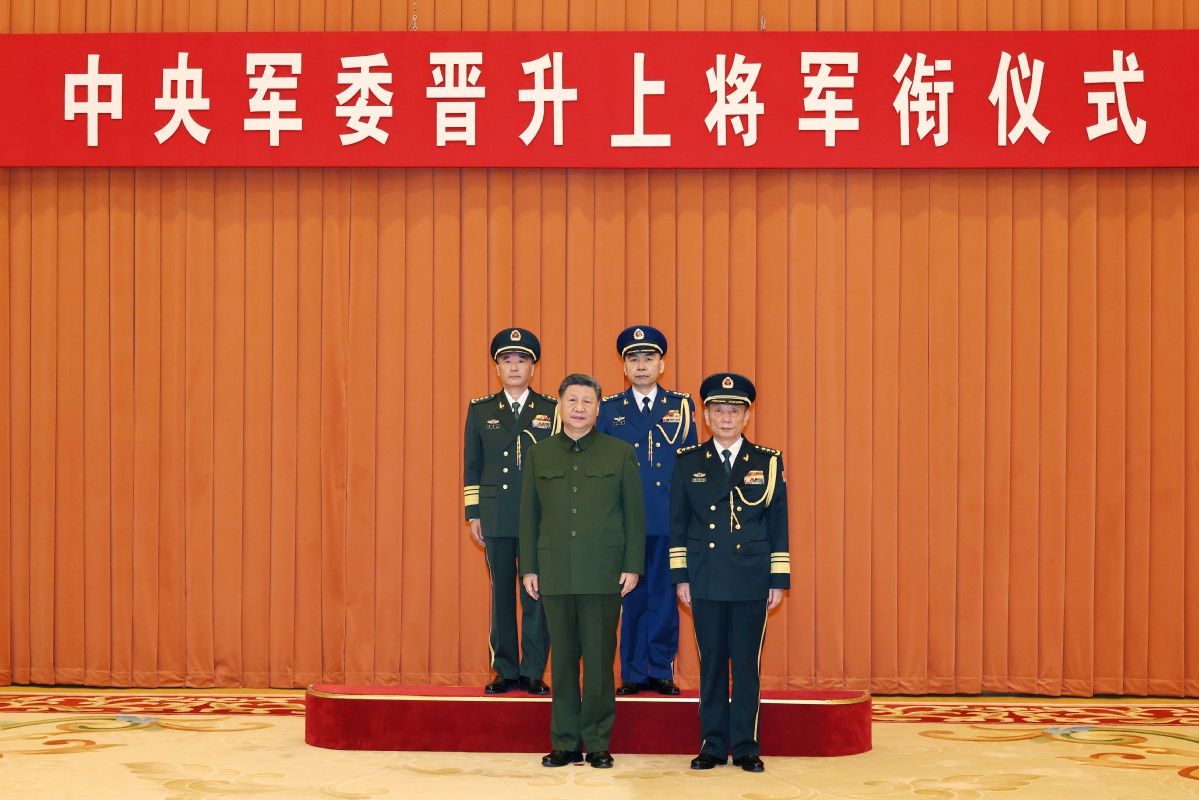
Chinese President Xi Jinping continues reshaping the country's military establishment through a sweeping anti-corruption campaign that shows no signs of abating, with the appointment of a new head of disciplinary oversight in the armed forces marking the latest significant personnel shift. Zhang Shuguang has assumed the position of secretary of the Central Military Commission's discipline inspection commission, a role that places him at the centre of efforts to root out alleged graft and misconduct throughout the People's Liberation Army. The announcement came at a ceremony in Beijing on Friday attended by Xi himself, underscoring the political importance the leadership attaches to military discipline and institutional control.
Simultaneously, Wang Gang has been elevated to commander of the People's Liberation Army Air Force, one of the most strategically significant posts within China's defence establishment. Both Zhang and Wang were promoted to the rank of general, the highest active-service rank in the Chinese military system. These appointments represent not merely routine personnel management but calculated moves within a broader consolidation of Xi's authority over military structures that have historically functioned with considerable autonomy across different service branches and regional commands.
The outgoing anti-corruption chief, Zhang Shengmin, transitions to the position of vice chairman of the Central Military Commission itself—a lateral move that retains his senior status whilst removing him from direct oversight of disciplinary investigations. The reassignment suggests a reshuffling rather than a demotion, though the shift away from anti-corruption work may indicate either the completion of an investigative phase or a change in strategic approach to military oversight. Former Air Force Commander Chang Dingqiu's next assignment remains undisclosed, leaving questions about whether his removal from the air force leadership reflects performance concerns or broader purge dynamics.
The current wave of military purges, initiated in mid-2023, represents the most extensive and systematic overhaul of China's armed forces in approximately fifty years. Xi commenced this campaign months after securing an unprecedented third term as general secretary of the Communist Party, a constitutional break from the two-term tradition that had governed Chinese politics for decades. This timing suggests the anti-corruption initiative serves simultaneously as both genuine institutional reform and a mechanism for consolidating power within a military apparatus that commands enormous resources and political influence.
The scale of removals has been extraordinary by any measure. Xi has already dismissed two vice chairs of the Central Military Commission—the body responsible for directing the entire armed forces—along with three additional CMC members, a former defence minister, and at least a dozen senior generals commanding major military regions and service branches. Each removal represents not simply an individual dismissal but a disruption of established networks of patronage, loyalty, and operational control that had developed over decades within China's defence bureaucracy.
Among the most striking developments came earlier this year when Xi initiated a formal investigation into Zhang Youxia, widely regarded as his closest military ally and most trusted general. Zhang's investigation shocked Chinese political observers because it demonstrated that proximity to Xi and a history of personal loyalty offered no protection against the anti-corruption machinery once activated. This action signalled that the purge operates according to institutional logic rather than personalised patronage, even as its ultimate effect serves to strengthen Xi's position within the party and military hierarchies.
Last week, Beijing took the additional step of stripping six military lawmakers of their seats in the National People's Congress, China's nominal parliament. This action removes military figures from formal representation in state institutions and serves as a public humiliation mechanism that signals their fall from favour. The combination of internal military removals and public denials of parliamentary representation suggests a coordinated, multi-institutional approach to eliminating rivals and consolidating Xi's dominance across overlapping power structures.
For Malaysia and the broader Southeast Asian region, these military purges carry significant implications for strategic calculations and bilateral relationships. China's military posture in the South China Sea, defence commitments to regional partners, and the internal stability of decision-making structures directly affect neighbouring countries' security environments. An armed forces undergoing wholesale leadership change may experience disruptions in operational continuity, decision-making coherence, and the reliability of established military-to-military communication channels that Southeast Asian defence establishments depend upon for crisis management and strategic stability.
The anti-corruption framing of these purges, whilst containing legitimate elements given corruption problems acknowledged even within official Chinese sources, also functions as a politically acceptable justification for what is fundamentally a power consolidation exercise. International observers and regional analysts must interpret these removals within the context of Xi's broader efforts to centralise authority within the party, eliminate potential power bases outside his direct control, and reshape institutions to reflect his strategic vision for China's domestic development and international role.
The appointment of new military leadership chosen by Xi represents an opportunity to install officers whose operational philosophies align with the president's strategic priorities. The anti-corruption apparatus itself, now headed by Zhang Shuguang, becomes a tool for monitoring and potentially disciplining officers who might harbour alternative visions for military modernisation, operational doctrine, or China's international positioning. In this sense, the personnel changes serve not only to remove problematic individuals but to establish mechanisms for ongoing institutional control and alignment with centralised decision-making.
Looking forward, the continued purge suggests Xi's confidence in his political position despite China's economic headwinds and social pressures. Rather than consolidating around existing military leadership, he continues aggressive restructuring of defence institutions, a strategy that carries both benefits and risks. While removing potential rivals and corrupt elements, such extensive upheaval also creates uncertainty within military bureaucracies and potentially disrupts the technical expertise and institutional knowledge required for sophisticated defence operations and strategic planning.

