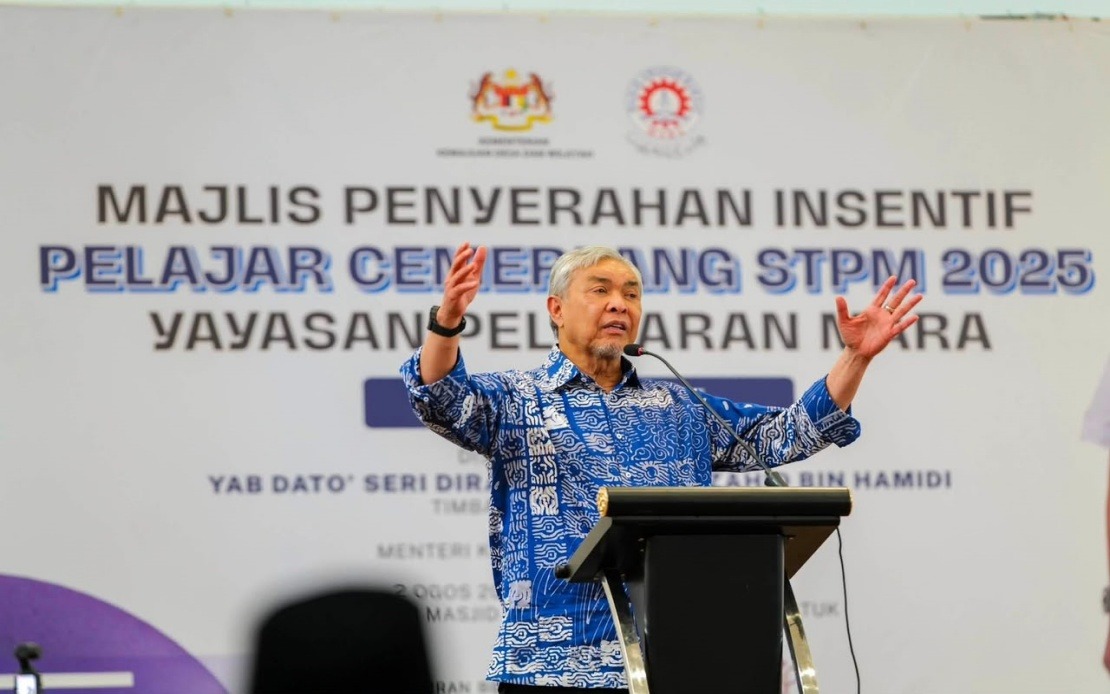
Yayasan Pelajaran MARA has acknowledged the academic accomplishments of 38 students from Bagan Datuk, honouring their distinguished results in the Sijil Tinggi Pelajaran Malaysia examination. The awardees come from SMK Khir Johari and SMK Tun Abdul Razak, two of the district's leading secondary institutions, and represent a significant cohort of high achievers whose success reflects broader educational progress in Perak's parliamentary constituency.
Deputy Prime Minister Datuk Seri Dr Ahmad Zahid Hamidi, who also serves as Member of Parliament for Bagan Datuk, announced the recognition during a post on his official social media channels. His remarks underscored not merely the individual accomplishments of these students but positioned their success within a wider narrative about community potential and the transformative power of educational opportunity. The accolades form part of YPM's ongoing commitment to identifying and supporting Malaysia's brightest young minds across the country.
Beyond the STPM Excellence Incentive recipients, the Bagan Datuk MP highlighted complementary achievements within the same cohort. Three students from the district have secured admission to Al-Azhar University in Egypt, one of Islam's most prestigious institutions, to pursue specialised studies in Islamic Syariah and Usuluddin. This international recognition speaks to the calibre of Islamic education being offered in local schools and opens pathways for students seeking advanced theological and jurisprudential training abroad.
The broader support ecosystem for Bagan Datuk's students extends further through YPM's Education Compassionate Fund, from which 23 additional students benefited. This parallel initiative addresses financial barriers that might otherwise impede capable learners from progressing to tertiary education, reflecting a two-pronged approach combining merit-based recognition with need-based assistance. Such targeted interventions acknowledge that excellence often requires not only ability but also economic enabling.
Dr Ahmad Zahid Hamidi characterised the achievements as vindication of his longstanding conviction that educational advancement represents the most valuable investment a society can make. His framing resonates with Malaysian policy discourse, where education consistently ranks as a priority area for federal and state governments. For Bagan Datuk specifically, the concentration of successful outcomes suggests that local educational institutions are delivering quality instruction and that students are responding to available opportunities with determination.
The recognition of these students also carries implications for brain retention and return migration. Dr Ahmad Zahid Hamidi expressed hope that Bagan Datuk's youth would pursue higher education at institutions throughout Malaysia and internationally before ultimately channelling their acquired expertise back into their home district. This aspiration reflects a common challenge facing economically developing regions: preventing the permanent loss of educated graduates to urban centres or overseas opportunities while simultaneously encouraging global exposure and skill acquisition.
For Malaysian students seeking international education pathways, the admission of three Bagan Datuk residents to Al-Azhar University demonstrates that excellence in local examinations can translate into acceptance at globally recognised universities. Al-Azhar, founded in 970 CE and located in Cairo, maintains one of the Islamic world's most rigorous academic standards and attracts scholars and students from across Muslim-majority nations and diaspora communities worldwide. Admission represents not only personal achievement but also reflects favourably on the calibre of pre-university instruction available within Malaysia's secondary education system.
The STPM Excellence Incentive programme operated by YPM targets students who have demonstrated exceptional performance in the Sijil Tinggi Pelajaran Malaysia, the nationally standardised examination taken after secondary schooling. Performance recognition at this level serves multiple functions: it validates students' efforts at a formative educational juncture, it acknowledges their schools' contributions to their development, and it provides material encouragement in the form of financial awards that facilitate access to tertiary education. For recipients, such recognition often becomes motivational currency as they embark on university studies.
The concentration of YPM support across multiple categories—Excellence Incentive, university placements, and Compassionate Fund allocation—within a single parliamentary constituency suggests coordinated institutional effort to maximise impact within a defined geographic area. This approach contrasts with purely scatter-gun merit recognition by instead treating educational advancement as an ecosystem requiring parallel interventions across income levels and achievement bands. The result is that Bagan Datuk's educational landscape becomes saturated with positive reinforcement and practical support.
Dr Ahmad Zahid Hamidi's remarks emphasised the critical role of parental engagement and familial encouragement in sustaining student motivation. This emphasis acknowledges that examination success, whilst individually achieved, typically reflects household environments that prioritise learning and sacrifice current consumption to fund educational costs. By publicly recognising both the students and implicitly their families, the Deputy Prime Minister situates academic achievement within its proper social context rather than treating it as an isolated individual accomplishment divorced from community and kinship networks.
For Malaysia's education sector and regional observers, the Bagan Datuk outcomes offer a positive indicator regarding equity in achievement distribution. That students from a non-metropolitan constituency are accessing international university placements and receiving multiple tiers of institutional support suggests that geographic inequality in educational opportunity may be narrowing, at least for the highest achievers. However, such successes require ongoing investment in school infrastructure, qualified educators, and support programmes to become systematised rather than exceptional.

