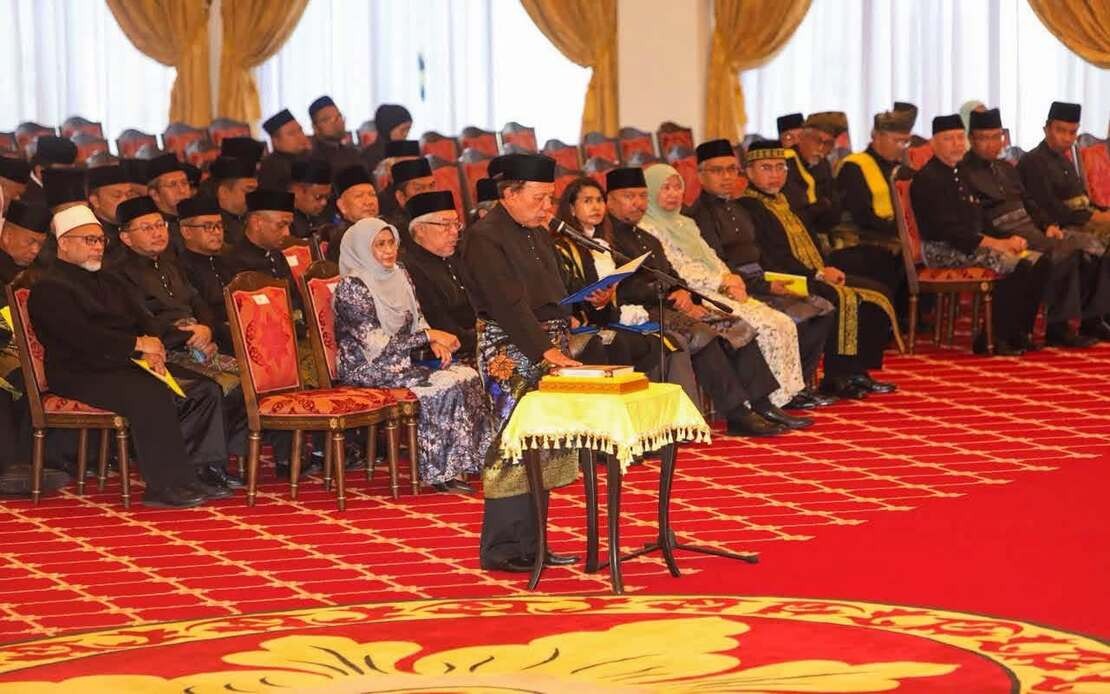
Malaysia's top leadership has rallied behind Datuk Ismail Lasim following his formal appointment as Negeri Sembilan Menteri Besar, with Deputy Prime Minister Datuk Seri Dr Ahmad Zahid Hamidi and multiple cabinet ministers extending congratulations and pledging support for the state's continued progress under the new administration.
Ismail, who represents the Juasseh state constituency, was sworn in before the Yang Dipertuan Besar of Negeri Sembilan, Tuanku Muhriz Tuanku Munawir, in a ceremony held at the Balairong Seri of Istana Besar Seri Menanti. The 67-year-old's elevation marks a significant transition in the state's political leadership, with the change receiving immediate endorsement from federal ministers across multiple portfolios.
Ahmad Zahid, who also serves as Rural and Regional Development Minister, used his Facebook platform to extend personal congratulations to the newly appointed Menteri Besar. In his message, Ahmad Zahid emphasised the weight of the responsibility that accompanies the position, while simultaneously expressing confidence that Ismail possesses the capability and determination to fulfill his duties effectively. The Deputy Prime Minister framed the appointment within a broader vision of collective endeavour, invoking religious sentiment with his statement that together, the administration would work to restore Negeri Sembilan to greatness.
Defence Minister Datuk Seri Mohamed Khaled Nordin adopted a similar tone in his public remarks, characterising the public's confidence in Ismail as a substantial trust that carries implications for the state's trajectory. Mohamed Khaled's statement honed in on the continuity aspect of governance, expressing hope that the incoming leadership would preserve the momentum of development initiatives while maintaining the stability that Negeri Sembilan has achieved. His remarks suggest that federal leadership views the appointment as an opportunity to sustain rather than fundamentally alter the state's administrative direction.
Plantation and Commodities Minister Datuk Seri Dr Noraini Ahmad contributed to the chorus of support by describing the moment as a threshold for the state's entry into a new chapter. Her statement reflected a ceremonial acknowledgment of the transition while offering ministerial backing for the challenges that lie ahead. Noraini's emphasis on divine guidance and the spiritual dimensions of public service reflected a pattern evident across all the federal messages, where religious invocation served to underscore the gravity of stewardship in governance.
Ismail's political trajectory spans nearly three decades, beginning with his election as a state assemblyman in 1999, positioning him as a figure with substantial experience navigating Negeri Sembilan's political landscape. His prior service in the state executive council commenced in 2004, during which he held consecutive appointments through 2018, providing him with intimate knowledge of state administration and policy implementation. His portfolio during those years focused on education, where he contributed to shaping human capital development strategies and formulating educational policies intended to advance the state's competitive positioning.
The appointment carries particular significance for Negeri Sembilan's political stability, as it follows from the formal constitutional process that granted the Yang Dipertuan Besar the authority to select the Menteri Besar. The involvement of multiple federal ministers in extending congratulations underscores the federal government's investment in ensuring smooth governance transitions at the state level, a concern that has become increasingly important in Malaysia's competitive political environment where state administrations serve as laboratories for policy innovation.
For Malaysian observers and regional analysts, the coordinated messaging from federal leadership indicates a deliberate strategy to project unity and continuity during the leadership transition. The emphasis on responsibility, development, and stability suggests that the federal government views the Negeri Sembilan state administration as an important component of its broader developmental agenda. This approach reflects the reality that states occupy a crucial position in Malaysia's federal structure, wielding significant authority over education, land, and local economic matters that directly affect citizen welfare.
The timing and substance of these congratulatory messages also signal confidence from federal quarters that Ismail's administration will maintain alignment with national policy priorities. Given that the various ministers represent different political factions within the ruling coalition, their unified stance suggests a broader consensus around the new Menteri Besar's suitability for the role. This consensus may facilitate cooperation between state and federal authorities on developmental projects and policy coordination, areas where jurisdictional overlap sometimes creates friction in Malaysia's federal system.
Ismail's background in education policy positions him advantageously at a moment when Malaysian states are grappling with questions about human capital development, technical skills training, and economic diversification. Negeri Sembilan, while traditionally dependent on resource extraction and agriculture, has been attempting to develop a more knowledge-intensive economic base. Ismail's prior experience in this domain may prove instrumental in charting a course toward greater economic resilience and opportunity diversification.
The ministerial endorsements also carry implications for investor confidence in Negeri Sembilan's political environment. Stability and continuity in governance typically correlate with business confidence and the willingness of both domestic and foreign capital to commit to long-term projects. The clear federal backing for the new administration may therefore have modest positive effects on the state's investment climate, particularly in sectors where policy consistency and effective regulatory frameworks prove decisive.
As Ismail begins his tenure as Menteri Besar, the nature of federal-state collaboration will likely prove consequential for his ability to deliver on development promises. The cooperative messaging from Ahmad Zahid, Mohamed Khaled, and Noraini suggests that he can anticipate supportive engagement from the federal government on matters ranging from infrastructure funding to policy coordination. However, the translation of goodwill into tangible development outcomes will ultimately depend on his administrative effectiveness, political acumen, and capacity to navigate the specific challenges facing Negeri Sembilan.

