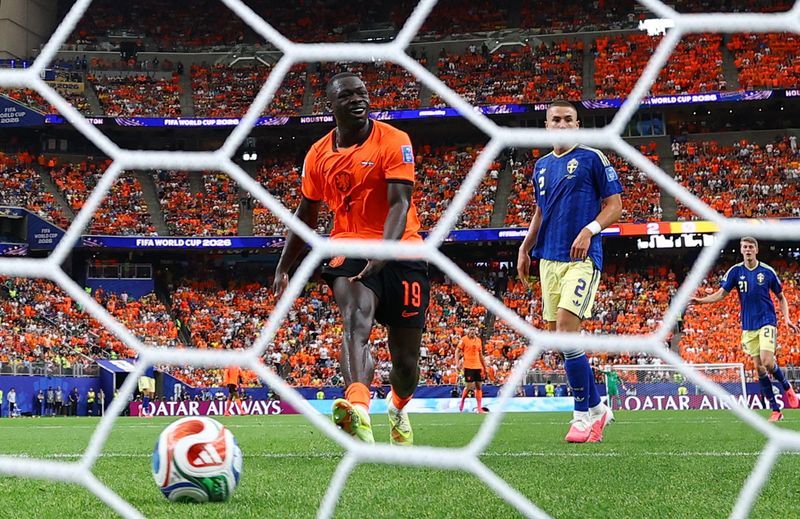
Ronald Koeman's tactical acumen was called into serious question following the Netherlands' opening World Cup encounter, a frustrating 2-2 draw against Japan in Dallas that left many questioning his substitution strategy. Yet the Dutch coach demonstrated precisely why managerial fortunes in football can shift dramatically within a single match, as his selection decisions proved instrumental in orchestrating a commanding 5-1 demolition of Sweden on Saturday. The contrast between the two performances underscores the fickle nature of football commentary, where a coach vilified for one decision can be praised as visionary for the next—and in this case, Koeman's boldest choice was rewarding his faith in Brian Brobbey as his lead attacker.
The 24-year-old striker had occupied an uncertain status within the Dutch squad for some time, sidelined during the qualifying campaign for the 2026 World Cup and excluded entirely for nearly a year before earning a recall to the setup in March. His journey back to prominence reflects both his own determination and Koeman's willingness to gamble on potential rather than established credentials. When given the opportunity to start against the Swedes, Brobbey justified that gamble spectacularly, finding the back of the net twice within the opening seventeen minutes to establish a commanding platform for the Netherlands' eventual rout. His performance did more than merely add goals to the scoreline; it fundamentally shifted the narrative around Dutch attacking play and succession planning at the most crucial juncture.
What makes Brobbey's emergence particularly significant is the technical evolution he has undergone. The striker himself acknowledged this development during comments at the Dutch training base earlier in the month, describing a marked transformation in his overall game. His season in the English Premier League with Sunderland evidently accelerated his maturation as a footballer, broadening his skillset beyond the traditional centre-forward attributes of physical dominance and aerial prowess. He has developed a more nuanced understanding of positioning, capable of making intelligent decoy runs, reading defensive space with greater sophistication, and dropping deeper to link play—qualities essential for modern attacking football at the highest level.
The supporting cast around him also enhances Brobbey's prospects for establishing himself as the Netherlands' primary striker. Cody Gakpo's menacing presence on the left flank provides consistent creative threat, while fullback Denzel Dumfries' attacking forays down the right wing generate additional overload situations. The recent addition of Crysencio Summerville to the squad further strengthens the creative infrastructure, ensuring that whoever operates as lead attacker possesses plentiful supply lines. For a striker like Brobbey, whose game has expanded beyond poaching to encompass intelligent movement and combination play, these supporting players offer the platform to flourish.
The Memphis Depay succession question has loomed large for Dutch football administrators and selectors for considerable time. Depay's status as the Netherlands' all-time leading international goalscorer carries enormous weight, and replacing such a figure presents genuine complexity. However, Depay's recent injury troubles and subsequent layoff have deprived him of the sharpness and match rhythm essential for peak performance at tournament football. Brobbey, by contrast, arrives with the benefit of sustained regular football in a competitive league, a physical freshness, and demonstrable clinical finishing ability. The Saturday performance against Sweden provided compelling evidence that he possesses the required technical quality and composure to assume the leading responsibility.
For Malaysian and Southeast Asian football enthusiasts, Brobbey's ascendancy offers instructive lessons about player development pathways and the importance of overseas experience. His season in England's top flight clearly accelerated his tactical intelligence and positional awareness in ways that domestic competition alone may not have achieved. This parallels the journeys of numerous Southeast Asian players who have sought to develop their games through stints in major European leagues, understanding that exposure to higher competitive intensity and tactical sophistication fundamentally reshapes a player's football maturity.
The Netherlands' commanding position atop their World Cup group reflects not merely Brobbey's individual contribution but Koeman's successful orchestration of the entire attacking unit. His willingness to make decisive personnel changes, despite the backlash following the Japan match, demonstrates confidence in his strategic vision. For followers in the region who often scrutinise tactical decision-making in international football, Koeman's vindication serves as a reminder that managerial success frequently hinges on making bold calls and possessing sufficient conviction to support them when results validate the risk.
Brobbey's emergence also carries implications for the broader competitive balance within the World Cup tournament. The Netherlands have historically ranked among Europe's strongest football nations, and identifying an effective lead striker strengthens their tournament credentials considerably. With attacking supply routes functioning smoothly and a proven finisher operating centrally, the Dutch become increasingly formidable opponents for any potential knockout-stage adversary. The 5-1 scoreline against Sweden, while partly reflecting the opposition's defensive vulnerabilities, nonetheless demonstrated the system functioning with genuine cohesion and clinical execution.
The striker's own narrative arc—from fringe player to tournament protagonist—resonates broadly across international football. Such comeback stories inspire players elsewhere who may have experienced marginalisation or rejection, reinforcing that persistence and continued development can create opportunities for redemption. For younger players in Asian football contemplating their own career trajectories, Brobbey's patient return to prominence offers relevant perspective on maintaining standards and readiness despite temporary setbacks.
Looking forward, Brobbey's immediate challenge involves maintaining this elevated performance level throughout the tournament while continuing to justify Koeman's faith through consistent finishing. The Netherlands face formidable opposition in their remaining group matches and potential knockout encounters, contexts where his composure under pressure and ability to deliver goals will prove decisive. Should he maintain his current trajectory, he will have decisively answered the succession question that has preoccupied Dutch football strategists, establishing himself as the natural heir to Depay's mantle and providing the Dutch with the attacking focal point their possession-based football system requires for maximum effectiveness.


%22%2F%3E%3C%2Fpattern%3E%3C%2Fdefs%3E%3Crect%20width%3D%22100%25%22%20height%3D%22100%25%22%20fill%3D%22url(%23ph1wluwg)%22%2F%3E%3Crect%20width%3D%22100%25%22%20height%3D%22100%25%22%20fill%3D%22url(%23ph1wluwp)%22%2F%3E%3Ctext%20x%3D%2250%25%22%20y%3D%2250%25%22%20text-anchor%3D%22middle%22%20dominant-baseline%3D%22central%22%20fill%3D%22rgba(255%2C255%2C255%2C0.95)%22%20font-family%3D%22Georgia%2C%20'Times%20New%20Roman'%2C%20serif%22%20font-weight%3D%22700%22%20font-size%3D%22226%22%20letter-spacing%3D%22-0.02em%22%3EMelaka%3C%2Ftext%3E%3C%2Fsvg%3E)