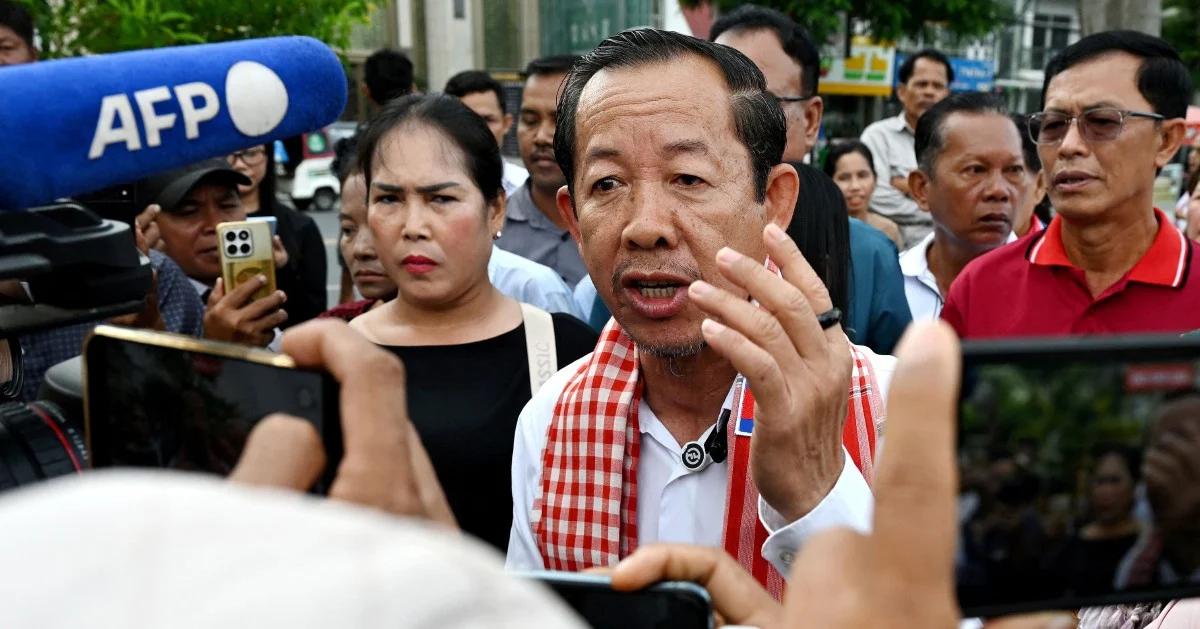
Cambodia's top court has dealt a significant blow to the country's opposition movement by upholding an election ban against prominent opposition politician Rong Chhun, even as it suspended an associated prison sentence. The Supreme Court decision, confirmed by Rong Chhun's legal representatives on Friday, preserves restrictions that prevent him from seeking elected office despite granting him relief from incarceration penalties. The ruling underscores deepening constraints on political participation in Cambodia and raises fresh concerns about the competitive landscape heading toward future electoral contests.
Rong Chhun, a notable figure within Cambodia's fragmented opposition, has long positioned himself as a vocal critic of the government. His legal troubles emerged from circumstances that remain contested between opposition supporters and authorities, with the charges reflecting broader tensions between the ruling establishment and those seeking to challenge its dominance. The suspended prison sentence suggests the court found grounds to mitigate the severity of the original conviction, yet the persistence of the electoral prohibition reveals a determination to restrict his direct political influence regardless.
The distinction between suspending incarceration while maintaining electoral disqualification is analytically important for understanding Cambodia's current political trajectory. Rather than representing a comprehensive reversal of conviction or wholesale exoneration, the court's approach appears calibrated to manage reputational concerns while preserving substantive restrictions on opposition activities. This selective clemency demonstrates how judicial systems can be deployed to achieve narrowly targeted political objectives—keeping opponents out of electoral competition without the international criticism that might accompany imprisonment of high-profile dissidents.
For Malaysia and other Southeast Asian democracies grappling with similar governance challenges, Cambodia's approach offers instructive lessons about institutional capture and the manipulation of legal mechanisms. The region has witnessed recurring patterns where courts validate restrictions on opposition politicians through procedural legitimacy, even when underlying circumstances suggest political rather than principled legal motivations. Malaysia's own experience with opposition restrictions, electoral irregularities, and judicial decision-making resonates with Cambodia's predicament, though the contexts and severity differ considerably.
Election bans constitute particularly consequential political tools because they operate outside the electoral process itself, removing competitors before voters can exercise choice. Unlike direct vote suppression or electoral fraud, bans function as preventive measures that reshape the candidate pool available to constituencies. When applied asymmetrically against opposition figures, they fundamentally alter competitive dynamics and diminish the meaningful choice available to citizens. Rong Chhun's disqualification means opposition supporters cannot cast ballots for him regardless of their preference, a deprivation of political agency that extends beyond standard electoral mechanics.
Cambodia's opposition landscape has contracted substantially over recent years, with the Cambodia National Rescue Party dissolved by court order in 2017 and numerous opposition figures either imprisoned, exiled, or judicially barred from politics. The Rong Chhun decision must be understood within this broader pattern of institutional restrictions rather than as an isolated incident. Each ban, each dissolution, each incarceration incrementally narrows the political space available to non-government actors and reduces the organizational capacity of alternative political movements. The cumulative effect transforms Cambodia from a fragile multiparty system into something approximating de facto one-party dominance maintained through legal rather than explicitly authoritarian mechanisms.
Regional observers and international human rights organizations have consistently flagged these restrictions as incompatible with democratic principles, yet Cambodian authorities argue that maintaining stability and preventing destabilization takes precedence over maximizing electoral competition. This framing appeals to concerns about political polarization and social fragmentation, issues that resonate across Southeast Asia where leaders cite security imperatives to justify constraining opposition activity. The tension between stability and pluralism remains unresolved across the region, with different nations calibrating their approaches according to local political calculations and international pressure.
The Supreme Court's decision carries implications beyond Cambodia's borders. As Southeast Asian governments observe how international responses and domestic consequences unfold, precedents established in one country inform strategic thinking in others. Should Cambodia face minimal external consequences for this electoral ban while avoiding sustained international isolation, neighboring governments may calculate that similar restrictions are politically sustainable. Conversely, if prolonged pressure or tangible costs accompany such restrictions, other nations might exercise greater restraint in deploying similar mechanisms.
The suspended prison sentence itself warrants careful consideration. Rather than representing judicial restraint or compassion, suspensions often serve tactical purposes—they allow authorities to claim moderation while preserving the conviction itself and all associated consequences including disqualification from office, loss of professional credentials, and diminished credibility. Observers noting the suspended sentence as a positive development risk overlooking how suspensions maintain criminal convictions and their collateral consequences while merely foregoing incarceration. This distinction matters considerably for opposition figures seeking rehabilitation or reinstatement into politics.
Looking forward, the Supreme Court's ruling likely closes judicial avenues for Rong Chhun to overturn the election ban through Cambodia's legal system. Unless successful appeals to international human rights bodies produce intervention or unless domestic political circumstances shift dramatically, this restriction will persist indefinitely. The decision therefore represents a potentially permanent reconfiguration of Cambodia's opposition landscape, eliminating from contention a figure who might otherwise have competed for elected office.
For Malaysian observers, the Cambodian situation underscores the importance of maintaining robust institutional independence and plural political competition before constraints harden into structural features. The trajectory from competitive elections toward restricted candidacy occurs incrementally, with each restriction justified individually while cumulatively producing fundamental changes in political participation. Cambodia illustrates how legal mechanisms, ostensibly neutral in application, can concentrate power when institutions lack independence from political leadership. These patterns demand vigilance from populations and international actors concerned with preserving democratic space.


%22%2F%3E%3C%2Fpattern%3E%3C%2Fdefs%3E%3Crect%20width%3D%22100%25%22%20height%3D%22100%25%22%20fill%3D%22url(%23ph2b1m6g)%22%2F%3E%3Crect%20width%3D%22100%25%22%20height%3D%22100%25%22%20fill%3D%22url(%23ph2b1m6p)%22%2F%3E%3Ctext%20x%3D%2250%25%22%20y%3D%2250%25%22%20text-anchor%3D%22middle%22%20dominant-baseline%3D%22central%22%20fill%3D%22rgba(255%2C255%2C255%2C0.95)%22%20font-family%3D%22Georgia%2C%20'Times%20New%20Roman'%2C%20serif%22%20font-weight%3D%22700%22%20font-size%3D%22272%22%20letter-spacing%3D%22-0.02em%22%3ESeven%3C%2Ftext%3E%3C%2Fsvg%3E)