%22%2F%3E%3C%2Fpattern%3E%3C%2Fdefs%3E%3Crect%20width%3D%22100%25%22%20height%3D%22100%25%22%20fill%3D%22url(%23ph2b1m6g)%22%2F%3E%3Crect%20width%3D%22100%25%22%20height%3D%22100%25%22%20fill%3D%22url(%23ph2b1m6p)%22%2F%3E%3Ctext%20x%3D%2250%25%22%20y%3D%2250%25%22%20text-anchor%3D%22middle%22%20dominant-baseline%3D%22central%22%20fill%3D%22rgba(255%2C255%2C255%2C0.95)%22%20font-family%3D%22Georgia%2C%20'Times%20New%20Roman'%2C%20serif%22%20font-weight%3D%22700%22%20font-size%3D%22272%22%20letter-spacing%3D%22-0.02em%22%3ESeven%3C%2Ftext%3E%3C%2Fsvg%3E)
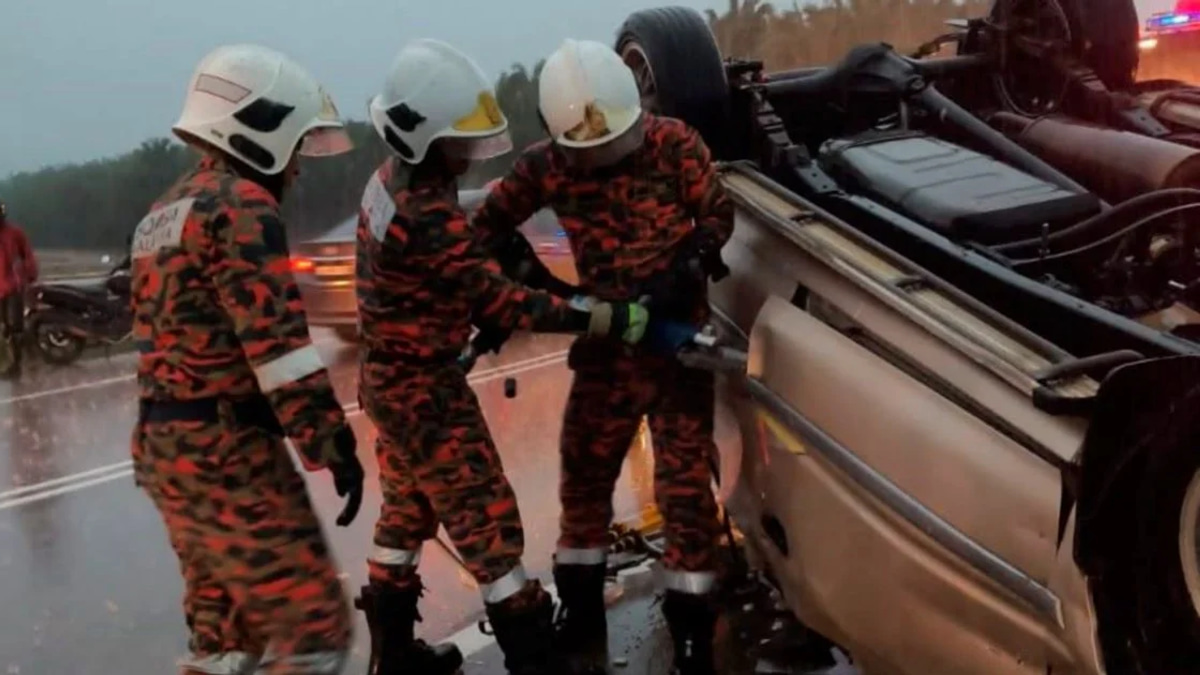
A routine highway journey on Malaysia's East Coast became a scene of chaos on Wednesday when poor lane discipline sparked a major traffic collision near Maran, leaving seven people injured and raising fresh concerns about dangerous driving practices on high-speed routes. The incident unfolded when a lorry driver made an unexpected lane change, triggering a domino effect that swept up multiple vehicles in the resulting chaos. Among those affected were three media officers attached to Deputy Prime Minister Datuk Seri Ismail Sabri Yaakob's office, along with a private driver and three others whose identities were not immediately disclosed.
The sequence of events that led to the pile-up illustrates a recurring hazard on Malaysia's federal highways, where heavy vehicles often shift lanes with minimal warning or consideration for surrounding traffic. These manoeuvres, whilst technically illegal under strict interpretations of road safety regulations, remain commonplace despite their proven danger. The lorry's abrupt lane change created a cascade of collisions as subsequent vehicles struggled to brake in time, unable to anticipate the sudden obstruction. Authorities who arrived at the scene found the highway partially blocked, with debris scattered across multiple lanes and emergency services mobilised to assist the injured.
The involvement of personnel from the Deputy Prime Minister's office added an official dimension to what might otherwise have been a routine accident report. The three media officers, whose roles involve accompanying the nation's second-highest political figure on official engagements and managing public communications, were travelling on the highway when the collision occurred. Their injuries, whilst serious enough to warrant immediate medical attention, were not described as life-threatening. The incident raises questions about vehicle safety protocols observed by high-ranking government officials and their staff during highway travel, particularly whether adequate safety distances and vehicle maintenance standards are maintained.
Local authorities in the Maran area, which lies within Pahang state in the heart of Malaysia's East Coast, quickly cordoned off sections of the affected highway to facilitate emergency response operations. The location carries particular significance as a transit corridor connecting major centres along the coast and serving as a key artery for commercial traffic moving between northern and southern regions. Traffic disruptions during peak incidents can have ripple effects extending across the entire regional transport network, affecting not only private commuters but also the movement of goods and time-sensitive commercial operations.
This incident underscores a persistent challenge facing Malaysia's road safety authorities: the difficulty in enforcing consistent lane discipline among commercial drivers operating heavy vehicles. Lorries and large goods vehicles, by virtue of their mass and reduced manoeuvrability, present heightened risks when their operators exercise poor judgment about lane changes. The physics of collision dynamics mean that when such vehicles are involved, the consequences tend to be more severe than accidents involving only passenger cars. Training programmes and licensing requirements for heavy vehicle operators remain an ongoing focus for authorities seeking to reduce highway fatalities and serious injuries.
The Maran stretch of the East Coast highway has experienced numerous accidents over the years, making it a known trouble spot within road safety circles. Contributing factors typically include high speeds, inadequate spacing between vehicles, driver fatigue, and mechanical failures. Weather conditions, whilst not immediately reported as a factor in this particular incident, can also play a role given that monsoon seasons bring heavy rainfall to the region. The concentration of accidents at specific locations often prompts authorities to conduct safety audits, improve signage, or introduce targeted enforcement campaigns aimed at modifying driver behaviour.
For the media officers involved, the incident represents an unplanned disruption to their professional duties accompanying the Deputy Prime Minister's office. Their recovery and return to normal operations will be monitored, particularly given the demands of their roles in managing high-level government communications. The incident may also prompt a review of transport safety protocols within the ministerial office, ensuring that vehicles used for official duties meet current safety standards and that drivers receive appropriate training in defensive driving techniques.
The broader implications of this pile-up extend to ongoing discussions within government and road safety agencies about what comprehensive measures might reduce highway collision rates. These discussions typically encompass infrastructure improvements such as better road markings and lane separation systems, stricter enforcement through increased highway patrols and technological monitoring, and educational campaigns targeting driver behaviour. Malaysia's Vision 2050 framework includes ambitious targets for reducing road fatalities, making incidents like this one a reminder of the persistent gap between stated goals and on-ground reality.
As investigations proceeded into the precise circumstances of the collision, the focus remained on determining whether the lorry driver operated at fault should face charges under existing traffic laws. Witnesses present at the scene, along with vehicle dash-cam footage and marks on the highway surface, typically provide crucial evidence in reconstructing accident sequences. The outcome of such investigations influences not only individual driver accountability but also broader policy discussions about whether existing penalties provide adequate deterrence against reckless lane changes and other aggressive driving behaviours on high-speed routes.