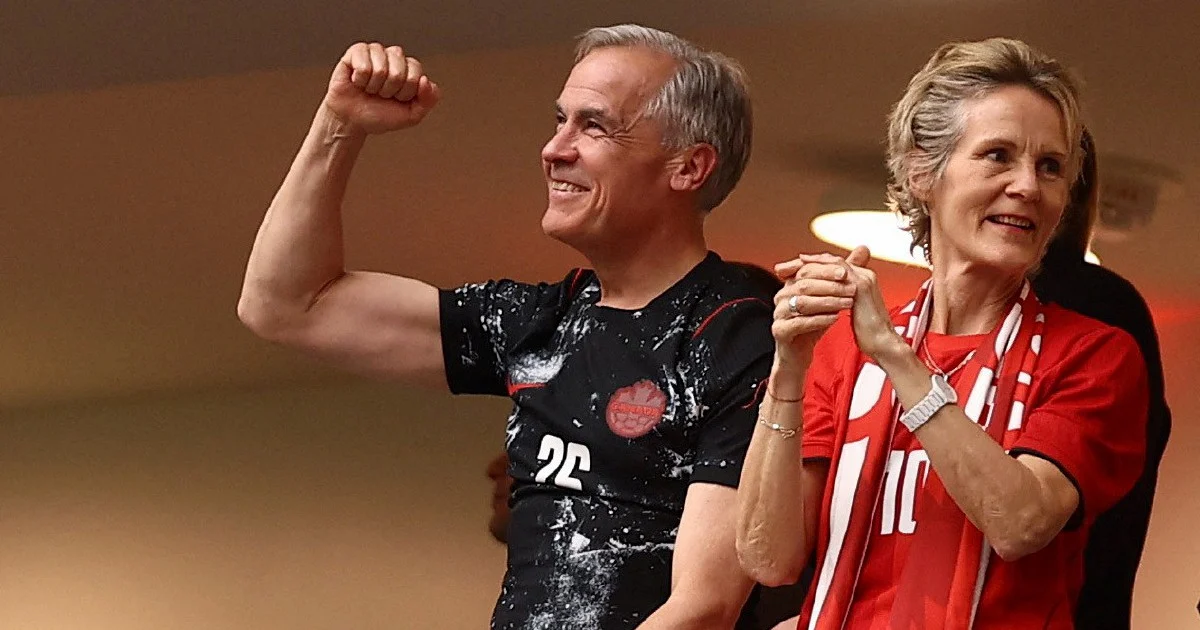
Canada has achieved a historic milestone in international football by securing its maiden victory in the FIFA World Cup finals tournament, prompting Prime Minister Mark Carney to make a personal visit to the team's locker room in Vancouver to offer his congratulations. The achievement represents a watershed moment for Canadian sports, breaking through decades of near-misses and underwhelming performances on the world's grandest football stage.
The Prime Minister's presence underscores the cultural significance of the result within Canada, where football has been gradually expanding its footprint as a professional sport. Carney's decision to visit the players directly, rather than issuing a statement, reflects the symbolic importance attached to this breakthrough achievement for a nation that has historically struggled to compete at the elite levels of international football competition.
Beyond mere statistical accomplishment, Carney specifically acknowledged what he characterised as the exemplary character demonstrated by the playing squad. His remarks centred not simply on the victory itself, but on the manner in which the team responded to adversity during the match. This emphasis on character and resilience carries deeper meaning in professional sports discourse, suggesting that how teams conduct themselves under pressure matters as much as the final scoreline.
The specific adversity that tested the team's mettle involved one teammate sustaining a broken leg during play. Such injuries, particularly at major tournaments where player availability is finite, can fundamentally alter team dynamics and tactical approaches. The fact that Carney singled out how players responded to this setback indicates the injury proved sufficiently significant that it could have derailed the entire match, yet the team persevered regardless.
For Malaysian and Southeast Asian observers, Canada's breakthrough carries particular relevance to regional football aspirations. The Asian Football Confederation members frequently measure their progress against established football nations, and Canada's historical struggles at the World Cup provide cautionary perspective on how even developed nations require sustained commitment and investment to achieve competitive results at this level. Several Southeast Asian countries harbour similar ambitions of World Cup qualification and success, making the Canadian pathway instructive.
Canada's football development infrastructure has undergone substantial modernisation over the past decade, with increased investment in youth academies, professional league development, and coaching expertise. This breakthrough result validates that systematic approach, demonstrating that nations outside traditional football powerhouses can breakthrough with dedicated long-term planning. The timing of the victory and Carney's prominence as Prime Minister may also elevate football's profile within Canadian popular culture, potentially triggering increased youth participation.
The locker room visit itself represents a deliberate political gesture by the Prime Minister's office. In democratic nations, such high-level recognition of sporting achievement serves multiple functions—it generates positive media coverage, affirms national pride during international competition, and positions government leadership as invested in national cultural pursuits. For a country with multiple competing professional sports, elevating football through prime ministerial endorsement carries strategic cultural messaging.
The broken leg injury introduces a humanitarian dimension to the narrative that extends beyond statistics. Sports injuries, particularly at elite levels, carry professional and financial consequences for affected athletes. The way teammates rallied despite losing a colleague to injury speaks to team cohesion and mental resilience—qualities that coaches and analysts increasingly recognise as decisive factors in tournament football where multiple matches over compressed schedules test physical and psychological endurance.
Canadian football's journey to this moment involved a lengthy apprenticeship within World Cup competition. Prior to this match, Canada had participated in the finals tournament but failed to record a victory, accumulating losses that reinforced perceptions of the country as a developing football nation. Breaking through that psychological barrier holds significance extending beyond this single match, as it establishes a precedent suggesting Canadian teams belong at this competitive level and can produce winning results.
The strategic implications for football development in North America are noteworthy. Canada's neighbouring United States possesses substantially larger professional league infrastructure and investment capital, yet both nations historically underperformed at World Cups relative to their economic capacity. Canada's breakthrough potentially signals that investment and strategic planning are beginning to yield tangible results, possibly encouraging continued commitment to football development across the continent.
Regional football federations throughout Southeast Asia monitoring Canada's trajectory will note that breakthrough success requires patience and institutional consistency. The Canadian Football Association's willingness to maintain long-term strategic vision despite years of disappointing results provides a template for nations seeking to elevate their competitive standing without abandoning programmes prematurely. This resonates particularly in regions where political leadership changes sometimes disrupt sporting investment continuity.
As the tournament progresses, Canada's ability to build on this inaugural victory will substantially influence perceptions of the team's achievement. Single victories at World Cups, while celebrated, gain enhanced significance when they launch deeper tournament runs. For now, however, Carney's visit and commendation capture a transformative moment when a nation overcame both external opponents and internal adversity to achieve what had previously seemed elusive.

%22%2F%3E%3C%2Fpattern%3E%3C%2Fdefs%3E%3Crect%20width%3D%22100%25%22%20height%3D%22100%25%22%20fill%3D%22url(%23ph2b1m6g)%22%2F%3E%3Crect%20width%3D%22100%25%22%20height%3D%22100%25%22%20fill%3D%22url(%23ph2b1m6p)%22%2F%3E%3Ctext%20x%3D%2250%25%22%20y%3D%2250%25%22%20text-anchor%3D%22middle%22%20dominant-baseline%3D%22central%22%20fill%3D%22rgba(255%2C255%2C255%2C0.95)%22%20font-family%3D%22Georgia%2C%20'Times%20New%20Roman'%2C%20serif%22%20font-weight%3D%22700%22%20font-size%3D%22272%22%20letter-spacing%3D%22-0.02em%22%3ESeven%3C%2Ftext%3E%3C%2Fsvg%3E)