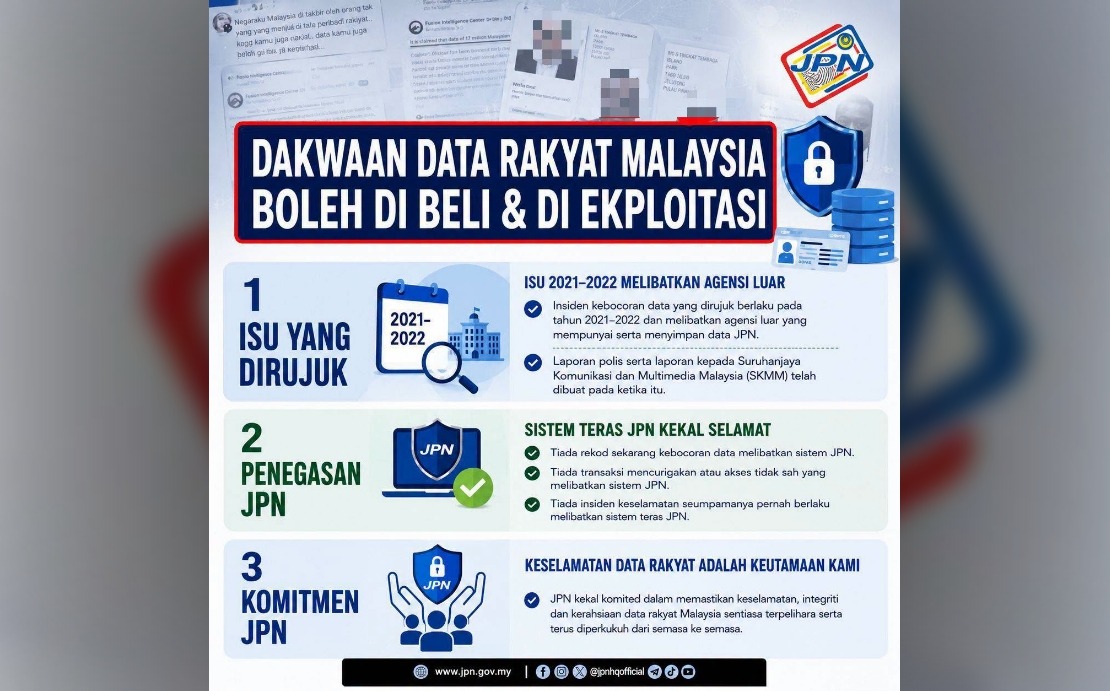
The National Security Council (MKN) has moved to dispel public alarm over a viral data leak circulating on social media, clarifying that the compromised information originated from cybersecurity breaches occurring before 2022 and bears no connection to any active digital platforms currently in operation. Through the National Cyber Security Agency (NACSA), the council issued a formal statement addressing widespread concern that had emerged online, seeking to reassure citizens and government stakeholders that the incident does not represent a fresh vulnerability affecting today's infrastructure.
According to NACSA's assessment, the personal data now being redistributed across social media platforms was unlawfully extracted through cyber intrusions targeting multiple systems prior to 2022, and is being deliberately circulated without authorisation by unknown parties. The agency emphasised that even though the sourced information originates from years-old breaches, its continued unauthorised distribution represents an ongoing threat to privacy and public trust in digital systems. The timing and deliberate resurfacing of historical data raises questions about whether criminal networks are systematically monetising old breaches through modern distribution channels.
Malaysian law, according to the MKN statement, explicitly prohibits the provision, dissemination, or granting of access to unlawfully obtained information, regardless of whether the hosting infrastructure operates domestically or internationally. This provision is particularly significant as it establishes clear jurisdiction over digital crime that crosses national borders. For Malaysian users, the legal warning carries practical implications: engaging with services that offer access to stolen data—whether by purchasing it, sharing it, or benefiting from it—constitutes a criminal act subject to prosecution under Malaysian statutes. The council's explicit framing suggests authorities may pursue both the original data thieves and downstream actors profiting from redistribution.
Immediate operational responses have already been activated across multiple government agencies. NACSA has coordinated with MyNIC and the Personal Data Protection Department to engage international service providers, directing them to remove affected websites and block access to repositories containing the stolen data. This multi-agency approach reflects the sophisticated nature of modern cybercrime, which often requires coordination across government bodies, private sector partners, and international infrastructure providers. The speed and coordination of this response signal that Malaysia's cybersecurity governance structures, while still evolving, are capable of mobilising resources rapidly when threats materialise.
Parallel to containment efforts, the Royal Malaysia Police has commenced digital forensic investigations aimed at identifying individuals responsible for the breach and its continued distribution. These investigations represent a critical component of Malaysia's law enforcement response to cybercrime, as traditional investigative techniques increasingly require specialised digital expertise. The involvement of law enforcement signals that authorities view this incident as sufficiently serious to warrant criminal prosecution rather than administrative resolution. For potential perpetrators, this suggests a genuine risk of prosecution and imprisonment if identified.
The incident has prompted NACSA to reiterate warnings to the Malaysian public about the consequences of accessing unlawfully obtained information. The agency framed participation in the redistribution of stolen data as contributing directly to the proliferation of cybercrime and undermining cybersecurity efforts nationwide. This messaging reflects a broader recognition that cybercrime requires consumer complicity—criminals cannot monetise stolen data if potential buyers refuse to engage. Public education campaigns targeting awareness of legal liability represent a sophisticated crime prevention strategy beyond traditional enforcement.
Pending legislation offers a window into how Malaysia's legal framework for cybercrime is evolving. The Cyber Crime Bill, scheduled for parliamentary tabling, represents the government's intention to strengthen penalties and expand criminalisation of various cyber offences. The proposed legislation would criminalise unauthorised access to computer systems and programmes absent legitimate authority, as well as formally defining identity theft—the unauthorised use of another person's identity for criminal purposes—as a distinct offence. These provisions address specific vulnerability categories that current law may not adequately cover, reflecting how cybercriminal tactics have outpaced legislative definitions.
Complementing this proposed legislation, the Cyber Security Act 2024, which entered into force in August 2024, has imposed comprehensive protection obligations on entities managing National Critical Information Infrastructure (NCII). These organisations must now implement codes of practice, conduct regular risk assessments, and perform periodic security audits. For Malaysia, this represents a structural shift toward mandatory security standards for critical systems, moving beyond voluntary best practices. The requirement for documented compliance creates accountability mechanisms and establishes measurable standards against which organisations can be evaluated.
Concern has focused partly on the MyDigital ID system, which has surpassed 16 million registrations. The MKN has clarified that MyDigital ID functions not as a data repository but as an identity verification platform that authenticates users directly against the National Registration Department's systems. This architectural distinction is crucial: MyDigital ID does not store personal data centrally, reducing the risk profile associated with a single compromised database containing millions of records. Instead, the system operates as a bridge between users and official registration authorities, pushing verification logic away from centralised storage. This technical approach represents a more defensible design philosophy than traditional database-centric identity systems.
The widespread integration of MyDigital ID across government and private sector applications—including telecommunications companies and banking institutions—carries important implications for digital transaction security. Broader adoption can strengthen identity verification processes and reduce reliance on less secure authentication methods. However, the rapid expansion also increases pressure on the system's underlying infrastructure to maintain security standards at scale. For Malaysian businesses and consumers, the normalization of MyDigital ID represents a significant shift in how identity transactions will occur across the economy.
The government has positioned cybersecurity as central to its digital transformation agenda, signalling that economic modernisation and security must advance together. This framing acknowledges that Malaysia's ability to realise the benefits of digital technology—from enhanced government services to digital commerce—depends fundamentally on public confidence in system security. If breaches proliferate and data theft becomes commonplace, adoption of digital services will stagnate. The MKN's emphasis on this connection suggests policymakers recognise that cybersecurity is not merely a technical issue but a prerequisite for economic and social progress.
Looking forward, the convergence of tightened legislation, mandatory security standards for critical infrastructure, and public awareness campaigns suggests Malaysia is pursuing a multi-layered defensive approach to cybercrime. Each component addresses a different dimension of the problem: legislation establishes legal consequences and expands criminal definitions; infrastructure security requirements impose operational safeguards; public messaging reduces demand for stolen data. Whether this comprehensive strategy proves sufficient will depend on sustained implementation and continuous adaptation as criminal tactics evolve.