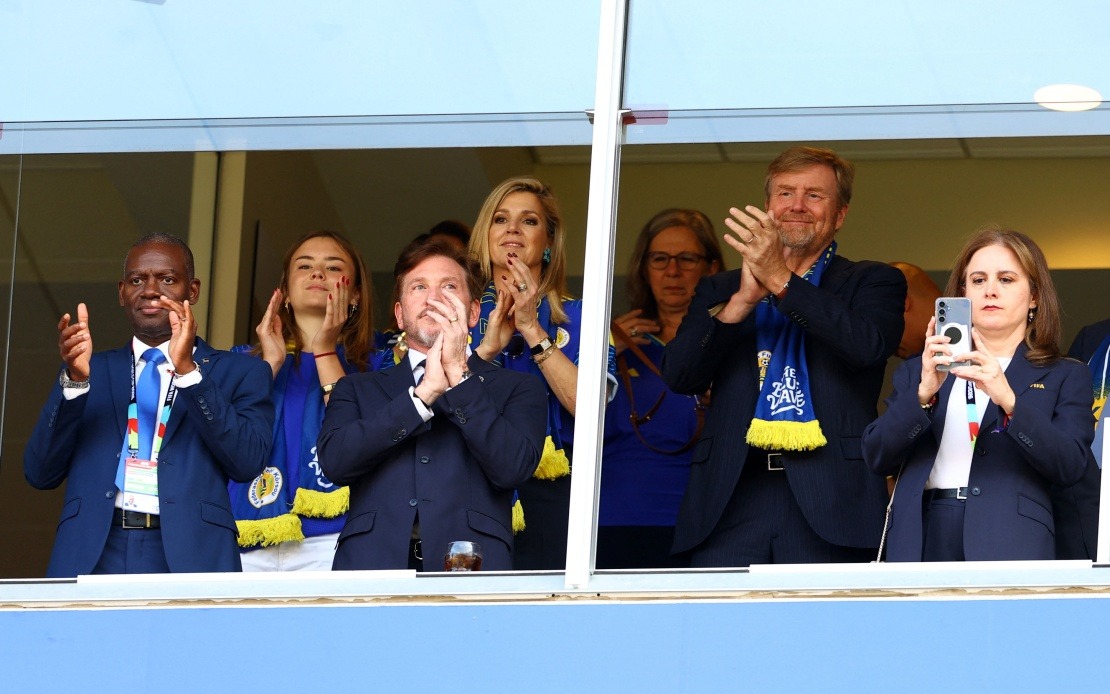
King Willem-Alexander and Queen Máxima of the Netherlands embarked on an ambitious continental journey on Saturday, attending two World Cup fixtures in as many American cities to support the nations under their constitutional umbrella. The royal couple first witnessed the Netherlands' commanding performance in Houston before racing against the clock to reach Kansas City, where they celebrated Curaçao's defensive masterclass. Their dual mission underscored the unique position of European monarchies with Caribbean territories and the symbolic importance of major sporting tournaments in reinforcing ties across geographically dispersed realms.
The pair's day began in Houston, where the Netherlands dismantled Sweden with an impressive 5-1 victory, a result that substantially strengthened their path toward the knockout stages. The Dutch side's dominant display offered Willem-Alexander and Máxima an ideal opening act to their tournament experience, with the team demonstrating the attacking prowess and tactical discipline that has made them consistent World Cup contenders. This commanding victory effectively positioned the Netherlands favourably ahead of their final group-stage encounter against Tunisia, with qualification now largely in their own hands.
Having completed their Houston obligations, the royals undertook a swift journey across the American heartland to arrive in Kansas City for Curaçao's encounter with Ecuador. The island nation's 0-0 stalemate, far from being a disappointment, represented a significant achievement for a smaller footballing nation competing against a South American side with deeper World Cup pedigree. The draw kept Curaçao's mathematical hopes alive, though their path to advancement remained narrow, requiring victory over Ivory Coast in their final group fixture.
As both monarch and constitutional head of state for the constituent nations within the Dutch realm, Willem-Alexander occupies a singular position rarely found among European royalty. Curaçao's status as a country within the Kingdom of the Netherlands grants the island its own government and international standing, distinct from the European Netherlands proper. This constitutional arrangement means the king's attendance at matches involving either entity carries official significance beyond mere sporting enthusiasm, serving as a tangible manifestation of the crown's connection to all territories under the Dutch realm.
The couple's wardrobe choices reflected their inclusive approach to the day's festivities. Sporting orange—the Netherlands' traditional colour—at the Houston stadium, they switched to Curaçao's blue for the evening's Kansas City fixture. This chromatic transformation symbolised their commitment to honouring each nation's distinct identity whilst maintaining their overarching royal responsibilities. Such attention to protocol and symbolism is characteristic of constitutional monarchy, where even seemingly minor gestures carry deeper meaning about unity and respect for diverse populations.
Following Curaçao's match, Willem-Alexander and Máxima demonstrated their engagement extended beyond stadium seats. Video footage released by the Curaçao Football Association captured the royals dancing and celebrating in the team's dressing room, moments of spontaneity that humanised their formal roles and connected them directly with the players who represented their nation. These celebratory scenes offered the Curaçao squad tangible evidence that their efforts, against more established footballing powers, carried recognition and appreciation at the highest levels.
The king himself articulated the special significance of this tournament for his family. In comments to broadcasters, Willem-Alexander observed that having both the Netherlands and Curaçao competing simultaneously effectively doubled the number of teams he could support, an optimistic framing that acknowledged the inherent complexity of his transnational position. He expressed hope that both would advance beyond the group stage, a sentiment that, while perhaps diplomatically balanced, nonetheless conveyed genuine engagement with each nation's tournament ambitions.
This World Cup experience formed part of a broader pattern of royal engagement with the tournament. Earlier in the week, Willem-Alexander and Máxima had attended the Netherlands' opening group match—a 2-2 draw with Japan—alongside Japan's own imperial couple, Emperor Naruhito and Empress Masako, who were conducting a state visit to the Netherlands at the time. That occasion had created a rare moment of monarchical convergence, with two imperial families watching their nations compete, underscoring how World Cups serve as international stages where protocol and sporting passion intersect.
For Southeast Asian observers, the Dutch monarchy's World Cup engagement offers instructive parallels about how post-colonial relationships between European nations and their overseas territories continue to evolve through cultural and sporting channels. The Netherlands has maintained distinctive constitutional arrangements with Caribbean territories that grant them considerable autonomy whilst preserving formal ties to the Dutch crown. The willingness of King Willem-Alexander to physically traverse continents to support both entities suggests a commitment to making these relationships substantive rather than purely ceremonial.
Curaçao's competitive performance, despite limited resources compared to traditional footballing powers, has resonated with smaller nations globally. Their 0-0 result against Ecuador, achieved through disciplined defensive organisation, demonstrated that even nations without deep World Cup histories can compete with honour against established competitors. This achievement carries particular resonance in the Caribbean and within post-colonial contexts, where sporting success often carries significance beyond the field.
The Netherlands' dominant victory, conversely, positioned them among the tournament's genuinely competitive squads, their attack-minded football and depth of talent suggesting they could maintain momentum through the knockout stages. The contrast between their emphatic victory in Houston and Curaçao's pragmatic draw in Kansas City illustrated the vast gulf in resources and experience between European football's traditional powers and emerging nations.
As the tournament progresses, the Dutch monarchy's World Cup itinerary reflects broader questions about representation and belonging within multinational kingdoms. Willem-Alexander's Saturday journey, covering thousands of miles to support two distinct national teams, embodied the complexity of modern constitutional monarchy in an increasingly globalised world. His presence acknowledged that territories separated by thousands of miles of ocean nonetheless share constitutional and symbolic ties that transcend geographical distance.