Authorities in Vietnam's northern Phu Tho province have secured charges against four individuals accused of orchestrating a scheme to transplant a criminal online fraud network from Cambodia into Vietnamese territory. The operation, which police disrupted before it could become fully operational, represents a troubling pattern of scam rings seeking to evade tightening enforcement across Southeast Asia by shifting their bases across borders.
The investigation began when officers detected suspicious activity linked to what they characterised as foreign-operated cybercriminal syndicates based in Cambodia. Intelligence suggested that facing intensified pressure from Cambodian authorities, the network was preparing to relocate substantial personnel and operations into Vietnam, where investigators believed they intended to establish a new fraudulent call centre. The scheme underscores the sophisticated, transnational nature of organised cybercrime in the region and the challenges border enforcement poses for individual nations working to combat it.
Central to the plot was Zhao Wei Zhong, a 37-year-old Chinese national identified as the operation's ringleader. Police say Zhao entered Vietnam under directives from an overseas supervisor, tasked with establishing the groundwork necessary to receive and house the expected wave of employees from the Cambodian scam enterprises. His role represented a calculated strategic move—deploying a trusted operator with prior experience in fraudulent schemes to prepare the infrastructure in advance of the main relocation.
Zhao's appointment to this preparatory position reflected his proven track record within the criminal ecosystem. Before his assignment in Vietnam, he had worked extensively at Chinese-operated scam centres based in Cambodia, where he cultivated the connections and expertise that made him valuable to his handlers. It was in Cambodia that he identified and cultivated contacts among local Vietnamese nationals who possessed the skills and willingness to assist the expansion plan.
Among those recruited were two Vietnamese residents from Bac Ninh province: Tran Thi Thu Huong, aged 24, and Dình Nam, aged 27. Investigators determined that Zhao enlisted their support to facilitate essential ground-level operations—translation services, transportation, and reconnaissance of suitable properties where the foreign workforce could be concealed during and after their entry into Vietnam. Their roles, though supporting, were integral to the practical execution of the larger scheme.
A fourth suspect, Nguyen Thanh Long, 43, residing in Hanoi, played a logistics coordination role. Police determined that Long assisted in arranging the necessary infrastructure and planning required to support the network's transition, though the specific details of his contributions remain less detailed in official statements. His involvement suggests a layered criminal structure with specialised responsibilities distributed across multiple individuals.
The police investigation progressed methodically through an evidence-gathering phase before moving to prosecutorial charges. On June 17, officers in Phu Tho province filed formal charges against three of the suspects—Zhao, Huong, and Long—on counts of organising and facilitating the illegal residence of foreign nationals within Vietnamese territory. All three were remanded into pretrial custody, reflecting authorities' assessment of their roles as significantly culpable.
Dình Nam, the youngest of the accused, faced identical charges but received differential treatment in the form of a movement restriction order. Rather than being incarcerated pending trial, Nam was barred from leaving his residence, a less severe provisional measure suggesting the investigation may have determined he played a more peripheral role or that mitigating factors influenced prosecutorial discretion. His continued confinement to his home nonetheless signals serious criminal liability.
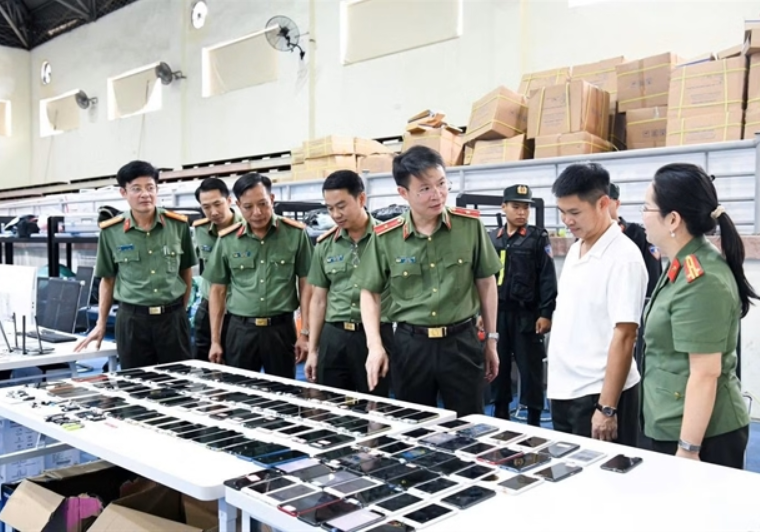
The physical disruption of the operation yielded substantial seizures of equipment intended to establish the functioning fraud call centre. Police recovered 73 computers—the processing workstations required for the scammers' operations—along with 134 mobile phones that would have served as communication conduits for fraudulent contacts with victims. Additionally, officers confiscated 34 USB drives, likely containing databases of potential victims, scripts, or operational protocols, as well as 20 Wi-Fi routers essential for establishing the secure communication infrastructure the enterprise required.
This case illuminates a critical vulnerability in Southeast Asian law enforcement: the relative ease with which criminal enterprises can relocate operations across borders when facing pressure in their current jurisdictions. Cambodia's intensified crackdowns on online fraud, while commendable, risk simply displacing the problem rather than eliminating it, unless coordinated with neighbouring nations. The sophistication demonstrated by this network—from pre-positioning a trusted operative to recruiting multilingual local facilitators to staging equipment—reflects the adaptation and organisational capacity of transnational crime groups.
For Malaysia and other regional nations, this case serves as a sobering reminder that vigilance against cybercriminal networks must encompass not only detection of active scam operations but also intelligence about relocation patterns and preparatory activities. The scale of equipment involved suggests that the Cambodian operation, had it succeeded in transplanting to Vietnam, would have become a major criminal enterprise capable of victimising thousands across the region.