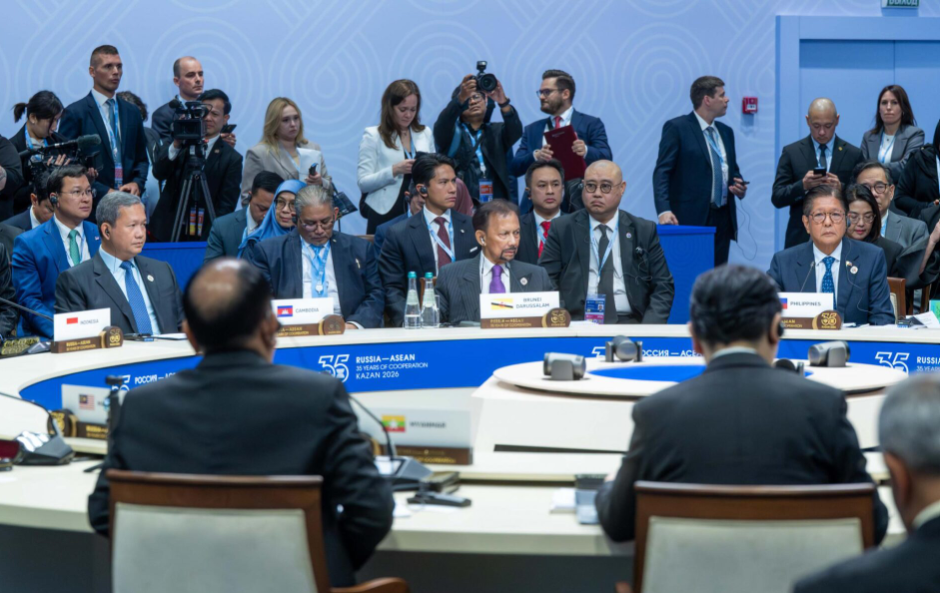
Sultan Hassanal Bolkiah travelled to Kazan, Russia on June 18 to participate in the Asean-Russia Commemorative Summit at the Kazan Expo International Exhibition Centre, where he underscored the strategic importance of deepening ties between Southeast Asia's ten nations and Moscow amid shifting global dynamics. In his remarks, the Brunei monarch expressed gratitude to Russian President Vladimir Putin for hosting the gathering, and acknowledged the hospitality provided by the Republic of Tatarstan and the city of Kazan. The Sultan was accompanied on the mission by Minister of Foreign Affairs Prince 'Abdul Mateen. During his address, the Sultan also conveyed formal condolences to Thailand's Prime Minister Anutin Charnvirakul on the recent death of Princess Bajrakitiyabha of Thailand, reflecting diplomatic protocol across the region.
The summit marking 35 years of formal dialogue between Asean and the Russian Federation comes at a particularly significant moment for regional geopolitics. The Sultan characterised the three-and-a-half decade relationship as remarkably resilient and increasingly consequential, having demonstrated the capacity to evolve constructively despite periodic international tensions and geopolitical realignment. He observed that collaborative initiatives had proliferated substantially across the three pillars of the Asean Community—political-security, economic, and socio-cultural dimensions—indicating a mature and multifaceted partnership extending well beyond traditional diplomatic courtesies.
Concrete achievements in bilateral engagement have generated tangible returns for both blocs, the Sultan noted, particularly in fostering enhanced direct connections between ordinary citizens and communities rather than remaining confined to government-to-government interactions. These people-to-people linkages, he suggested, constitute the foundation upon which durable regional partnerships are constructed, as they create mutual understanding and shared investment in peaceful outcomes. The Sultan positioned this interpersonal dimension as complementary to formal cooperation frameworks, arguing that genuine stability emerges when populations across borders develop genuine appreciation for one another's cultures and aspirations.
Looking ahead to 2045, when Asean will have fully realised its long-term strategic vision, the Sultan identified several transnational challenges requiring coordinated responses that transcend individual national capabilities. The enumeration of political instability, economic fragmentation resulting from protectionist measures and supply-chain disruptions, accelerating climate impacts, and the disruptive potential of artificial intelligence and digital transformation reflected a sophisticated understanding of contemporary risk landscapes. He articulated the conviction that sustained Russian-Asean cooperation would strengthen each party's capacity to navigate these overlapping crises through collective action rather than isolated national responses.
Energy and food security emerged as particularly salient cooperation domains in the Sultan's framing. Southeast Asia's rapid economic growth has increased dependence on reliable energy supplies, while climate volatility threatens agricultural productivity across the region. Russia's substantial natural resources and technological expertise in extractive industries position it as a consequential partner for Asean nations seeking to diversify their energy portfolios and enhance resource security. Simultaneously, Moscow's agricultural capabilities and experience in climate-resilient farming methods offer valuable knowledge transfer opportunities as Southeast Asian governments work to insulate their populations against food price volatility and production disruptions.
Disaster management and non-traditional security challenges—encompassing transnational criminal networks, pandemics, and maritime security threats—represent additional cooperation vectors where Asean and Russia possess complementary capabilities. The Sultan stressed that capabilities in early warning systems, emergency response coordination, and capacity-building programmes could be substantially enhanced through structured bilateral and multilateral mechanisms. The geographic scale of the Asia-Pacific region, combined with its exposure to natural hazards ranging from typhoons to earthquakes and tsunamis, creates imperative demand for knowledge-sharing frameworks that accelerate institutional learning across maritime states.
Human capital development constituted a central pillar of the Sultan's articulated vision for partnership expansion. Investment in educational exchange programmes, professional training initiatives, and institutional twinning arrangements between Asean and Russian universities and research facilities would create generational cohorts equipped to sustain cooperative momentum beyond the immediate horizon. The Sultan's emphasis on equipping emerging leaders with technical skills, intellectual networks, and cross-cultural competencies acknowledged that institutions require continuous renewal through infusions of talent with deep commitments to bilateral relationships.
The summit produced four significant outcome documents formalising commitments across multiple domains. The Kazan Declaration 2026: Asean-Russian Federation – Unity in Diversity: 35 Years Together provided the overarching political framework, while the Comprehensive Plan of Action to Implement the Asean-Russian Federation Strategic Partnership (2026–2030) established concrete operational targets and resource allocations for the subsequent quinquennium. Specialised cooperation was codified through the Joint Statement of Asean and the Russian Federation on Energy Cooperation, addressing resource security and sustainable development, and the Joint Statement on Cultural Cooperation, institutionalising educational and artistic exchanges. The Sultan's warm reception of the Kazan Declaration reflected confidence that these instruments would provide sufficient structural coherence to sustain momentum through inevitable political transitions and shifting international circumstances.
A second plenary session conducted as a working lunch examined regional integration processes across Eurasia, featuring contributions from Asean's Secretary-General, the Shanghai Cooperation Organisation's Secretary-General, and the Eurasian Economic Commission's Board Chairman. This format permitted comparative discussion of integration methodologies and institutional innovations across distinct regional groupings, potentially yielding valuable lessons for Asean's own integration trajectory. The inclusion of SCO and EEC perspectives acknowledged the interconnected nature of Eurasian regional architecture and the value of cross-learning among institutional actors pursuing integration objectives through distinct strategic approaches and cultural-political contexts.
The summit schedule incorporated a dedicated business forum on June 17, reflecting official recognition that sustained governmental cooperation requires parallel commercial relationships and private sector engagement. Corporate leaders from both blocs explored investment opportunities, supply-chain partnerships, and technology transfer arrangements, generating practical momentum that government declarations alone could not achieve. This multi-stakeholder architecture—integrating diplomatic, business, educational, and cultural dimensions—represents a sophisticated approach to alliance-building suited to the complexity of contemporary Southeast Asian-Russian relations.