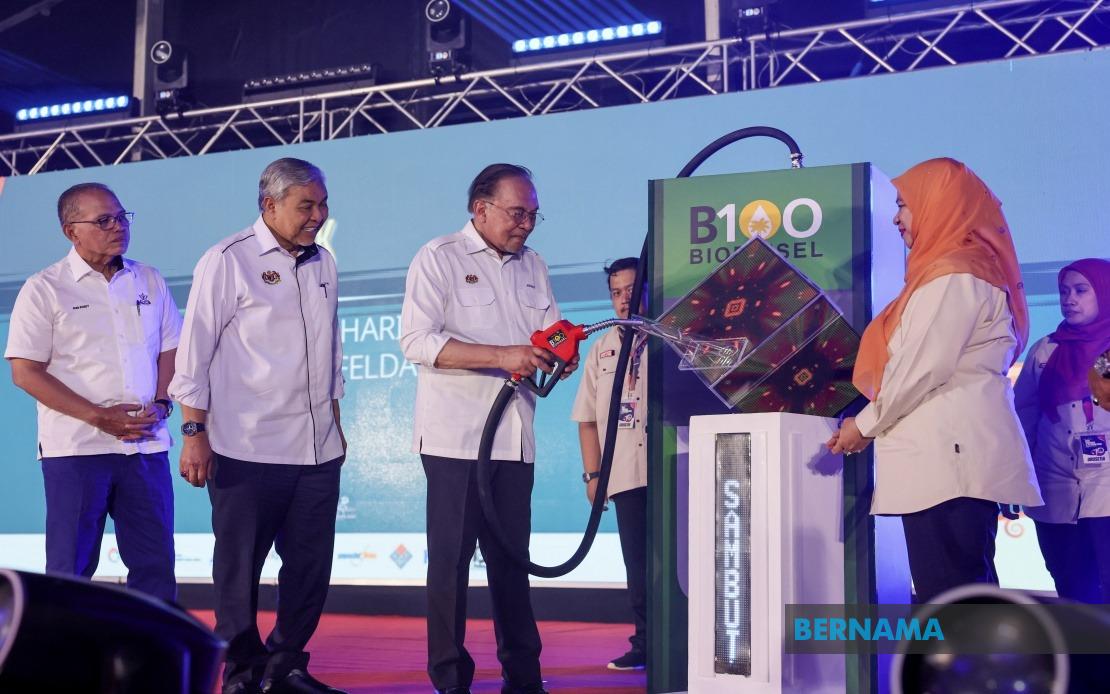
Prime Minister Datuk Seri Anwar Ibrahim has announced the government's intention to amend the Land (Group Settlement Areas) Act 1960 (Act 530) to permit Federal Land Development Authority (FELDA) settlers to construct more than one residential building on individual plots they own. The declaration was made during FELDA Settlers' Day and the organisation's 70th Anniversary celebration at Tun Abdul Razak Stadium in Bandar Pusat Jengka, signalling a significant shift in policy that addresses longstanding constraints on settlement development.
Under instructions from the Prime Minister, FELDA has been tasked with preparing legislative amendments within a two-month window, with the revised framework subsequently submitted to Cabinet consideration before eventual parliamentary introduction later in 2025. This timeline reflects the government's urgency in addressing housing flexibility issues that have accumulated across FELDA's extensive settlement network. The move acknowledges that rigid building restrictions, originally designed to maintain uniform settlement patterns and ensure efficient land use, have become outdated in the context of evolving family structures, economic pressures, and housing demand.
Currently, approximately 8,000 residential units have been constructed on individual FELDA lots and are occupied by residents, with the official occupancy date recorded as December 31, 2025. These homes represent the output of the FELDA New Generation Housing Project (PGBF), a scheme initiated in 2013 that has expanded across multiple states. Notably, the government has pledged to proceed with utility connections for these 8,000 existing dwellings even as the legal amendments remain in progress, preventing bureaucratic delay from obstructing essential infrastructure provision.
The utility rollout arrangement distributes responsibilities across multiple agencies, reflecting Malaysia's federal structure and utility governance arrangements. State governments have been designated to assume control of water supply infrastructure and connections to the 8,000 homes, acknowledging the constitutional authority of states over water services. Simultaneously, Tenaga Nasional Berhad (TNB), the national electricity utility, has received explicit direction to accelerate its electricity connection programme covering all 8,000 residential units, ensuring that homes are not left without power supply during the intervening period before Act 530 amendments are finalised.
The FELDA New Generation Housing Project itself represents a substantial undertaking spanning seven Malaysian states including Pahang, Johor, Negeri Sembilan, Kedah, Terengganu, Kelantan and Perak. The initiative encompasses 43 separate sites and comprises 8,224 total housing units, making it one of the most geographically dispersed FELDA development programmes. This distribution reflects deliberate efforts to decentralise FELDA settlement activity beyond traditionally established plantation areas, though it also creates complexity in infrastructure coordination and service delivery.
The proposed legislative amendment carries particular significance for rural housing and settlement development policy in Malaysia. Act 530, originally enacted in 1960 during a different era of rural development thinking, embedded assumptions about optimal settlement structure and land use patterns that no longer reflect contemporary needs. Many FELDA settlers have faced restrictions in expanding homes for growing families, establishing secondary rental units for income generation, or permitting their adult children to build separate residences on family plots. The amendment directly addresses these accumulated grievances.
From an economic perspective, permitting multiple dwellings per lot enhances asset utilisation for FELDA settlers whose primary residential investment is locked into land parcels under restrictive covenants. The ability to construct additional units for rental purposes could generate household income streams particularly valuable in rural areas where employment opportunities remain limited. This flexibility aligns with broader trends toward densification in suburban and peri-urban areas, where single-unit-per-lot requirements increasingly constrain housing supply and affordability.
The initiative also reflects evolving demographic realities across Malaysian FELDA settlements. Second and third-generation settler families often include adult children seeking to establish independent households without relocating entirely from ancestral lands. Permitting multiple dwellings addresses this intergenerational housing transition challenge while maintaining family connections to FELDA communities. Without such flexibility, younger family members typically face the choice of either remaining dependent within parental homes or seeking settlement elsewhere.
Implementation of the amended Act 530 will require careful regulatory framework development to maintain appropriate planning controls and infrastructure standards. State authorities will need to establish guidelines for multiple-unit development on FELDA lots, addressing density limits, building setback requirements, access roads, and utility capacity. The amendment itself provides the legislative permission but does not automatically resolve questions about optimal development densities or amenity standards for densified FELDA settlements.
For FELDA settlers in states like Pahang, where the PGBF programme has concentrated significant numbers of new residential units, utility infrastructure will face considerable stress during the implementation period. The explicit instruction to TNB to accelerate electricity connections acknowledges this pressure, though water supply coordination with state authorities may present greater logistical challenges given the decentralised nature of water management. Success in delivering utilities to 8,000 homes within reasonable timeframes will substantially influence public perception of the broader FELDA modernisation agenda.
The announcement positions FELDA modernisation as a priority within the current government's development framework. FELDA settlements collectively shelter hundreds of thousands of Malaysian households and represent significant community political constituencies. Demonstrating responsiveness to settler grievances through legislative flexibility enhances government credibility within these constituencies while addressing legitimate housing flexibility concerns. The two-month timeline for amendment preparation also signals political commitment to meaningful reform rather than indefinite consultation.
Regional implications extend beyond FELDA specifically, as other land development schemes across Malaysia observe how Act 530 amendments proceed. If successful, the model could inform modifications to similar restrictive land tenure arrangements affecting other settlement patterns throughout the country. The approach demonstrates that older legislative frameworks governing land use can be adapted to contemporary needs without wholesale dissolution of community planning principles, offering a template for balancing flexibility with order in long-established residential areas.
The initiative ultimately represents pragmatic recognition that rigid regulatory frameworks become counterproductive when circumstances change substantially. FELDA settlers who have invested decades in community development and land improvements justifiably expect reasonable flexibility in utilising their assets. By enabling multiple dwellings on individual lots through legislative amendment, the government addresses accumulated policy rigidity while maintaining the institutional framework that has structured FELDA settlement development for over six decades.

