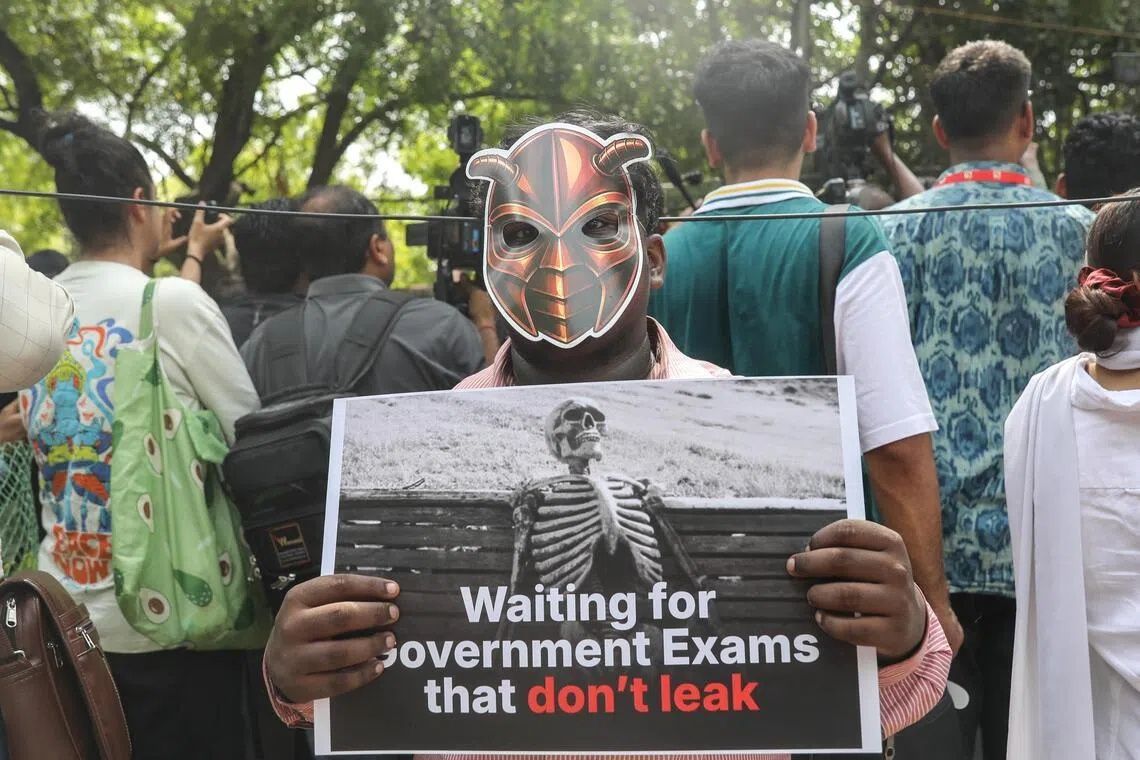
India's education system faces a critical moment as 2.2 million aspiring medical students prepare to sit a retaken entrance examination under unprecedented security measures on June 21, following the cancellation of the previous test amid a major paper leak scandal. The incident has exposed serious vulnerabilities in one of Asia's most competitive examination systems and triggered broader concerns about the integrity of India's educational testing infrastructure.
The original National Eligibility cum Entrance Test (NEET) examination, which serves as the sole gateway for admission to India's medical colleges, was scrapped after confidential question papers circulated among candidates before the scheduled testing date. This breach not only invalidated an examination taken by millions of hopeful students but also unleashed a wave of public anger that has engulfed the education ministry. The scale of disruption is enormous: with only marginally more than 100,000 undergraduate medical seats available across the country, the competition is brutally intense, making this examination the defining moment for aspiring doctors vying for prestigious positions.
The fallout from the initial failure has reverberated far beyond examination centres. Student protests have intensified, with demonstrators demanding the resignation of Education Minister Dharmendra Pradhan, and Indian media outlets have reported distressing cases of teenagers taking their own lives in response to the examination fiasco. The crisis has struck a nerve with India's youth and their families, who perceive the examination system as fundamentally compromised and see it as symptomatic of deeper institutional rot within the country's educational administration.
Compounding the medical examination debacle, a separate marking controversy involving the testing of nearly two million high school students has further eroded public confidence. Reports have emerged of incorrect grade assignments and results being allocated to wrong candidates in the online marking system used for these crucial school examinations. This parallel failure has created a perfect storm of distrust, suggesting that systemic problems extend across multiple testing systems rather than being isolated incidents. Together, these twin crises have sparked an unprecedented level of social media activism, including the emergence of a satirical movement called the "Cockroach People's Party" that has garnered millions of online followers since May and amplified calls for ministerial accountability.
To prevent recurrence of such breaches, Indian authorities have assembled an extraordinary security apparatus for Sunday's examination. Officials have deployed more than 200,000 personnel across examination centres nationwide, including police and security personnel, creating a visible show of governmental control intended to reassure candidates and parents. The scale of this deployment underscores the seriousness with which authorities regard the restoration of examination integrity and the immense challenge of securing an event involving millions of test-takers across the vast Indian subcontinent.
The National Testing Agency (NTA), the body responsible for administering NEET, has announced a comprehensive security framework featuring advanced technological safeguards. Biometric authentication systems will verify the identity of each candidate, artificial intelligence-enabled camera surveillance will monitor examination halls continuously, and GPS tracking will monitor the movement of question papers from secure facilities to test centres. These layered security measures represent a significant technological escalation designed to detect and prevent both the internal leaks that characterised the previous failure and external attempts at fraud during the examination process itself.
Beyond technological measures, authorities have taken the drastic step of restricting access to the Telegram messaging application, which the NTA explicitly cited as a tool exploited by "cheating rackets to defraud candidates" through the rapid dissemination of leaked questions. However, Telegram's chief executive Pavel Durov challenged the effectiveness of this approach, asserting that restricting a single platform merely displaces the problem to alternative communication channels and that the fundamental issue lies with insider sources who actually leak examination materials in the first place. His observation highlights a critical blind spot in the government's response: technological and procedural measures, while necessary, cannot address the core vulnerability of having individuals within the examination system willing to breach confidentiality for financial gain.
The National Testing Agency has charged that messaging applications enabled organised criminal networks to orchestrate sophisticated examination fraud schemes, drawing a direct line between communication technology and the leakage infrastructure. India's Central Bureau of Investigation has made arrests related to the paper leak, including apprehending someone identified as a chemistry lecturer who allegedly orchestrated the scheme. These arrests suggest involvement by educated professionals who exploit their proximity to educational systems, indicating that the problem extends beyond simple security lapses to encompass active corruption within the examination apparatus itself.
The broader context for these failures lies in the extraordinary pressures created by India's competitive examination culture. The National Eligibility cum Entrance Test is administered annually to millions of candidates, all competing for a severely limited pool of seats, which has spawned an enormous coaching industry worth billions of rupees. This lucrative market creates substantial financial incentives for cheating syndicates, making examination security not merely a procedural matter but an ongoing battle between determined criminal networks and government authorities. The intensity of competition transforms examination fraud from an academic issue into a commercial enterprise with genuine criminal dimensions.
For Malaysian readers and Southeast Asian observers, India's examination crisis offers instructive lessons about the vulnerabilities inherent in large-scale standardised testing systems, particularly in developing economies where technological security must contend with motivated insider actors and sophisticated criminal enterprises. The incident demonstrates that scale and complexity, while sometimes assumed to strengthen systems through redundancy and procedural rigour, can paradoxically create new vulnerabilities and make oversight more difficult. As Malaysia and other regional nations continue developing their own educational testing infrastructure and considering technological innovations for examinations, India's experience serves as a cautionary tale about the importance of comprehensive security architecture that addresses both technological and human factors in examination administration.
%22%2F%3E%3C%2Fpattern%3E%3C%2Fdefs%3E%3Crect%20width%3D%22100%25%22%20height%3D%22100%25%22%20fill%3D%22url(%23ph40ds4g)%22%2F%3E%3Crect%20width%3D%22100%25%22%20height%3D%22100%25%22%20fill%3D%22url(%23ph40ds4p)%22%2F%3E%3Ctext%20x%3D%2250%25%22%20y%3D%2250%25%22%20text-anchor%3D%22middle%22%20dominant-baseline%3D%22central%22%20fill%3D%22rgba(255%2C255%2C255%2C0.95)%22%20font-family%3D%22Georgia%2C%20'Times%20New%20Roman'%2C%20serif%22%20font-weight%3D%22700%22%20font-size%3D%22151%22%20letter-spacing%3D%22-0.02em%22%3EFollowing%3C%2Ftext%3E%3C%2Fsvg%3E)