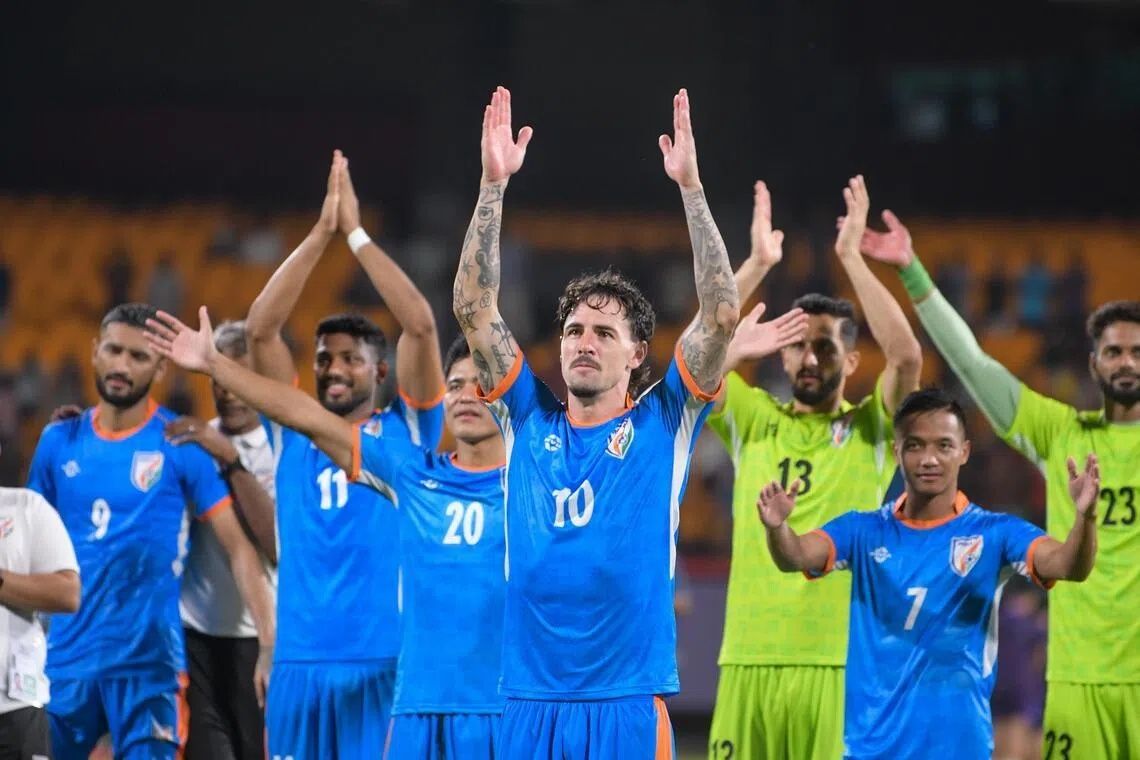
The sight of Indian-origin athletes competing for other nations has long frustrated sports fans across India, particularly when the country's own football team fails to qualify for major tournaments. During the 2026 FIFA World Cup, social media accounts have documented cases like Tahsin Mohammed Jamshid, a Malayalee forward playing for Qatar, and Diogo Costa, a Portuguese goalkeeper with Goan heritage, competing under foreign flags. With India's men's football team ranked 139th globally and absent from the World Cup, such moments sting particularly sharply. Now, New Delhi appears ready to address this frustration through an unconventional mechanism: a Sports Passport framework that would fundamentally reshape how the country engages sporting talent from its vast diaspora.
The Indian government's Ministry of Youth Affairs and Sports has submitted a detailed proposal to the Prime Minister's Office outlining a Sports Passport system designed to permit Overseas Citizens of India and Persons of Indian Origin to represent India in international competitions without requiring them to abandon their current citizenship. This framework would operate as an exception to India's strict prohibition on dual citizenship, a rule shared by fellow Asian nations Singapore, Malaysia and Japan. According to sports news outlet Khel Now, officials close to the initiative suggest the government may require six to eight months to reach a decision on implementation, indicating serious consideration at the highest levels of Indian administration.
The proposal represents a dramatic reversal of policy established in 2008, when the sports ministry mandated that only holders of Indian passports could represent the country. That earlier restriction was implemented ostensibly to protect opportunities for domestic players who faced competition from better-resourced overseas counterparts. Yet the intervening years have witnessed a seismic shift in global sporting practice. Nearly a quarter of all players at the 2026 FIFA World Cup now represent nations different from their birthplaces, a stark increase from the ten percent figure common in the early 2000s. Sports lawyer Nandan Kamath, managing trustee of the GoSports Foundation, emphasises that this gap between India's citizenship laws and international sporting norms has become untenable. FIFA regulations explicitly permit footballers to represent any nation with which they can demonstrate ancestral connection or residential history, creating an inherent conflict with India's rigid citizenship framework.
The historical precedent for foreign-born athletes representing India exists but remains limited. Several decades ago, overseas Indians competed for India in swimming, rugby and tennis before the 2008 restrictions took effect. More recently, Australian forward Ryan Williams provided a case study in both possibility and bureaucratic friction. Williams possessed eligibility through his Indian-born Anglo-Indian mother, who herself played football for Australia. After over a year of administrative procedures, Williams acquired an Indian passport and joined the Bengaluru franchise in the Indian Super League. His debut for India proved memorable: within four minutes of representing the national team in AFC Asian Cup qualifiers against Hong Kong, he scored the fastest goal ever recorded by an Indian debutant. Yet Kunaal Majgaonkar, former head of content and media at JSW Sports, notes that such acquisitions remain prohibitively arduous, requiring players to surrender their original citizenship entirely—a sacrifice many would-be recruits refuse to contemplate.
The timing of this proposal reflects broader strategic calculations within Indian sports administration. Officials involved in the consultations have indicated that the Sports Passport framework forms part of India's preparation for a potential 2036 Olympic Games bid, while simultaneously addressing the country's marginal performance in non-cricket sports. India's massive population of 1.4 billion produces consistently disappointing international results outside cricket, hampered by infrastructure deficiencies, bureaucratic inefficiency and the overwhelming prioritisation of the subcontinent's obsession with the bat and ball. The sports passport would theoretically unlock access to world-class talent from the 37 million-strong Indian diaspora—the largest immigrant population globally—transforming squads in football, basketball and tennis where India has chronically underperformed.
The mechanism itself has precedent in international sports. Qatar operates a Mission Passport system, which enabled Tahsin Mohammed Jamshid—a nineteen-year-old Keralite born in Doha—to represent Qatar at the World Cup. His father had worked in Doha as an accountant, establishing the residency basis necessary for Mission Passport eligibility. This document grants no citizenship rights, permanent residency, social benefits or financial privileges beyond sporting participation, functioning purely as a vehicle for athletic representation. Spain, Turkey and Bahrain employ comparable systems, using such documents strategically to strengthen national squads without the complications of full citizenship transfers.
Critical voices, however, warn that the proposal represents a shortcut to endemic structural problems rather than a genuine solution. Arata Izumi, a midfielder who became the first Japanese citizen to surrender his passport for Indian nationality in 2012, articulates the scepticism of those who have lived the alternative path. He contends that importing parachuted-in foreign players undermines the authenticity of national representation and demoralises domestic competitors who have invested their careers competing under significantly harsher conditions. This tension between immediate sporting performance and the long-term health of grassroots development remains unresolved in the government's proposal.
The framework would disproportionately benefit team sports, particularly football, where professional infrastructure and international competition create genuine pathways for recruitment and integration. Individual sports with more flexible eligibility criteria would benefit less dramatically. The Indian football context proves especially significant: the men's team failed to qualify not only for the 2026 FIFA World Cup but also for the AFC Asian Cup 2027, a continental tournament where regional nations expect consistent participation. Such repeated failures have prompted soul-searching within Indian football administration regarding whether traditional domestic talent development produces adequate quality. A sports passport offering access to diaspora footballers trained in professionally advanced leagues might indeed prove transformational, though whether such transformation would extend to systemic improvements in grassroots coaching and infrastructure remains doubtful.
The proposal's path forward remains uncertain, with the All India Football Federation and sports ministry declining to provide substantive comment to reporters. Implementation, if approved, would require coordination across multiple government agencies, sporting federations and international bodies to establish eligibility criteria, anti-fraud mechanisms and compliance procedures. The government would need to define precisely which categories of overseas Indians qualify—OCI holders alone, or also Persons of Indian Origin with more attenuated connections—and establish standards for demonstrating sporting capability. These procedural complexities, combined with potential diplomatic sensitivities around accepting athletes trained abroad, could stretch implementation well beyond the speculative six to eight month timeline mentioned in initial reports.
For Malaysian and broader Southeast Asian sporting interests, India's potential sports passport has ripple effects worth monitoring. The framework could trigger similar considerations within other regional nations wrestling with diaspora engagement and sporting performance, particularly in football where professional opportunities have concentrated in wealthy Gulf states and wealthy Asian nations. Malaysia, Singapore and Thailand maintain comparable populations of overseas citizens, yet none has pioneered comparable mechanisms. Should India succeed in attracting world-class diaspora talent to strengthen its football squad, it might spur neighbouring countries to reconsider their own citizenship and sporting nationality policies, potentially reshaping competitive balances across Asian football over the coming decade.