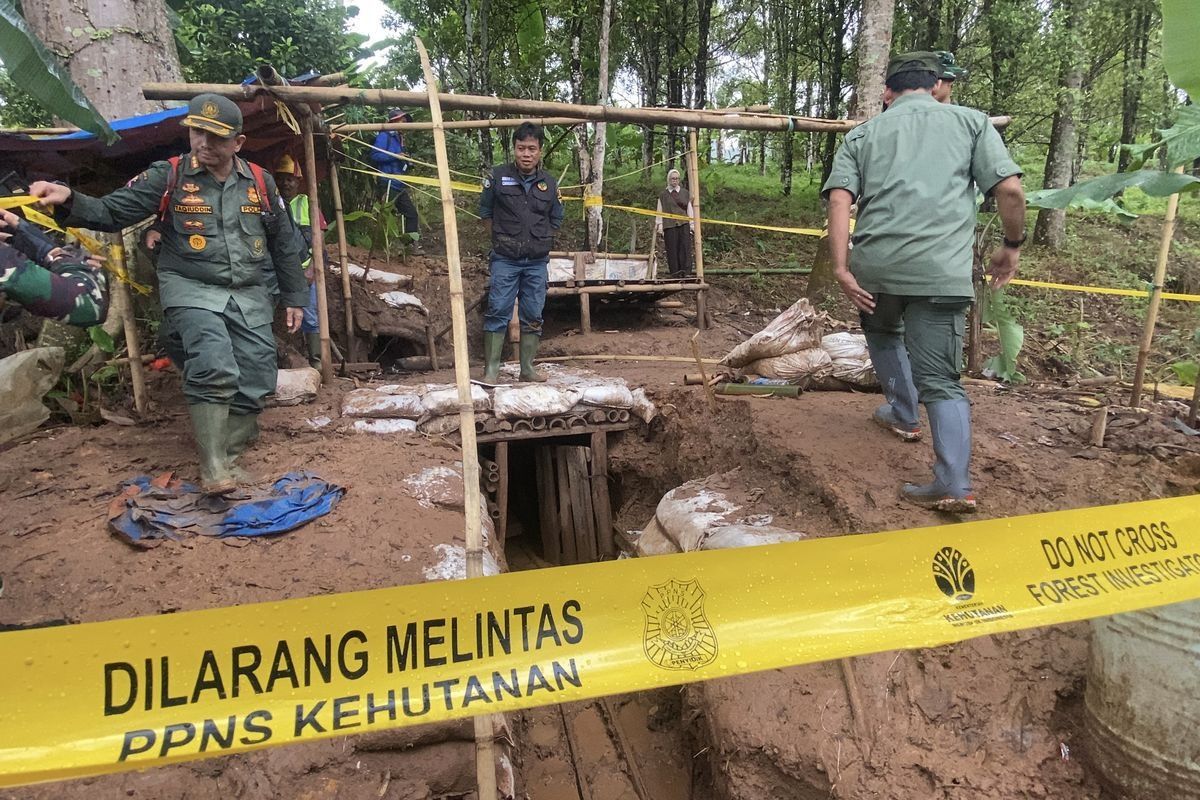
Indonesia's energy ministry announced charges against 24 foreign nationals suspected of involvement in an illegal gold mining operation centred in the Maluku region, marking a significant enforcement action against transnational mining criminal networks. The announcement, delivered by energy ministry official Jeffri Huwae on Thursday, June 25, revealed that the suspects had allegedly worked to establish physical infrastructure supporting the illicit extraction operation, constructing roads and mineral processing facilities in the Gunung Botak area where the scheme was discovered.
The scale of the operation suggests a sophisticated criminal enterprise with substantial investment in developing a functioning mining complex rather than opportunistic extraction. Building processing facilities and road networks requires coordination, capital, and a degree of permanence that points to organised intent rather than transient illegal activity. The charges filed against the suspects carry serious consequences under Indonesian law, with violators facing maximum prison sentences of five years, a penalty reflecting the state's determination to combat resource crimes that deprive the nation of legitimate mineral wealth and generate significant environmental damage.
While the energy ministry confirmed the charges, it withheld certain operational details that would normally accompany such announcements. The nationalities of the suspects and the quantity of gold allegedly extracted through the illegal operation remain undisclosed, information that would typically inform public understanding of the scale and origin of such schemes. The ministry did not provide immediate clarification when asked for additional details, suggesting either an ongoing investigation requiring discretion or procedural caution during early prosecution phases.
Investigative reporting by Indonesia's state news agency Antara indicated last month that the detainees were predominantly Chinese nationals, with 24 individuals initially held for questioning in connection with the Gunung Botak operation. These workers reportedly operated under sponsorship from local company PT Harmoni Alam Manise, indicating that the criminal scheme involved Indonesian intermediaries who facilitated or enabled foreign participation in the illegal extraction. This pattern of local-foreign collaboration in resource crimes reflects a persistent vulnerability in Indonesia's mining enforcement, where domestic partners provide legitimacy and local knowledge to foreign operators.
The current status of the suspects reveals the practical challenges Indonesia faces in prosecuting transnational crime. Of the 24 foreign nationals charged, only half remain within Indonesian jurisdiction and are detained. The remaining 12 suspects are documented as at large and outside Indonesia's borders, likely having fled the country following investigation commencement. This split emphasises how international dimension complicates enforcement and highlights the difficulty of pursuing justice when suspects possess the mobility and means to cross borders before meaningful legal action materialises.
Beyond the foreign nationals, Indonesian authorities also filed charges against two domestic nationals connected to the operation, acknowledging that the scheme required local collaboration and complicity. These local charges underscore a critical aspect of illegal mining networks: they invariably depend on Indonesian citizens—whether as workers, facilitators, local government contacts, or company representatives—to function. Prosecuting both foreign and domestic suspects reflects a more comprehensive approach to dismantling the full criminal apparatus rather than targeting only the most visible foreign actors.
This enforcement action follows a pattern of cross-border mining crimes involving foreign nationals that Indonesia has pursued increasingly over recent years. In Papua, Indonesia's easternmost region, police arrested four Chinese nationals in Senggi district during the previous year, demonstrating that illegal operations involving foreign miners recur across multiple regions. The geographic spread of such cases—from Maluku in the east to Papua—suggests either persistent enforcement gaps across Indonesia's vast archipelago or a sustained attraction for foreign criminal syndicates seeking to exploit specific mineral deposits and weaker local enforcement capacity.
The Maluku operation's focus on building processing infrastructure distinguishes it from purely extractive operations. By developing facilities to process raw ore into a more refined form, the scheme aimed to increase profit margins and potentially obscure the origin of the gold through downstream processing. This level of sophistication indicates that the foreign operators possessed or accessed technical knowledge about mineral processing, suggesting either multinational criminal networks with specialised expertise or training of local workers in extraction and refinement methods.
For Malaysia and other Southeast Asian nations, the case illustrates how illegal mining transcends borders and involves international criminal coordination. Vietnamese, Thai, and Malaysian syndicates have similarly engaged in cross-border illegal mining within Indonesia, often in partnership with local operators. The prevalence of such schemes across the region points to weak enforcement capacity relative to the profit incentives driving extraction, as well as porous borders that allow rapid movement of personnel and equipment. Indonesian authorities' willingness to publicly charge foreign suspects may also reflect diplomatic pressure and commitments to bilateral cooperation on transnational crime.
The broader context of Indonesia's mining sector—a nation with substantial gold reserves and legitimate extraction industries—makes it an attractive target for illegal operators seeking to profit from unregulated extraction and processing. The country balances legal mining development with combating organised crime, a tension evident in cases where foreign operators operate alongside legitimate domestic mining companies. As Indonesia continues enforcement campaigns, the ability to prosecute and extradite suspects from outside its borders will determine whether such actions deter future operations or merely displace criminal activity to less-monitored regions.

