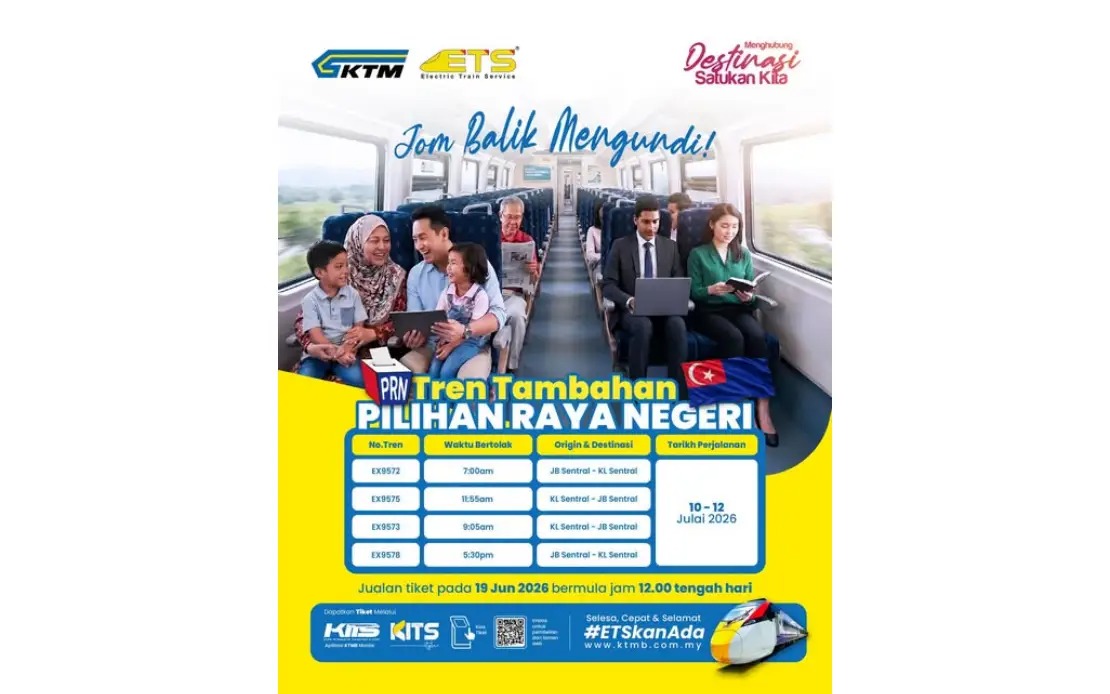
Keretapi Tanah Melayu Berhad (KTMB) has moved to ease travel logistics for the upcoming Johor state election by introducing extra train capacity on southern routes. The rail operator announced the expanded Electric Train Service (ETS) offering in recognition of the anticipated surge in passenger demand as voters journey back to their home constituencies for polling day on July 11.
Ticket bookings for the additional services opened at noon on June 19, with KTMB providing multiple channels for purchase. Passengers can secure reservations through the KTMB Mobile app, the KITS Style application, the online ticketing portal at online.ktmb.com.my, or directly at KTMB ticket kiosks located throughout the country. This multi-platform approach reflects the operator's effort to accommodate the expected volume of election-related travel.
The supplementary train services will operate across a three-day window spanning July 10 through July 12, bookending the election date itself. This timing allows voters who have relocated to other states for work or study to return home beforehand and depart afterward, accommodating the typical travel patterns associated with electoral participation. The extension through July 12 provides flexibility for those unable to vote on the official day or who wish to return on the following day.
The Election Commission announced the Johor state election following the dissolution of the State Legislative Assembly on June 1. The condensed campaign period leading to the July 11 polling date means that voter mobility becomes a crucial operational consideration for transport providers. Historical voting patterns in Malaysia consistently show significant internal migration during state and federal elections, particularly in major states like Johor where large segments of the working-age population reside outside their home districts.
Johor's status as a major employment hub and commercial centre means that many voters have relocated to Kuala Lumpur, Selangor, or other peninsular states for career opportunities. The election therefore triggers a temporary reversal of these migration patterns, with substantial numbers attempting to secure transport simultaneously. KTMB's capacity expansion directly addresses this cyclical demand surge that occurs predictably during electoral periods.
The railway operator's decision to coordinate with the electoral timeline demonstrates how Malaysia's transport infrastructure adapts to support democratic participation. Unlike neighbouring countries where such considerations might receive less formal institutional attention, KTMB's proactive approach reflects recognition that enabling voter access strengthens electoral legitimacy. The provision of additional capacity removes potential barriers that might otherwise discourage participation among voters in other states.
For passengers, the availability of multiple booking methods reduces friction in securing seats. The digital-first approach through mobile apps and online platforms aligns with contemporary consumer expectations, while maintaining traditional kiosk options ensures accessibility across demographic groups. The early opening of ticket sales at a fixed time creates fair access and prevents instances of differential access based on technological sophistication.
The Johor election carries significance beyond the state itself. As Malaysia's second-largest state by population and a crucial economic driver for the nation, the outcome influences broader political dynamics affecting federal governance. The enhanced transport provisions therefore support not merely local political participation but contribute to ensuring representative legitimacy for decisions affecting a substantial portion of the Malaysian population and economy.
Previous electoral cycles have documented instances where transport capacity constraints created bottlenecks affecting voter turnout, particularly among working-age populations without flexible employment schedules. By expanding capacity preemptively, KTMB helps mitigate such potential complications. The three-day operational window provides temporal flexibility that accommodates varying work schedules and personal circumstances among the broader voter population.
The announcement also reflects coordination between public sector agencies in supporting electoral processes. KTMB's commercial interests align with civic infrastructure requirements, creating natural synergy where profit-seeking behaviour and democratic participation support objectives coincide. This coordination, while unremarkable, remains essential infrastructure for maintaining functional electoral systems in geographically dispersed nations.
For Malaysian readers, particularly those working outside their home states, the availability of additional train services directly addresses the practical challenges of exercising franchise rights. The announcement signals that transport infrastructure planning now explicitly accounts for electoral demand patterns. Such measures contribute incrementally to reducing friction in democratic participation and deserve recognition as functional elements of electoral administration that operate beyond the purely political realm.