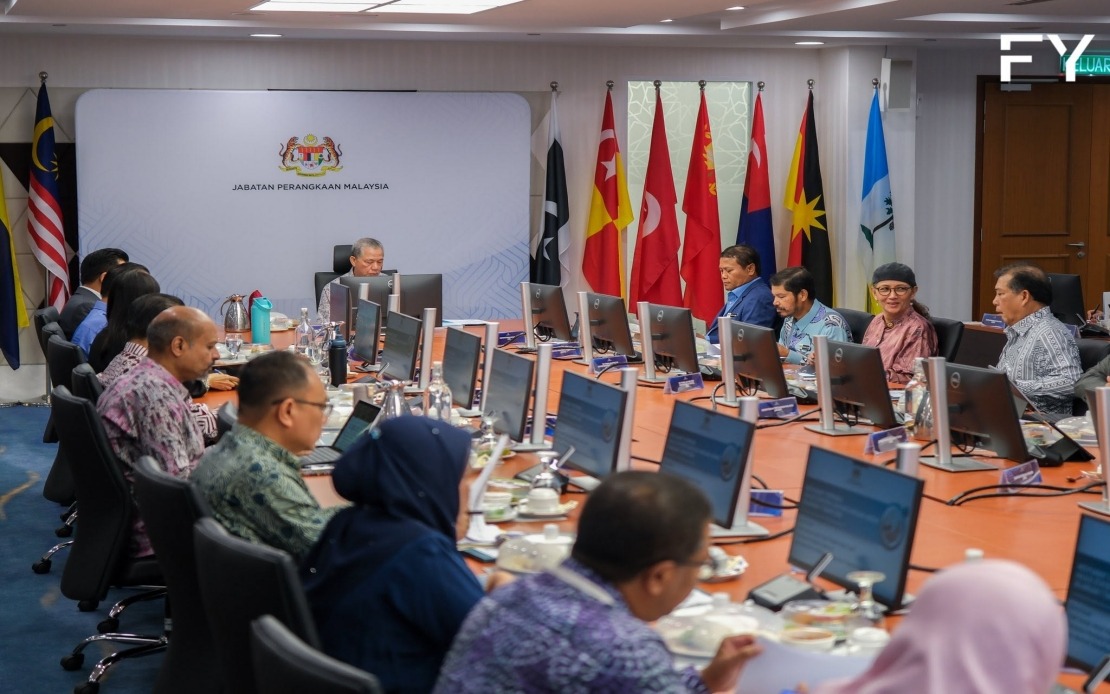
Malaysia's government is positioning itself for the next phase of economic planning by treating data and artificial intelligence as strategic assets rather than administrative tools. Deputy Prime Minister Datuk Seri Fadillah Yusof articulated this vision while chairing the National Statistics and Data Council's high-level meeting in Kuala Lumpur, signalling a comprehensive shift toward evidence-based governance across the 13th Malaysia Plan period spanning 2026 to 2030.
The emphasis on data-driven policymaking reflects a deepening recognition within government circles that traditional approaches to development planning are increasingly inadequate for navigating complex, interconnected global challenges. Fadillah identified economic uncertainty, geopolitical volatility, digital transformation acceleration, climate change imperatives and rapid technological advancement—particularly in artificial intelligence—as compelling reasons to overhaul how Malaysia formulates and implements national strategy. This positioning effectively transforms the conversation around government statistics from a technical administrative function to a core element of national competitiveness and resilience.
Malaysia's recent economic performance provides tangible evidence supporting this strategic direction. First-quarter GDP growth of 5.4 per cent in 2026 demonstrates that policies constructed on solid data foundations can deliver measurable results. The Deputy Prime Minister specifically attributed this performance to development initiatives forged through data-informed decision-making, creating a compelling narrative that connects statistical rigour to prosperity. For Malaysian businesses and investors, this signals that future policy frameworks will likely be increasingly grounded in quantitative evidence rather than political preference or historical precedent.
The Strengthening of the National Statistical System initiative represents an institutional undertaking of considerable scope. Rather than confining data collection and analysis to government statisticians, the framework envisions strategic collaboration spanning ministries, federal agencies, state governments, private-sector organisations, universities and research institutions. This distributed approach reflects recognition that data relevant to national development exists across multiple domains and institutional boundaries. The integration of administrative data from various government sources, when executed properly, could eliminate duplicative data collection and accelerate governmental responsiveness to emerging trends.
Fadillah stressed the critical importance of developing sophisticated data infrastructure capable of linking information from disparate sources whilst maintaining security standards and ethical safeguards. In Southeast Asia's increasingly competitive economic environment, the ability to rapidly synthesise diverse datasets and extract actionable intelligence represents a genuine competitive advantage. Malaysia's ambition to build such capabilities positions it against regional peers similarly pursuing digital transformation, with implications for talent recruitment, technology investment and regional data standards alignment.
Artificial intelligence emerges as a pivotal component of this broader data strategy. Rather than treating AI as an isolated technology sector, the government is framing it as an enabling tool for enhanced productivity, innovation and competitive positioning across the economy. Big data analytics capabilities powered by AI systems could theoretically allow policymakers to identify economic opportunities, anticipate infrastructure needs and detect emerging social challenges with unprecedented precision. However, actualising this potential requires sustained investment in technical talent, governance frameworks and institutional change—all non-trivial undertakings for any government.
Specific policy domains receiving particular attention include energy transition, climate change adaptation, water sector modernisation and sustainable development initiatives. These sectors share a common characteristic: they demand comprehensive, real-time data to inform complex resource allocation decisions with long-term consequences. The water sector exemplifies this challenge acutely for Malaysia; effective water resource management requires integrating hydrological data, demographic projections, industrial demand forecasts and climate patterns into coherent planning frameworks. Similarly, energy transition success depends on sophisticated data ecosystems linking renewable generation capacity, grid stability requirements, consumption patterns and infrastructure investment timelines.
The meeting's substantive agenda reveals the practical architecture supporting this data-centred governance vision. Standardising official statistical conventions across government agencies addresses a perennial challenge in developing countries, where inconsistent definitions and collection methodologies undermine data comparability. Strengthening data governance—encompassing access protocols, quality assurance and accountability mechanisms—represents essential groundwork for the AI-powered analytics systems Fadillah envisions. Integration of administrative data from tax authorities, employment agencies, social service providers and other government bodies could unlock insights currently scattered across bureaucratic silos.
Youth development and national road asset management figure prominently in the council's strategic initiatives, suggesting attention to both human capital formation and physical infrastructure modernisation. A dedicated science, technology and innovation talent database could facilitate better workforce planning whilst identifying gaps in Malaysia's technical capabilities. Data systems tracking road assets across federal and state networks could optimise maintenance scheduling and capital expenditure whilst extending infrastructure lifespan—practical applications demonstrating how data sophistication translates into tangible public value.
The structural challenge confronting Malaysia centres on translating these aspirational frameworks into institutional reality. Building integrated, high-integrity national data ecosystems requires solving complex problems around data standardisation, interagency coordination, cybersecurity and ethical governance. Several Southeast Asian nations have launched comparable initiatives; Thailand's National Big Data Strategy and Indonesia's data centre ambitions represent regional reference points. Malaysian success requires sustained political commitment transcending electoral cycles, sufficient budgetary allocation to technology and talent acquisition, and cultural shifts within government encouraging experimentation with evidence-based policymaking.
For Malaysian corporations and international investors, these developments signal a future where government procurement, regulatory decisions and infrastructure investment will increasingly reflect data-driven assessments rather than political patronage. Organisations capable of providing data services, AI solutions and technical expertise to government agencies face expanding opportunities. Conversely, policy uncertainty diminishes when decisions rest on transparent, shared data foundations rather than opaque political calculations—potentially enhancing business confidence and long-term investment planning horizons.
The success of the 13th Malaysia Plan ultimately depends on whether policymakers can translate abundant data into superior decisions. Statistical sophistication without institutional commitment to evidence-based governance produces merely expensive data warehouses. Conversely, genuine transformation in how Malaysia formulates policy—with data and AI becoming authentic decision-making foundations rather than retrospective justifications—could meaningfully improve development outcomes. The Deputy Prime Minister's emphasis suggests at least rhetorical commitment to this more ambitious vision, though execution challenges remain formidable across a government system accustomed to traditional power dynamics and political compromise.