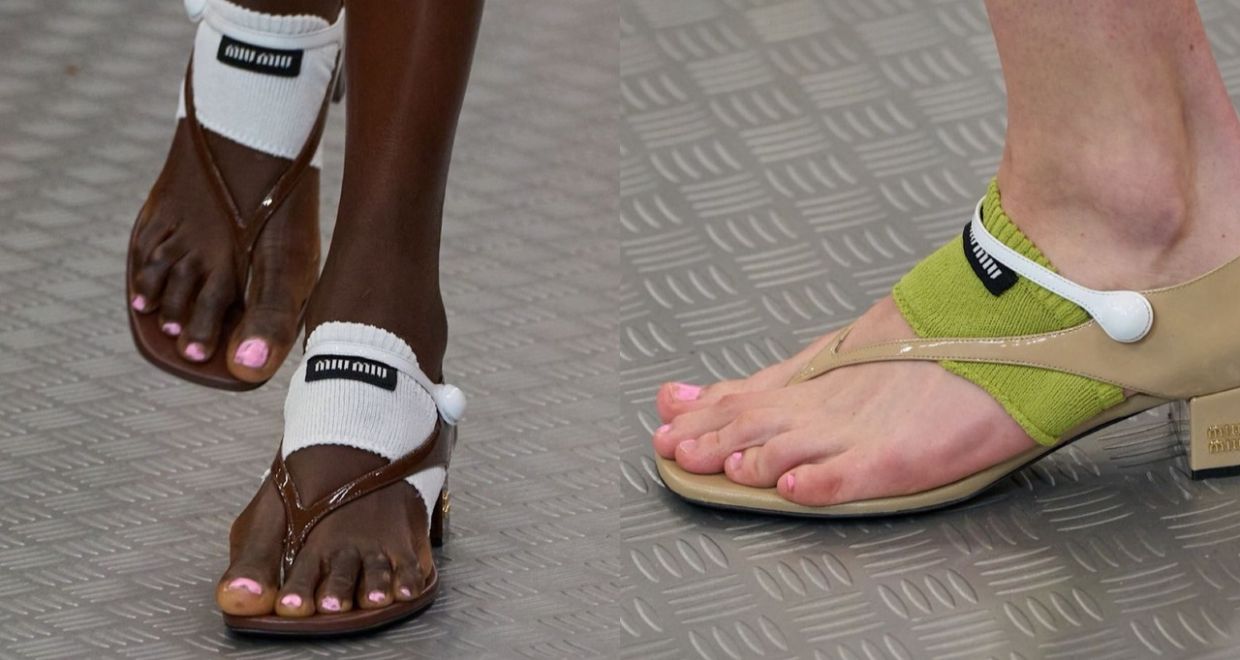
Fashion retailers across Asia are promoting an unconventional solution to the perpetual summer dilemma: open-toe socks. These cropped hosiery pieces, which extend across the foot's upper portion while leaving toes exposed, are gaining traction as a styling solution for consumers seeking a middle ground between entirely bare feet and traditional full-coverage socks. Retailers report that open-toe socks sit alongside related trends like flip-flop socks and sheer leg warmers as key items this season, with early heat waves driving consumer interest in lighter footwear options overall.
The phenomenon gained particular momentum in South Korea, where unseasonably warm weather accelerated demand for summer footwear categories. Data from major fashion platforms reveals the trend's growing commercial significance. Online fashion retailer W Concept recorded an 80 percent sales increase for summer shoes including mules, slides, and flip-flops between May 31 and June 7 compared to the previous year. More strikingly, style commerce platform Ably reported that transaction values for socks designed to be worn with flip-flops surged 1,664 percent over a month-long period from mid-May through mid-June, while search interest climbed 3,227 percent during the same timeframe.
The trend's origin story traces to high fashion. Luxury label Miu Miu introduced an unconventional sock design in its 2025 Spring/Summer collection, presenting hosiery that wrapped only around the arch rather than covering the entire foot. This designer interpretation provided the aesthetic foundation that later inspired broader adoption among mainstream consumers. Celebrity endorsement accelerated the trend's visibility when South Korean actor Cha Jung-won shared a coordinated look pairing sky-blue flip-flops with beige knit leg warmers on social media, introducing the combination to a wider audience and lending credibility to what might otherwise seem an impractical styling choice.
Understanding the distinction between open-toe socks and traditional winter hosiery proves essential to grasping the trend's appeal. Contemporary summer versions deliberately diverge from their cold-weather predecessors in both material composition and functional purpose. Manufacturers utilise sheer, mesh, and loosely knitted fabrics that prioritise breathability and aesthetic contribution over thermal insulation. Rather than serving a purely practical warming function, these socks operate as visible accessories that introduce colour contrast, textural interest, and layered depth to otherwise minimal flip-flop-and-bare-foot combinations.
Retailers emphasise the psychological and practical benefits driving adoption. Representatives from 29CM, a major fashion commerce platform, suggest that open-toe socks possess an acquired appeal that strengthens with familiarity. The retailer positions the trend as a "summer cheat code" for transforming predictable footwear arrangements—whether flip-flops, sandals, or ballerina flats—into more visually interesting outfits when completely bare feet appear too minimal. The positioning acknowledges a specific styling tension many consumers experience: the desire to appear intentional and fashion-forward while maintaining summer comfort and functionality.
Beyond aesthetics, pragmatic advantages contribute to the trend's expansion. Because open-toe socks cover the foot's upper surface, they substantially reduce friction and chafing points caused by flip-flop straps against bare skin. This friction reduction proves particularly valuable during the monsoon season prevalent throughout Southeast Asia, when consumers face challenging choices between comfort and footwear necessity. During wet conditions, open-toe socks can be paired with rain boots to provide a protective barrier that prevents skin irritation while maintaining breathability superior to traditional full socks. This dual functionality—addressing both style and comfort across diverse climate conditions—makes the category especially relevant for Malaysian consumers navigating tropical and seasonal rainfall patterns.
For consumers considering their first open-toe sock purchase, style experts recommend beginning with neutral foundation shades. Grey, black, and white options integrate seamlessly into existing wardrobes and minimise visual risk for fashion-cautious shoppers. Grey socks paired with either black flip-flops or ballerina flats coordinate effectively with standard summer staples including denim, Bermuda shorts, and satin skirts. Those willing to embrace bolder styling choices can experiment with vivid colour palettes featuring yellow, pink, or sky blue. Deliberately mismatching sock and shoe colours—selecting contrasting hues rather than tonal coordination—reportedly enhances the overall effect and signals intentional fashion thinking rather than accidental miscoordination.
Successful styling employing open-toe socks requires restraint in the remainder of the ensemble. Because the socks and footwear already command visual attention through colour and texture, fashion commentators suggest balancing these focal points with simplified upper-body and lower-body components. A straightforward t-shirt paired with shorts, or a simple shirt with a skirt, provides adequate visual weight without competing for attention. Deliberately chosen patterns—particularly dots or florals—pair especially well with this trend, as they introduce additional visual interest without contradicting the accessory-forward approach central to the aesthetic.
The trend reflects broader shifts in contemporary fashion philosophy regarding seasonality and functionality. Fashion editor Je Hye-yoon characterises the moment as one in which socks transition from concealed essentials to intentional style statements. Rather than hiding socks beneath closed shoes as traditional practice dictates, this approach celebrates visible hosiery as an expressive design element. The invitation to "bare the toes, leave them open or tuck them between flip-flop straps" captures the trend's flexibility, acknowledging that consumers can adapt the concept to personal preference and comfort levels.
For Southeast Asian fashion consumers, open-toe socks offer particular relevance given the region's perpetual summer climate. Unlike seasonal trends that emerge and fade with temperature shifts, this development addresses a consistent styling challenge: achieving visual interest and fashion intentionality within summer's inherent minimalism. The trend demonstrates how fashion cycles increasingly draw from both luxury heritage and practical necessity, creating hybrid solutions that satisfy aesthetic desires while acknowledging regional climate realities. As retailers across Asia expand their open-toe sock offerings, the category appears positioned for sustained growth beyond initial novelty, establishing itself as a legitimate summer staple rather than a fleeting fashion curiosity.