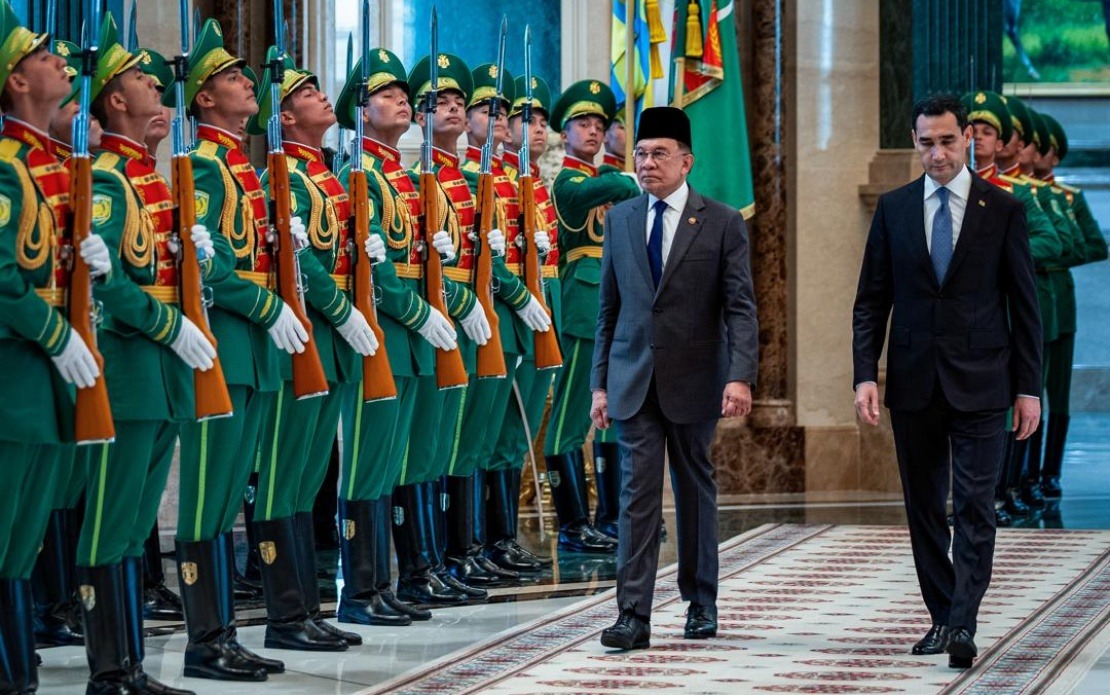
Prime Minister Datuk Seri Anwar Ibrahim was formally received at the Turkmenistan Presidential Palace in Ashgabat on Wednesday, marking a significant diplomatic milestone as his first official visit to the Central Asian country since assuming Malaysia's top office. The ceremony underscored the importance both governments place on developing closer ties across the geographic divide separating Southeast Asia and the oil-rich former Soviet republic. Anwar's two-day visit, which commenced on June 18, represents an extension of Malaysia's broader engagement strategy with Central Asian nations—a region long overlooked in Malaysian foreign policy but increasingly recognised for its strategic and economic potential.
The welcoming formalities reflected standard diplomatic protocol reserved for high-level state visits. President Serdar Berdimuhamedov greeted the Malaysian leader upon his arrival at the palace, with both national anthems performed as military honours were presented. This ceremonial reception signalled Turkmenistan's recognition of Malaysia's status as a significant Southeast Asian power and suggested receptiveness to strengthening bilateral relations across multiple sectors. The formal proceedings, conducted at the presidential residence rather than a secondary venue, indicated priority treatment and set a positive tone for substantive discussions between the delegations.
Following the initial ceremony, Anwar was introduced to Turkmenistan's Cabinet ministers and senior government officials, a courtesy that facilitates networking and signals intent to engage across multiple government levels rather than limiting engagement to presidential circles alone. The Malaysian delegation, in turn, was presented to President Berdimuhamedov, allowing the Turkmen leader to establish rapport with other senior Malaysian officials who would participate in broader discussions. This format proved instrumental in demonstrating Malaysia's commitment to a multi-faceted partnership extending beyond ceremonial gestures to encompass substantive governmental cooperation.
The diplomatic agenda proceeded with a private four-way discussion between Anwar and Berdimuhamedov, during which the leaders likely addressed issues of mutual strategic concern without the broader delegation present. These intimate discussions often prove most consequential, enabling frank exchanges on sensitive matters or personal viewpoints that require confidentiality. Following this closed session, both delegations reconvened for formal bilateral meetings to explore avenues for enhanced cooperation. The two-part meeting structure—combining exclusive and expanded formats—represents standard practice among state leaders but suggests both governments prepared substantial ground to cover during the visit.
The bilateral discussions focused on matters identified as mutually beneficial, though specific details were not disclosed in the initial readout. For Malaysia, engagement with Turkmenistan offers potential benefits including expanded trade relationships, energy security considerations, and diplomatic diversification within Central Asia. Turkmenistan, as a significant natural gas producer holding the world's fourth-largest reserves, represents a potential partner for Malaysia's evolving energy requirements. Beyond energy, the nations might explore cultural exchanges, educational partnerships, and technological cooperation—areas where Malaysian institutions and enterprises have demonstrated competitive advantages.
Anwar's visit to Turkmenistan carries broader significance for Malaysia's positioning within international affairs. Since assuming office in November 2022, the Prime Minister has prioritised international engagement, particularly with nations beyond Southeast Asia's immediate vicinity. Central Asian states offer Malaysia opportunities to diversify its diplomatic footprint and reduce perceived over-reliance on traditional partners. Turkmenistan's location along historic Silk Road trade corridors and its membership in regional organisations provide potential platforms for Malaysian participation in Central Asian economic and political developments.
The timing of this inaugural official visit reflects Malaysia's maturation as a regional power seeking engagement across diverse international contexts. Anwar's administration has signalled commitment to strengthening ties with nations sharing Malaysia's developmental aspirations and moderate values. Turkmenistan, despite its geopolitical complexities, presents an opportunity for Malaysia to expand its influence in a strategically important region where Southeast Asian presence remains limited. The visit demonstrates that Malaysian foreign policy extends beyond ASEAN and traditional Asia-Pacific partners to encompass emerging engagement frontiers.
For Turkmenistan, welcoming Malaysia's Prime Minister at the presidential palace reflects interest in developing relationships with important Southeast Asian economies. Turkmenistan has pursued diversified international engagement, seeking to reduce reliance on traditional regional powers while building partnerships with non-regional actors. Malaysia's status as an established Southeast Asian economy and Islamic-majority nation offering a moderate governance model aligns with Turkmenistan's interest in building broad-based international relationships. The official reception accorded to Anwar suggests Turkmenistan views Malaysia as a valuable partner worthy of sustained diplomatic engagement.
The visit also carries implications for Malaysia's broader Central Asian strategy. As China and Russia exercise considerable influence in Central Asia, Malaysia's diplomatic outreach represents an effort to establish independent relationships not mediated through larger powers. Turkmenistan, maintaining a policy of permanent neutrality, shares Malaysia's preference for non-aligned positioning and equidistant relationships with major powers. This commonality of approach provides foundation for partnerships transcending transactional interests and reflecting shared diplomatic philosophies.
Future cooperation between Malaysia and Turkmenistan will likely develop across multiple channels established during this visit. Trade and investment frameworks may be formalised, potentially opening opportunities for Malaysian businesses in Turkmenistan's energy and construction sectors while attracting Turkmen investment in Malaysia's financial and technology industries. Educational exchange programmes could be expanded, enabling Malaysian and Turkmen students to benefit from each other's academic institutions. Diplomatic representation may be strengthened, with possibilities for establishing permanent missions in capital cities if bilateral relations continue developing positively.
The success of Anwar's inaugural visit will be measured not merely by the ceremony and formalities but by concrete outcomes materialising in subsequent months. Bilateral agreements signed during the visit, whether addressing trade, investment, or cultural cooperation, will demonstrate the substantive value both governments derived from the engagement. Subsequent high-level visits and increased people-to-people exchanges will indicate whether this diplomatic overture represents a sustained strategic commitment or remains a singular diplomatic gesture.
%22%2F%3E%3C%2Fpattern%3E%3C%2Fdefs%3E%3Crect%20width%3D%22100%25%22%20height%3D%22100%25%22%20fill%3D%22url(%23ph4hbbfg)%22%2F%3E%3Crect%20width%3D%22100%25%22%20height%3D%22100%25%22%20fill%3D%22url(%23ph4hbbfp)%22%2F%3E%3Ctext%20x%3D%2250%25%22%20y%3D%2250%25%22%20text-anchor%3D%22middle%22%20dominant-baseline%3D%22central%22%20fill%3D%22rgba(255%2C255%2C255%2C0.95)%22%20font-family%3D%22Georgia%2C%20'Times%20New%20Roman'%2C%20serif%22%20font-weight%3D%22700%22%20font-size%3D%22320%22%20letter-spacing%3D%22-0.02em%22%3EUS%3C%2Ftext%3E%3C%2Fsvg%3E)
%22%2F%3E%3C%2Fpattern%3E%3C%2Fdefs%3E%3Crect%20width%3D%22100%25%22%20height%3D%22100%25%22%20fill%3D%22url(%23ph3e48rg)%22%2F%3E%3Crect%20width%3D%22100%25%22%20height%3D%22100%25%22%20fill%3D%22url(%23ph3e48rp)%22%2F%3E%3Ctext%20x%3D%2250%25%22%20y%3D%2250%25%22%20text-anchor%3D%22middle%22%20dominant-baseline%3D%22central%22%20fill%3D%22rgba(255%2C255%2C255%2C0.95)%22%20font-family%3D%22Georgia%2C%20'Times%20New%20Roman'%2C%20serif%22%20font-weight%3D%22700%22%20font-size%3D%22320%22%20letter-spacing%3D%22-0.02em%22%3EPAS%3C%2Ftext%3E%3C%2Fsvg%3E)
%22%2F%3E%3C%2Fpattern%3E%3C%2Fdefs%3E%3Crect%20width%3D%22100%25%22%20height%3D%22100%25%22%20fill%3D%22url(%23ph5u2f8g)%22%2F%3E%3Crect%20width%3D%22100%25%22%20height%3D%22100%25%22%20fill%3D%22url(%23ph5u2f8p)%22%2F%3E%3Ctext%20x%3D%2250%25%22%20y%3D%2250%25%22%20text-anchor%3D%22middle%22%20dominant-baseline%3D%22central%22%20fill%3D%22rgba(255%2C255%2C255%2C0.95)%22%20font-family%3D%22Georgia%2C%20'Times%20New%20Roman'%2C%20serif%22%20font-weight%3D%22700%22%20font-size%3D%22151%22%20letter-spacing%3D%22-0.02em%22%3EPerikatan%3C%2Ftext%3E%3C%2Fsvg%3E)