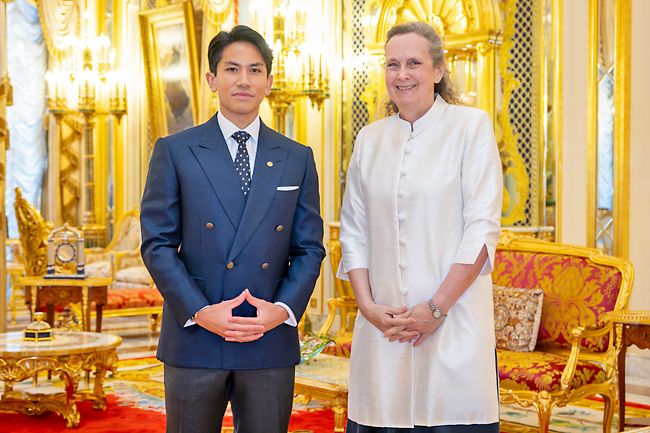
His Royal Highness Prince 'Abdul Mateen, Brunei's Minister of Foreign Affairs, hosted a formal farewell audience for United States Ambassador Caryn R McClelland on Saturday at Istana Nurul Izzah in Bandar Seri Begawan, marking the conclusion of her diplomatic posting to the sultanate. The ceremony underscored the significance both nations place on maintaining their established relationship and recognising the departing envoy's contributions to bilateral affairs during her tenure in Brunei.
Throughout her ambassadorial service, McClelland worked to advance American interests and strengthen Washington's connections with the sultanate across multiple dimensions of cooperation. Prince Mateen's remarks during the audience reflected appreciation for her efforts in consolidating the historically cordial relations between Brunei Darussalam and the United States, relations that have been cultivated over decades of diplomatic engagement and mutual respect.
The bilateral relationship between Brunei and the United States encompasses far more than ceremonial exchanges. During McClelland's tenure, both governments pursued substantive collaboration in defence and security matters, an arena of growing importance given regional geopolitical developments and maritime security concerns affecting Southeast Asia. The two nations have worked closely on initiatives designed to maintain stability in the Indo-Pacific region, where American strategic interests and Brunei's regional position intersect meaningfully.
Educational partnerships have formed another pillar of their cooperation. Student exchange programmes and institutional linkages between American universities and Brunei's educational institutions have facilitated knowledge transfer and professional development opportunities for Bruneian scholars and young professionals. These people-to-people exchanges represent the softer dimension of diplomacy, building lasting connections that transcend official channels and creating generations of individuals with firsthand understanding of each other's societies.
Trade and investment flows between the two countries have also expanded during this period. American businesses have maintained interest in Brunei's market, while Bruneian entities have explored opportunities within the American economy. These commercial ties, though modest compared to Brunei's engagement with larger trading partners, contribute meaningfully to economic diversification efforts within the sultanate and provide American firms with a foothold in Southeast Asia's emerging economy.
McClelland's arrival as ambassador came in May 2022, when she formally presented her credentials to His Majesty Sultan Hassanal Bolkiah, the Sultan and Yang Di-Pertuan of Brunei Darussalam. This marked the beginning of her representation of American diplomatic interests in a nation of significant regional importance. As a state with the second-largest proven oil reserves in Southeast Asia and substantial natural gas reserves, Brunei occupies a strategic position despite its small population and land area. The sultanate's role in regional organisations, particularly ASEAN, amplifies its diplomatic significance beyond its modest territorial footprint.
For Malaysia and other Southeast Asian observers, the rotation of diplomatic personnel within regional missions carries implications for broader regional engagement patterns. The United States maintains active diplomatic presence across Southeast Asia, with ambassadorial postings reflecting America's strategic commitment to the region. Brunei's significance within ASEAN, coupled with its geographical position on the island of Borneo, makes the quality of bilateral ties particularly relevant to regional stability and cooperation frameworks.
The farewell audience represents standard diplomatic protocol, yet such ceremonies perform important functions beyond ceremonial purposes. They provide opportunities for reflection on collaborative achievements and often signal areas of continued focus for incoming diplomats. McClelland's departure creates an opportunity for the incoming ambassador to build upon foundations laid during her service, potentially accelerating initiatives under discussion or introducing fresh approaches to established relationships.
Brunei's consistent engagement with the United States reflects the sultanate's strategic foreign policy orientation toward maintaining balanced relationships with major powers while protecting its sovereignty and regional interests. The sultanate maintains diplomatic relations with major global actors while prioritising its position within ASEAN and strengthening ties with neighbouring countries, particularly Malaysia and Indonesia. This balancing act remains central to Bruneian diplomacy and explains the importance leadership places on sustaining partnerships with powers like the United States.
As McClelland concludes her service, her successor will inherit a relationship characterised by respect, established protocols, and genuine cooperation across multiple sectors. The depth of bilateral engagement reflected in Prince Mateen's remarks suggests that American-Bruneian relations have moved beyond the transactional into substantive partnership. Future ambassadors will build upon this foundation, likely expanding collaboration in emerging areas such as climate change cooperation, digital governance, and cybersecurity—domains of increasing diplomatic importance across Southeast Asia.
The timing of diplomatic transitions always presents both continuity and possibility. While McClelland departs with formal recognition of her service, her successor faces the opportunity to deepen America's engagement with a nation that, despite its small size, exercises disproportionate influence within regional institutions and maintains strategic importance for Indo-Pacific stability. For Malaysian observers, such transitions remind us that diplomatic relationships in Southeast Asia remain fluid yet fundamentally important to regional peace and prosperity.

%22%2F%3E%3C%2Fpattern%3E%3C%2Fdefs%3E%3Crect%20width%3D%22100%25%22%20height%3D%22100%25%22%20fill%3D%22url(%23phcw7og)%22%2F%3E%3Crect%20width%3D%22100%25%22%20height%3D%22100%25%22%20fill%3D%22url(%23phcw7op)%22%2F%3E%3Ctext%20x%3D%2250%25%22%20y%3D%2250%25%22%20text-anchor%3D%22middle%22%20dominant-baseline%3D%22central%22%20fill%3D%22rgba(255%2C255%2C255%2C0.95)%22%20font-family%3D%22Georgia%2C%20'Times%20New%20Roman'%2C%20serif%22%20font-weight%3D%22700%22%20font-size%3D%22151%22%20letter-spacing%3D%22-0.02em%22%3EThousands%3C%2Ftext%3E%3C%2Fsvg%3E)