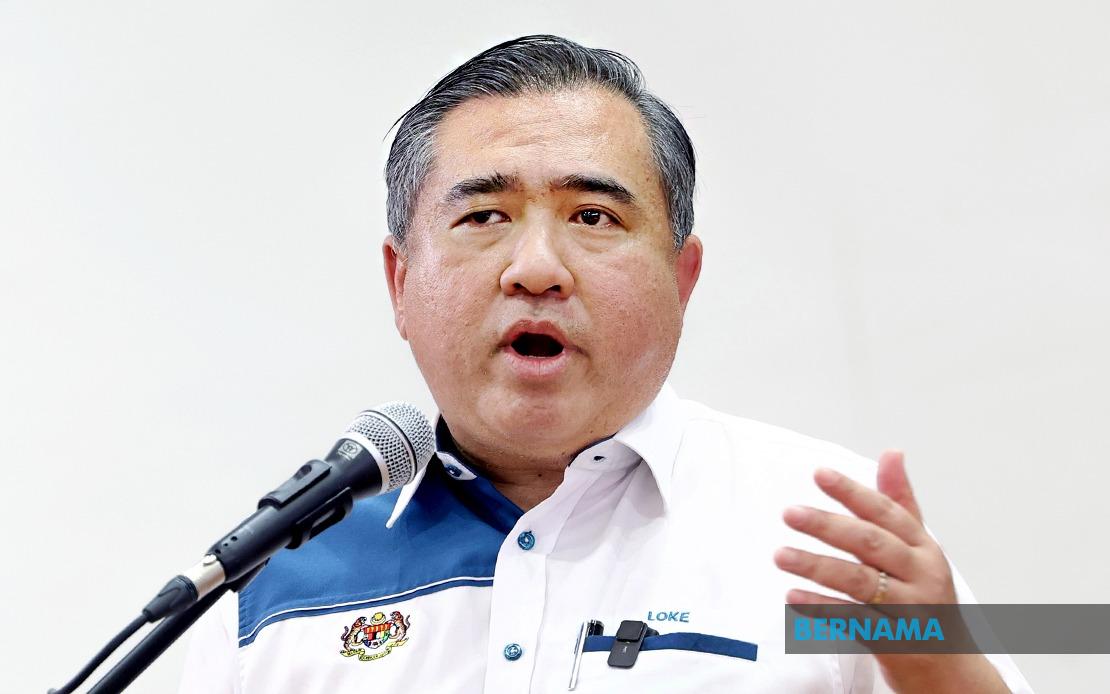
Transport Minister Anthony Loke has defended the deployment of diesel trains on Johor's Southern Shuttle service as a pragmatic temporary measure, emphasising that the decision prioritises public convenience over waiting indefinitely for next-generation rolling stock. Addressing criticism about the use of older locomotives, Loke explained the rationale in a Facebook statement, indicating that commuters would benefit from immediate access to the rail link rather than enduring a prolonged delay of two to three years for new Electric Multiple Unit (EMU) trains to be manufactured and delivered.
The Southern Shuttle connects three key Johor locations—Kulai, JB Sentral, and Pasir Gudang—offering residents a faster and more comfortable alternative to road-based transportation. The service has proven attractive to commuters, with the Kulai-JB Sentral segment reducing travel time to approximately 40 minutes, while the Kempas Baru-Pasir Gudang stretch takes between 40 and 45 minutes. By introducing rail connectivity on previously underutilised freight corridors, the scheme opens fresh mobility possibilities for the state's residents and workers.
The Ministry of Transport has committed significant financial backing to sustain the expansion of rail-based public transport across Malaysia. An annual subsidy ranging from RM11 million to RM15 million has been earmarked specifically to enhance affordability and accessibility for ordinary citizens seeking to shift away from private vehicles. This investment reflects a broader policy direction to decarbonise transport infrastructure and reduce urban congestion through modal shift initiatives, aligning with Malaysia's sustainability objectives and regional peer pressure for greener mobility solutions.
Loke's statement contained a subtle but important concession: the current diesel arrangement is genuinely transitional. Once the Gemas-Johor Bahru electrified double-tracking project reaches completion, the Southern Shuttle will transition from diesel locomotives to modern Electric Train Service (ETS) operations on the same corridor. This planned upgrade suggests the Ministry has a defined exit strategy and is not simply postponing infrastructure investment indefinitely. The electrification project represents a substantial capital commitment to modernise the southern rail corridor, which has historically operated with aging or limited capacity assets.
The decision to deploy existing diesel stock immediately rather than delaying service launch reveals a tension within transport policymaking between perfection and pragmatism. Loke essentially posed a choice: either wait two to three years for 10 new EMU train sets to enter service, or commence operations now using available resources. From the perspective of commuters in Kulai, JB Sentral, and Pasir Gudang, the logic favours immediate action. Rail transport planning in Malaysia has historically suffered from protracted implementation cycles, and bringing forward a service launch by years carries real economic and social value for affected populations.
However, the service has not escaped criticism, particularly regarding fare structures. Observers have highlighted that ticket prices on the Southern Shuttle are approximately three times higher than equivalent journeys on comparable services in Kuala Lumpur and Seremban. This disparity raises questions about cost recovery methodology, subsidy distribution, and whether the stated RM11-15 million annual subsidy is adequate to bridge affordability gaps. For a service intended to serve the travelling public and encourage modal shift away from private vehicles, pricing remains a critical lever that may determine long-term ridership success.
The opening of the Kempas Baru-Pasir Gudang route represents another notable dimension of the Southern Shuttle expansion. This corridor previously served freight traffic exclusively, and converting it to mixed passenger-freight operations required regulatory approval and infrastructure adaptation. The willingness to repurpose freight capacity for passenger services underscores the Ministry's recognition that Johor's urban corridors face mounting transport demand that existing roads cannot accommodate efficiently. Freight operators may face scheduling constraints, but the broader mobility needs of Johor's growing population appear to have taken precedence.
For Malaysian readers and policymakers, the Southern Shuttle case study illustrates classic implementation trade-offs in transport development. The decision to launch with diesel traction while awaiting electrified rolling stock is neither perfect nor permanent, but it acknowledges that delaying gratification for marginal quality improvements often proves counterproductive. Residents in Johor now have access to faster, more comfortable rail options that did not exist weeks ago—a tangible benefit that outweighs theoretical future improvements. The annual subsidy commitment also signals that the Ministry intends to sustain affordability and prevent fare escalation from undermining adoption.
Looking ahead, the completion of the Gemas-Johor Bahru electrified double-tracking project will be critical. This infrastructure investment will enable transition to modern ETS operations, retire the temporary diesel fleet, and potentially unlock capacity for additional services or improved frequency. The 10 new EMU train sets mentioned by Loke will eventually bolster the Southern Shuttle fleet, providing redundancy and enabling service expansion beyond the current three-station network. Until that transition occurs, however, passengers and observers must accept that interim compromises are the practical cost of advancing public transport development in Malaysia's southern economic zone.