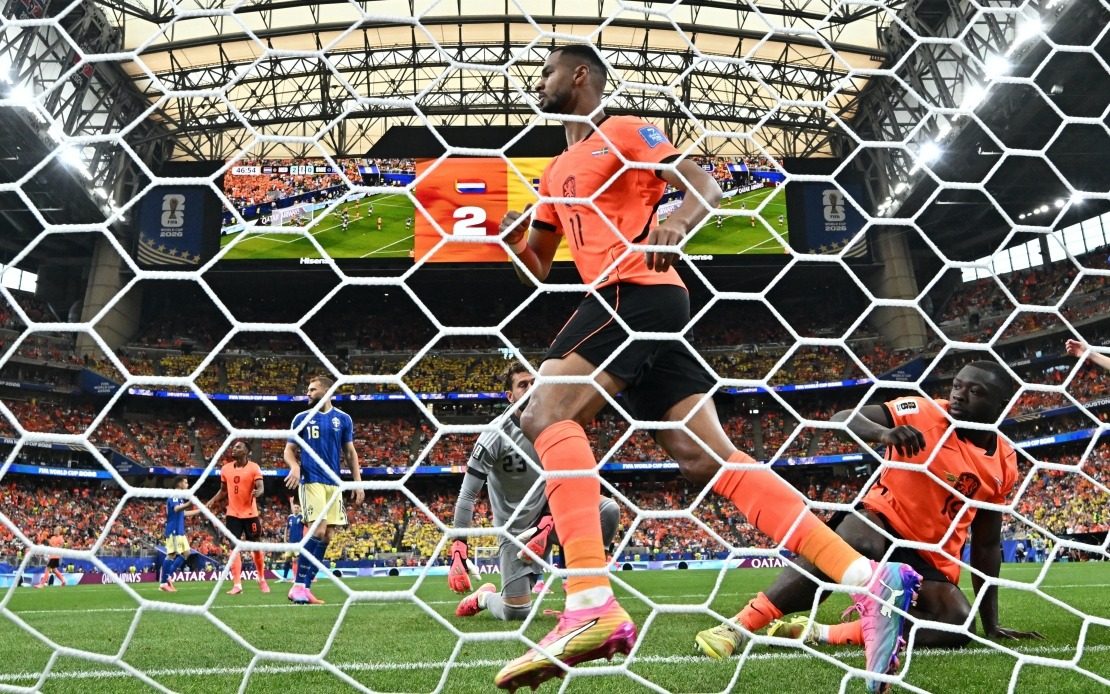
The World Cup tournament has entered rarefied scoring territory, reaching its 100-goal milestone at the fastest pace in nearly seven decades. Cody Gakpo's contribution in the Netherlands' commanding 5-1 triumph over Sweden brought the competition to this significant benchmark in merely 33 matches, translating to an average of 3.03 goals per fixture. This remarkable offensive output represents a dramatic shift from previous tournaments and raises intriguing questions about what factors are converging to produce such a prolific scoring environment.
Historical comparisons illuminate just how exceptional the current pace truly is. The last time the World Cup reached 100 goals this quickly was in 1954 in Switzerland, when the milestone arrived after just 20 matches—though that tournament operated under considerably different formats and rules that are largely unrecognizable by modern standards. In contrast, the Brazil 2014 edition required 36 matches to achieve the same total, Spain 1982 also took 36, while Argentina 1978 and the United States 1994 both needed 38 matches. The current trajectory represents a decisive departure from these established patterns, suggesting that something fundamental has shifted in how this tournament is unfolding.
Technological innovation has emerged as one leading explanation for the elevated goal-scoring rates. The official match ball for this tournament, known as the Trionda, has drawn particular scrutiny from analysts and observers who contend that its aerodynamic properties have compromised goalkeepers' ability to read and react to shots struck from distance. This design characteristic appears to have contributed to an unusually high number of goals—approximately 10 thus far—originating from outside the penalty area, where precision and goalkeeper positioning become even more critical factors.
Environmental conditions unique to the tournament's location have also played a measurable role in reshaping match dynamics. The prevalent heat throughout the competition creates cumulative fatigue that inevitably leads to defensive vulnerabilities as matches progress. Recognizing this reality, tournament organizers introduced mandatory three-minute cooling breaks, which paradoxically may be amplifying the scoring trend. These stoppages grant coaches precious additional opportunities to reorganize their tactical setups and make strategic substitutions, potentially disrupting defensive organization at critical junctures and creating temporary imbalances that attacking teams can exploit.
The structural expansion to 48 teams rather than the traditional 32 has fundamentally altered the competitive landscape in ways both obvious and subtle. Initial appearances suggested that this format would simply produce a succession of lopsided encounters between elite nations and comparative minnows. Germany's devastating 7-1 demolition of Curaçao, Canada's 6-0 evisceration of Qatar, and Tunisia's paired collapses—losing 5-1 to Sweden and 4-0 to Japan—appeared to validate this concern and threatened to undermine competitive balance.
However, the emerging pattern of results presents a more nuanced picture that challenges the assumption of inevitable one-sided contests. Curaçao's capacity to extract a goalless draw against Ecuador demonstrates that smaller nations possess the organizational acumen and defensive discipline to frustrate more fancied opponents when properly marshalled. Similarly, Cabo Verde's 0-0 stalemate against Spain showcased that even prestigious European sides can find themselves stymied by well-organized defensive blocks. Qatar's performance in its opening fixture, where it navigated much of the match against Canada with only nine players due to red card complications, further illustrates that competitive resilience can emerge from unexpected circumstances.
The continued competitiveness of traditionally underestimated nations further substantiates the argument that the expanded format has genuinely enhanced the tournament's overall quality and unpredictability. Jordan and Uzbekistan, despite suffering defeats to Austria and Colombia respectively on a 3-1 scoreline, demonstrated sufficient organizational coherence and tactical awareness to remain genuinely competitive throughout their contests. These performances suggest that the expanded field has not simply produced a watered-down competition but rather has generated a more intricate tapestry of matchups where outcomes remain genuinely uncertain and where smaller footballing nations can hold their own against more established powers.
The convergence of these multiple factors—the Trionda ball's aerodynamic characteristics, the environmental toll of heat and the tactical opportunities it creates through cooling breaks, and the competitive dynamics introduced by the 48-team expansion—appears to be generating a tournament whose offensive character represents a genuine departure from historical norms. For Malaysian and Southeast Asian observers, this elevated goal-scoring trend carries particular relevance, as it demonstrates how format changes and technological evolution can fundamentally reshape international football competition in ways that extend beyond simple predictions of dominance by traditional powerhouses.
The World Cup thus far has validated the assertions of tournament organizers and format innovators that expansion and modification need not inevitably diminish competitive integrity or produce merely one-sided contests. Instead, the evidence suggests that careful structural adjustments, combined with environmental and technological factors, can produce a competition that rewards attacking excellence while simultaneously allowing determined defensive organization to produce meaningful results. As the tournament progresses, continued monitoring of goal-scoring patterns and their underlying causes will provide valuable insights into how modern football competition evolves and what factors genuinely influence match outcomes in high-stakes international environments.

%22%2F%3E%3C%2Fpattern%3E%3C%2Fdefs%3E%3Crect%20width%3D%22100%25%22%20height%3D%22100%25%22%20fill%3D%22url(%23ph38dg7g)%22%2F%3E%3Crect%20width%3D%22100%25%22%20height%3D%22100%25%22%20fill%3D%22url(%23ph38dg7p)%22%2F%3E%3Ctext%20x%3D%2250%25%22%20y%3D%2250%25%22%20text-anchor%3D%22middle%22%20dominant-baseline%3D%22central%22%20fill%3D%22rgba(255%2C255%2C255%2C0.95)%22%20font-family%3D%22Georgia%2C%20'Times%20New%20Roman'%2C%20serif%22%20font-weight%3D%22700%22%20font-size%3D%22151%22%20letter-spacing%3D%22-0.02em%22%3EMalaysian%3C%2Ftext%3E%3C%2Fsvg%3E)