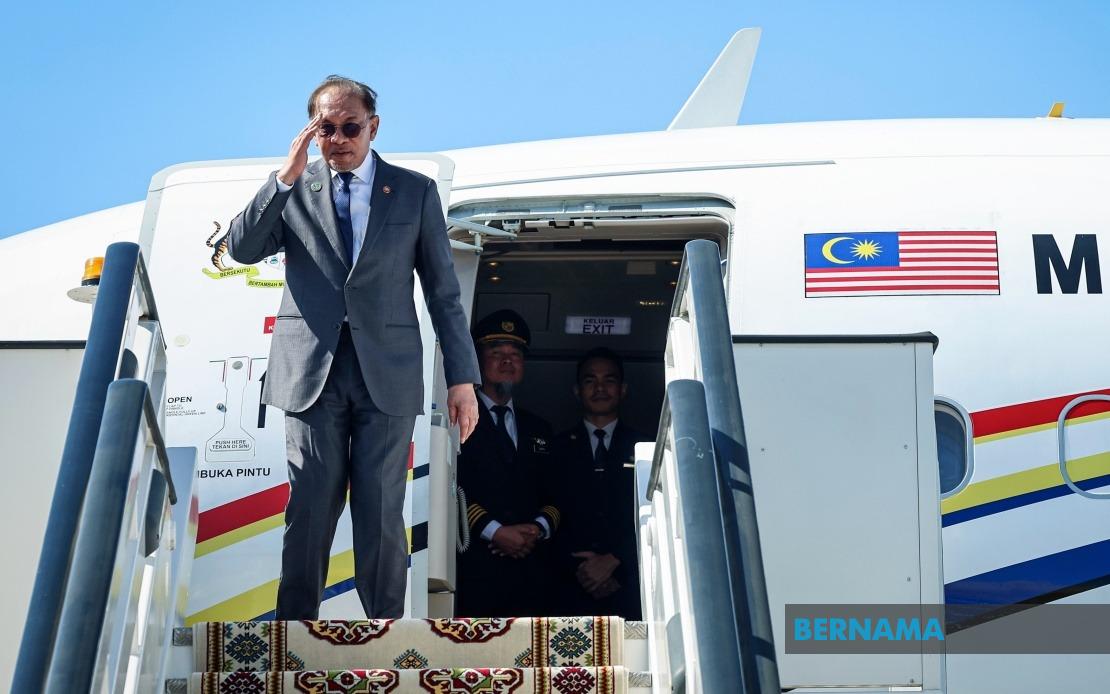
Prime Minister Datuk Seri Anwar Ibrahim touched down in Penang this morning after wrapping up a two-day official mission to Turkmenistan, immediately transitioning into a tightly scheduled day of engagements across the state. The whirlwind itinerary showcases the demanding nature of Malaysia's top political office, which combines Anwar's responsibilities as Prime Minister with his portfolio as Finance Minister. His flight departed Ashgabat International Airport at 4.45 pm local time on June 19, arriving in Malaysia's northern industrial hub to fulfil a series of ceremonial and recognition duties that underscore the government's focus on economic development and media professionalism.
Anwar's first engagement in Penang centred on industrial expansion, with the Prime Minister officially inaugurating MKS Instruments Malaysia Sdn Bhd at Bandar Cassia Technology Park in Batu Kawan at 11 am. The facility represents the company's commitment to Malaysia as a manufacturing and research hub, particularly in precision instrumentation sectors that contribute to the country's high-tech economy. Such openings are strategically significant for Penang, which has repositioned itself as a technology and innovation corridor competing with regional manufacturing centres across Southeast Asia.
Following the corporate opening, Anwar presided over a groundbreaking ceremony for the Setia Fontaines Industrial Park at 1 pm in Bandar Setia Fontaines, Kepala Batas. This development project carries broader implications for the Northern Corridor's long-term economic trajectory, signalling sustained investment in industrial infrastructure beyond the congested Klang Valley. Setia's parallel launch of two additional strategic collaborations within the Setia Fontaines township underscores how major real estate and industrial developers are integrating mixed-use ecosystems—combining residential, commercial, and manufacturing spaces—to create self-contained business environments that attract both domestic and foreign enterprises.
The centrepiece of Anwar's Penang schedule was his attendance at the National Journalists' Day (HAWANA) 2026 Grand Finale at PICCA Convention Centre @ Butterworth Arena at 3 pm, where approximately 1,000 media practitioners from Malaysia and international delegations converged. This event carries symbolic weight in Malaysian governance, as it publicly acknowledges the fourth estate's role in democratic society while allowing political leadership to articulate the administration's relationship with the press. The gathering provides a forum where concerns about media freedom, professionalism standards, and economic sustainability of newsrooms can theoretically surface, though such conferences often serve primarily ceremonial functions.
During the HAWANA ceremony, Anwar presented the principal HAWANA Award and Special HAWANA Award to journalists and communicators judged to have made exceptional contributions to the profession and public discourse. These accolades recognise individuals who have advanced journalism standards across print, broadcast, and digital platforms, addressing a sector that has experienced significant structural challenges in recent years due to declining advertising revenues and audience fragmentation. Recognition programmes like HAWANA serve to motivate media professionals at a time when newsroom budgets face constraints and traditional journalism business models continue eroding globally.
A particularly noteworthy component of the ceremony involved distributing Tabung Kasih@HAWANA contributions to media practitioners facing financial hardship. This welfare initiative reflects awareness within government circles that journalism, despite its public importance, frequently fails to provide sustainable livelihoods for practitioners, especially freelancers and workers at smaller publications. The fund represents implicit acknowledgment that media industry challenges extend beyond editorial independence to encompass basic economic security for those practising the profession.
HAWANA itself, administered by the Communications Ministry with the Malaysian National News Agency (Bernama) serving as implementing agency, functions as Malaysia's primary platform for celebrating journalism as a profession and acknowledging contributions to public information and civic education. The biennial scale of the event and its capacity to draw international participants position it as a regional showcase for Malaysian media capabilities and professionalism standards. For the government, such events demonstrate commitment to press freedom rhetoric while providing opportunities to engage media leadership on policy matters.
Anwar's visit to Penang must be contextualised within his broader diplomatic calendar. He had recently attended the 35th ASEAN-Russia Commemorative Summit in Kazan, Russia, accompanied by Investment, Trade and Industry Minister Datuk Seri Johari Abdul Ghani and Economy Minister Akmal Nasrullah Mohd Nasir. His Turkmenistan visit, the first since becoming Malaysia's 10th Prime Minister in November 2022, occurred at the invitation of President Serdar Berdimuhamedov and represented efforts to expand Malaysia's diplomatic footprint in Central Asia, a region traditionally dominated by Chinese and Russian spheres of influence. These sequential engagements—spanning Russia's Asian borderlands, the Central Asian republics, and domestic constituency management—illustrate the compressed diplomatic schedule required of contemporary prime ministers juggling foreign policy with domestic governance obligations.
The Prime Minister's packed schedule continued beyond Penang, with Anwar scheduled to attend the Himpunan Pertubuhan Lima Generasi (PLG) Malaysia dinner in Negeri Sembilan the same evening. This dinner engagement suggests ongoing engagement with civil society organisations and generational cohorts that government seeks to maintain within its political coalition. The cumulative effect of such back-to-back commitments across multiple states and international venues demonstrates the substantial physical and mental demands placed on Malaysia's leadership, particularly when ministerial portfolios multiply responsibilities beyond the symbolic role of Prime Minister.
From a broader governance perspective, Anwar's itinerary reflects how modern Southeast Asian prime ministers must balance multiple constituencies: international relations and trade missions, industrial development and corporate stakeholder engagement, media and civil society relations, and domestic political coalition maintenance. His dual role as Prime Minister and Finance Minister adds an extra layer of complexity, requiring him to maintain expertise across disparate policy domains while sustaining the ceremonial and diplomatic functions the office demands. The Penang visit illustrates how these competing demands compress into single days, with economic development, media recognition, and public relations activities succeeding one another in rapid succession.