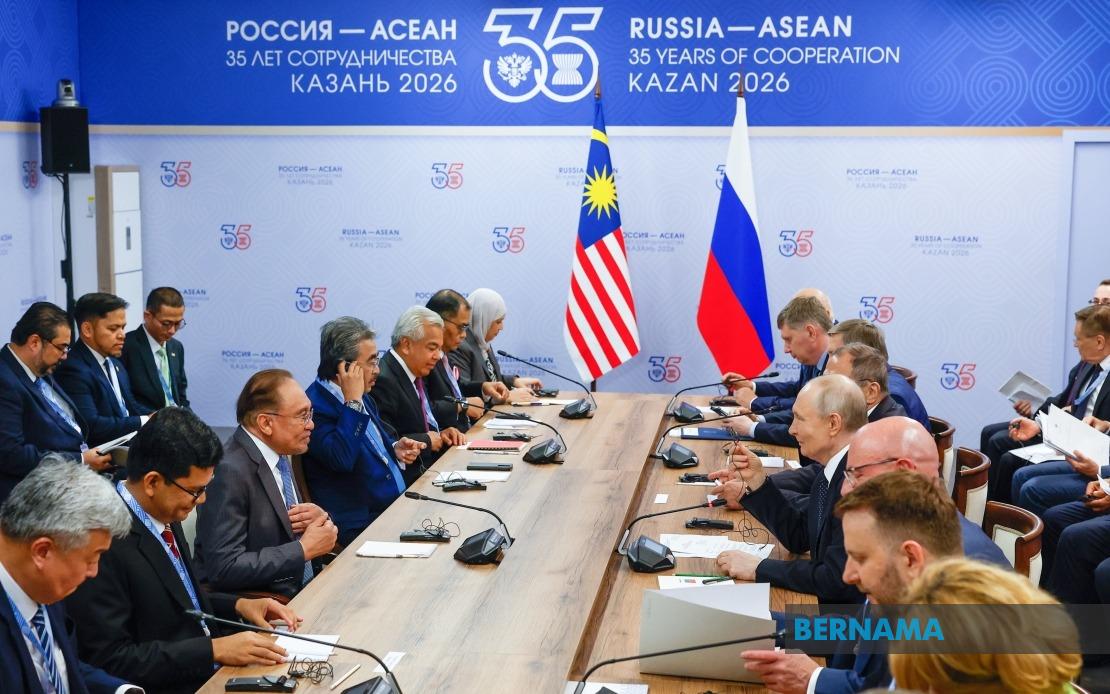
Prime Minister Datuk Seri Anwar Ibrahim has publicly commended Russian President Vladimir Putin and Chinese President Xi Jinping for their principled positions on Middle Eastern conflicts, particularly their calls for peace and denunciations of violence affecting civilians across Gaza, Iran and Lebanon. Speaking during an exclusive interview with the Russian media outlet RT while visiting Kazan for the Commemorative Summit marking 35 years of ASEAN-Russia diplomatic relations, Anwar articulated Malaysia's distinctive approach to navigating complex geopolitical tensions without compromising its core values or aligning itself with any singular superpower.
The Prime Minister underscored Malaysia's consistent parliamentary position against military actions by Israel, emphasising that the nation has pursued this stance across party lines through deliberate diplomatic engagement. He stressed that Malaysia's opposition to these military operations stemmed from a commitment to universal principles rather than ideological allegiance, distinguishing this approach from the zero-sum thinking that often characterises great power competition. Anwar detailed his personal efforts to broker understanding by engaging with senior leaders across the Gulf region, Pakistan, Türkiye and Iran, demonstrating Malaysia's active diplomatic footprint in seeking equitable resolutions to ongoing regional tensions.
A central theme of Anwar's remarks centred on Malaysia and ASEAN's rejection of neutrality in favour of what he termed "centrality"—a more nuanced framework that permits principled positions on human rights violations and atrocities without surrendering independence of foreign policy. This conceptual distinction reflects the region's evolving maturity in international relations, allowing ASEAN nations to champion humanitarian concerns and accountability while resisting pressure from traditional power blocs. The emphasis on centrality rather than neutrality signals to both established and emerging powers that Southeast Asian nations possess their own moral compass and will not be instrumentalised merely as strategic assets in larger geopolitical contests.
Anwar directed considerable criticism at what he characterised as Western hypocrisy in its approach to Middle Eastern conflicts. He questioned the logical consistency of nations that simultaneously advocate for international law and sovereignty while supporting military operations against independent states, noting that such contradictions undermine the legitimacy of the international rules-based order. The Prime Minister highlighted how Western silence on aggression against Iran stands in stark contrast to vocal condemnation of other state actions, illustrating what he called a selective application of humanitarian and legal principles based on strategic interests rather than consistent ethical standards.
The geopolitical ramifications of these conflicts extend far beyond the immediate theatre of operations, according to Anwar's assessment. He pointed to the broader destabilisation affecting Gulf nations and the international community, encompassing not only immediate economic hardship from military conflict but also fundamental threats to core principles of international law and coexistence. This perspective reflects growing concern among developing nations that the rules-based international order, crafted largely by Western powers in the post-Cold War period, increasingly serves those same powers' interests rather than functioning as a neutral arbiter of state behaviour.
For Malaysian audiences and Southeast Asian observers, Anwar's positioning carries significant implications for the region's diplomatic strategy amid superpower competition. By publicly acknowledging Russian and Chinese efforts toward peace while maintaining independent analysis, Malaysia demonstrates how smaller nations can engage respectfully with multiple powers without surrendering agency. This balancing act proves increasingly vital as geopolitical competition intensifies, with Southeast Asian countries navigating between Washington, Beijing, Moscow and other regional powers seeking influence.
The Prime Minister's emphasis on Malaysia's bipartisan parliamentary consensus against aggression reflects domestic political support for an independent foreign policy stance. This unity suggests that Malaysia's diplomatic positioning transcends typical partisan divisions, grounded instead in shared national interests and principles. Such consensus strengthens Malaysia's negotiating position internationally, as other nations recognise that Malaysia's positions reflect genuine national sentiment rather than the preferences of a single political faction.
Anwar's criticism of double standards in international law enforcement extends a recurring Malaysian argument that the post-Cold War international system inadequately serves developing nations' interests. He contends that wealthy and powerful nations invoke international law selectively, applying rigorous standards to adversaries while overlooking violations by allies. This critique resonates throughout the Global South and increasingly within ASEAN, where nations seek a more equitable and consistent international legal framework.
The visit to Kazan and the ASEAN-Russia commemorative summit provided an opportune platform for Malaysia to reaffirm its commitment to multilateral engagement beyond traditional Western-centric frameworks. By choosing to grant an exclusive interview to RT during this visit, Anwar signalled Malaysia's willingness to communicate directly with Russian audiences, reinforcing diplomatic channels between Kuala Lumpur and Moscow. This engagement reflects Malaysia's broader strategy of maintaining multiple diplomatic relationships simultaneously, ensuring that no single power can claim exclusive access or influence.
Moving forward, Malaysia's articulation of "centrality" as a guiding principle may influence how other ASEAN members approach their own foreign policies. As regional tensions mount and pressures for alignment intensify, a principled framework emphasising independence while permitting moral stances offers an attractive alternative to binary choices. Malaysia's public endorsement of Russian and Chinese peace efforts, coupled with its simultaneous criticism of Western hypocrisy, demonstrates that such nuanced positioning remains possible for determined middle powers willing to invest diplomatic capital in maintaining principled independence.