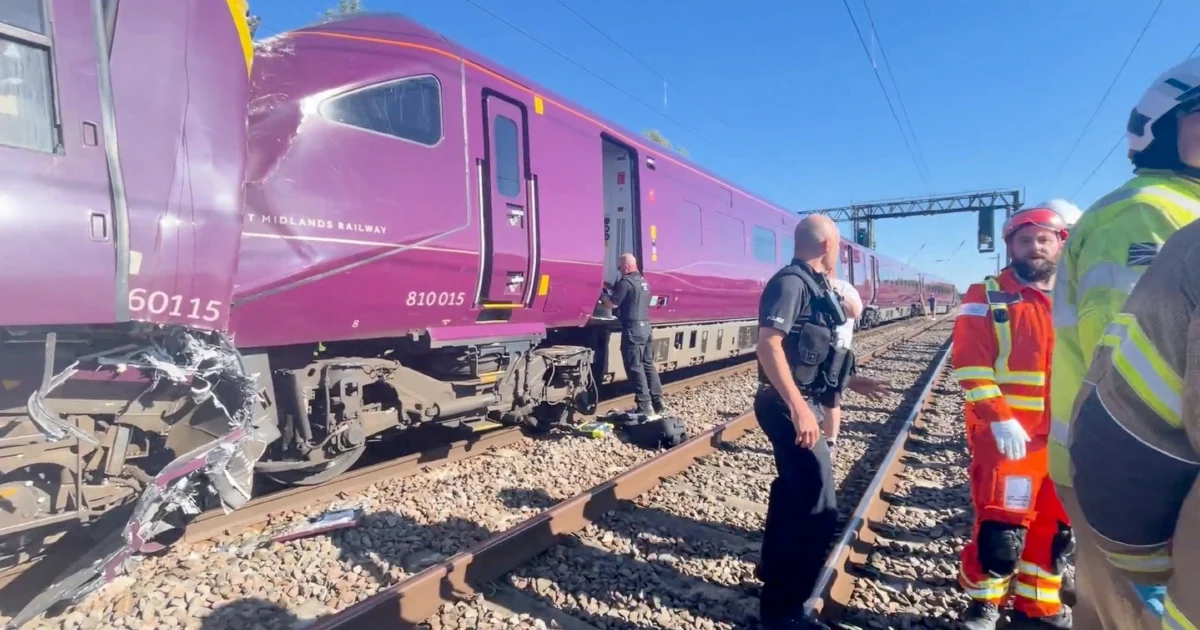
A serious railway accident unfolded north of London on Friday when two passenger trains collided, claiming one life and leaving many others requiring medical attention. According to statements from UK emergency services, the crash resulted in a total of dozens injured passengers, with 11 individuals sustaining injuries classified as "very serious" by responders at the scene.
Railway incidents of this magnitude represent significant events in British transport infrastructure, given the extensive reliance on rail networks for commuter and intercity travel across the United Kingdom. The collision occurred during what would typically be an ordinary Friday, disrupting normal passenger operations and creating an immediate emergency response across multiple service sectors. Such incidents often have cascading effects on regional transport networks, affecting thousands of commuters and prompting detailed investigations into causation factors.
For Malaysian and Southeast Asian observers, such accidents underscore the critical importance of maintaining rigorous safety protocols across rail systems serving high-density passenger corridors. The UK, with its mature and extensively regulated rail infrastructure, demonstrates that even well-established networks require constant vigilance. This has direct relevance for developing transport systems across the region, where rapid expansion of rail connectivity must be balanced against the need for robust safety frameworks and emergency response capabilities.
Emergency services coordinated what appears to have been a substantial response operation, with personnel deployed to manage both immediate rescue operations and ongoing medical treatment for the injured. The designation of 11 individuals as suffering "very serious" injuries suggests that several passengers sustained trauma requiring specialised trauma care and potentially extended hospitalisation. The involvement of multiple emergency services indicates the complexity of managing incidents affecting large numbers of people simultaneously.
Rail safety remains a persistent concern globally, with transport authorities constantly reviewing accident data to identify patterns and implement preventative measures. The collision occurred during daylight hours on a working day, when trains typically carry substantial passenger loads. Understanding the sequence of events leading to such collisions—whether involving human error, mechanical failure, signalling issues, or track maintenance deficiencies—becomes essential for preventing recurrence.
The immediate aftermath of such an incident typically involves establishing a secure perimeter, triaging injured passengers, and preserving evidence for subsequent investigation. Families of those affected begin searching for information about loved ones, while transport authorities attempt to restore normal operations across affected rail lines. The psychological impact on surviving passengers, witnesses, and emergency responders should not be underestimated, as such traumatic events often require specialist support services.
British Rail Accident Investigation Branch protocols would typically be activated following such an incident, initiating formal procedures to determine precise causation. These investigations can span weeks or months, examining technical evidence, witness statements, and operational procedures. The findings from such investigations frequently influence international rail safety standards, as the UK shares safety data and learnings with other jurisdictions, including those across Southeast Asia expanding their rail networks.
For passengers in the affected region, such incidents prompt reassessment of rail travel safety perceptions. While statistically rail remains one of the safest transport modes, high-impact accidents generate significant public concern and media attention. Transport operators must balance operational efficiency with safety investment, a challenge particularly acute in densely populated regions where rail capacity is stretched to meet demand.
The incident highlights the interdependency of multiple systems required for safe rail operations—including track maintenance, signalling accuracy, train braking systems, driver training, and operational management protocols. Any weakness in these interconnected systems can potentially contribute to accidents. The investigation will likely reveal which combination of factors aligned to create the collision scenario, providing valuable lessons for railway operators worldwide.
For Malaysian stakeholders developing or operating rail services, incidents such as this underscore the necessity of investing substantially in both infrastructure maintenance and staff training. The human cost of railway accidents—measured in lives lost and injuries sustained—demonstrates that rail safety cannot be compromised by budget constraints or convenience. As Southeast Asian nations continue expanding their rail networks, prioritising safety culture and rigorous maintenance protocols alongside capacity expansion becomes increasingly critical to protecting passengers and maintaining public confidence in rail transportation systems.