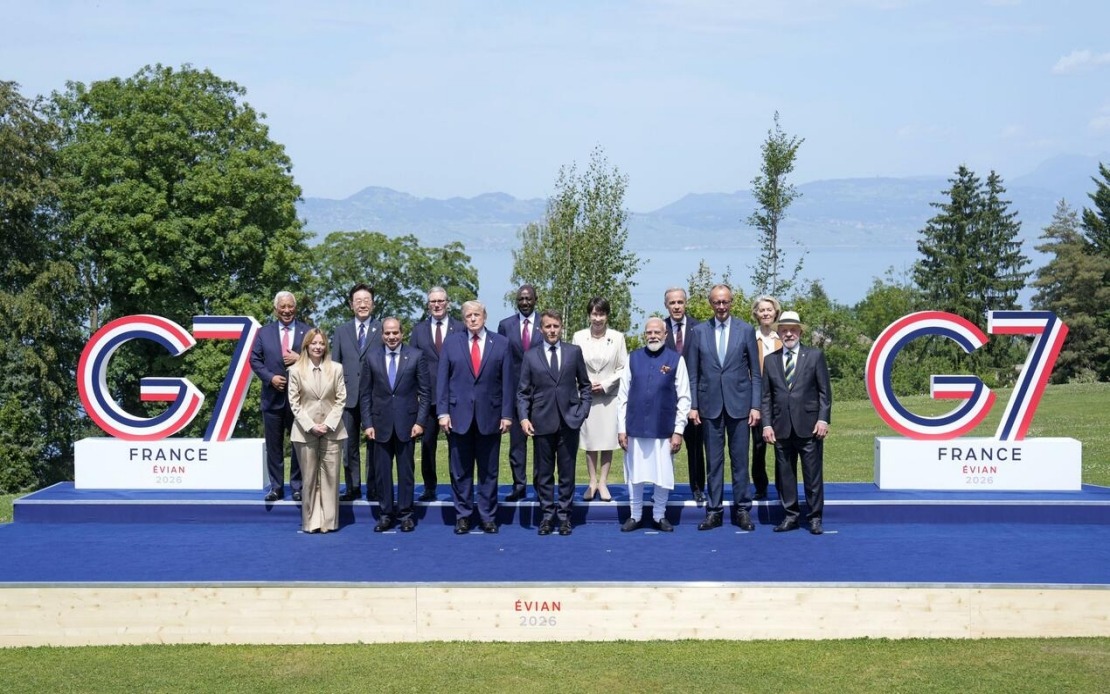
The Group of Seven summit convening in Evian-les-Bains, the elegant French spa town bordering Switzerland on Lake Geneva's shores, produced a carefully worded commitment to sustain backing for Ukraine even as fissures within the Western alliance became increasingly apparent. On the second day of the three-day gathering, G7 members agreed to maintain collective pressure on Russia while simultaneously listening to a direct assessment from Ukrainian President Volodymyr Zelenskyy about his country's deteriorating military position and pressing humanitarian needs. Yet beneath the surface of this consensus lay simmering disagreements between the United States and its European partners over fundamental strategic questions, trade relationships, NATO burden-sharing, and how to manage the broadening conflict in West Asia.
US President Donald Trump seized the opportunity to articulate his vision for ending the Ukraine war, arguing that Russia has absorbed catastrophic human losses and therefore possesses incentive to negotiate. His language reflected a transactional approach to international conflict, suggesting that military exhaustion rather than diplomatic principle should drive Moscow toward a settlement. Trump indicated willingness to leverage American economic tools—specifically the restoration of sanctions against Russia previously eased to moderate global oil prices—as negotiating pressure. This stance signalled that the incoming administration prioritises rapid conflict resolution over supporting Ukraine's territorial recovery or enforcing the principle of sovereignty that underpins the international order. The strategic calculus appeared to rest on the notion that further prolonging the war serves neither combatant, a framing that oversimplifies the asymmetric positions and objectives of Kyiv and Moscow.
Trump's recent diplomatic efforts with Iran, particularly negotiations surrounding the reopening of the Strait of Hormuz and restoration of oil flows through this critical global chokepoint, provided the template for his approach to Russia. He suggested that as oil markets stabilise following the Iran agreement, Washington would possess greater flexibility to reimpose Russian sanctions as leverage. This linkage between Middle Eastern and European conflicts illustrated how the incoming administration conceptualises geopolitical challenges as interconnected nodes within a larger negotiation network rather than as distinct crises requiring tailored responses. For Southeast Asian observers, this approach carries profound implications: it signals that American strategic bandwidth may become stretched across multiple theatres, potentially leaving regional partners in East and Southeast Asia with reduced attention and support on matters such as South China Sea security and maritime freedom of navigation.
Japanese Prime Minister Sanae Takaichi articulated European concerns about the sustainability of G7 unity, emphasising the necessity of maintaining collective resolve to compel Russia toward "positive and concrete action." She pointedly warned that unilateral attempts to alter geopolitical status quo through military force cannot be tolerated—a formulation that, by implication, encompassed not only Russian aggression but also signalled anxiety about Trump's recent rhetoric regarding Greenland and other territories. Takaichi's explicit mention of deepening Russian-Chinese military cooperation and Russia's expanding military relationship with North Korea reflected Tokyo's mounting concern that a fragmented Western response to Ukraine might embolden Beijing and Pyongyang to pursue their own strategic ambitions. For Malaysian and regional policymakers, these developments underscore the interconnection between European security architecture and broader Indo-Pacific stability, suggesting that weakness in Western resolve toward Russia could reverberate across Asia.
Zelenskyy's public messaging diverged subtly from Trump's emphasis on negotiations, instead highlighting Ukraine's need for enhanced air defence capabilities and diplomatic initiatives aimed at persuading Russia to cease hostilities. This distinction revealed the fundamental gap between Ukrainian objectives—preserving territorial integrity and security—and the American preference for a rapid settlement that might require Kyiv to accept territorial concessions. The Ukrainian president's observation that Kyiv has strengthened its battlefield position through closer European cooperation than American support represented a quiet acknowledgment that Ukraine's survival increasingly depends on maintaining European solidarity even as the United States potentially pivots toward disengagement. For the region, this European-Ukrainian alignment suggests that European powers may assume greater responsibility for security architecture beyond their traditional domain, potentially affecting global security calculations including those relevant to Southeast Asia.
The summit's attention to West Asia reflected the expanding complexity of international security challenges that stretch Western attention and resources. During a working lunch attended by G7 leaders alongside representatives from Egypt, Qatar, and the United Arab Emirates, participants reviewed the nearly four-month-old Iran conflict and its cascading consequences. The preliminary agreement between Washington and Tehran to restore navigation through the Strait of Hormuz and resolve their military confrontation represented another instance of Trump's deal-making approach, yet it also demonstrated how rapidly American priorities can shift depending on diplomatic opportunities. For Southeast Asian economies dependent on global oil supplies and maritime trade, the stabilisation of Middle Eastern tensions carries significant material consequences, influencing energy prices, shipping costs, and regional stability.
The G7's formal discussion of development finance reform addressed a structural challenge to international development cooperation that carries particular relevance for Southeast Asian nations and other emerging economies. Traditional official development assistance has become demonstrably inadequate for addressing the scale of infrastructure investment, climate transition, and poverty reduction required in lower-income countries. France's leadership in reforming this system toward creating mutually beneficial partnerships that align donor strategic interests with recipient development objectives represents a pragmatic but potentially contested approach. The emphasis on mobilising private capital for long-term infrastructure financing could benefit Southeast Asian nations by expanding access to development resources, though it also implies that wealthier nations will expect reciprocal strategic advantages rather than purely philanthropic motivation for engagement.
The inclusion of outreach partners—Brazil, Egypt, India, Qatar, South Korea, and the United Arab Emirates—alongside core G7 members signalled an attempt to broaden the legitimacy and reach of Western-led international cooperation frameworks. However, this expansion also reflected anxiety within established developed economies about losing influence over global governance structures as economic power diffuses toward emerging markets. For Malaysia and other ASEAN members, these developments suggest that strategic autonomy may be increasingly valuable as traditional alignments shift. The G7's effort to reshape development partnerships toward greater reciprocity and mutual benefit may create opportunities for developing nations to negotiate better terms, though it also implies that access to development finance will become explicitly linked to geopolitical alignment.
The summit occurred at a moment when Ukraine has recalibrated its strategic orientation toward Europe, recognising that American commitment under a Trump administration cannot be assumed indefinitely. This rebalancing carries implications extending beyond Europe's borders. If Ukraine succeeds in deepening European security integration independent of American leadership, the precedent could encourage other American allies in Asia to develop more autonomous defence capabilities and regional security arrangements. The possibility that NATO and European defence structures might evolve toward greater autonomy from American leadership represents a significant shift in global security architecture that could reshape international alignments affecting Southeast Asia.
Trump's characterisation of his role as potential peacemaker in both the Iran and Ukraine conflicts reflected confidence in his personal negotiating abilities but also suggested a strategic reorientation of American foreign policy toward selective engagement rather than comprehensive alliance management. This approach potentially creates space for middle-power nations like Malaysia to exercise greater diplomatic influence in their own regions, less constrained by demands from a fully engaged superpower. However, it also introduces uncertainty regarding American reliability as a security guarantor, a concern that extends beyond Europe to Asia-Pacific where many nations depend on American commitment to regional stability. The summit's outcomes revealed that while G7 members publicly maintained unified messaging on Ukraine, their underlying strategic calculations diverged significantly, presaging potentially significant shifts in international cooperation frameworks that will reverberate globally.