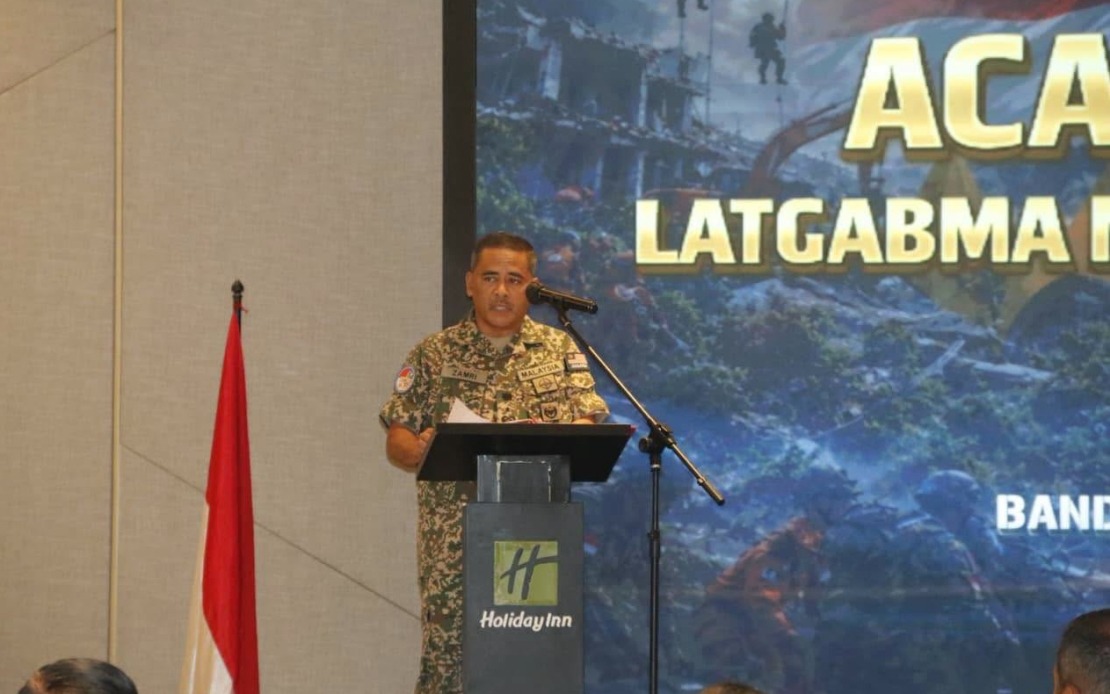
The Malaysian Armed Forces and Indonesia's National Armed Forces have taken a significant step in deepening their bilateral defence relationship through an extensive joint training exercise currently underway in Lampung, Sumatra. The LATGABMA MALINDO DARSASA 12AB/2026 exercise, which runs for 13 days, brings together 719 military and civilian personnel from both countries in what defence officials describe as far more than a routine operational drill. According to a statement from the Joint Forces Headquarters at Al-Sultan Abdullah Camp in Kuala Lumpur, this collaborative endeavour represents a tangible expression of the strong fraternal ties and strategic confidence that bind the two neighbouring nations.
The exercise's dual focus on testing integrated operational concepts across land, maritime, and air domains while simultaneously building interpersonal rapport among personnel underscores how modern military cooperation extends beyond traditional combat readiness. Brigadier General Datuk Zamri Othman, who serves as both commander of the 1st Infantry Brigade and chief of the MAF Exercise Planning Group, emphasised that the initiative goes beyond perfunctory military training. He highlighted that the exercise creates invaluable opportunities for armed forces from both countries to harmonise their operational procedures and cultivate mutual confidence—elements that prove essential when nations must coordinate rapidly during crises.
The geopolitical landscape facing Southeast Asia has evolved considerably over recent decades, with state actors increasingly recognising that traditional military threats no longer dominate security agendas. Instead, both Malaysia and Indonesia confront an expanding spectrum of non-traditional security challenges that respect no borders and demand coordinated responses. Maritime piracy and smuggling continue to plague shipping lanes throughout the region, while terrorism remains a persistent concern that occasionally resurfaces in both nations. Beyond these conventional security worries, however, emerging threats including sophisticated cyber attacks and the devastating potential of natural disasters have elevated the importance of cross-border military cooperation to new levels of strategic significance.
This exercise represents the continuation of a partnership framework with deep historical roots. The LATGABMA MALINDO DARSASA series has occurred every three years since 1984, operating under the auspices of established bilateral mechanisms including the General Border Committee and the Malaysia-Indonesia Joint Training Committee. The most recent iteration took place in Pekan, Pahang, in 2023, where participating forces focused primarily on anti-terrorism scenarios. The decision to rotate hosting responsibilities between the two nations ensures that each country brings its own geographical expertise and operational experience to the training environment, enriching the collective learning that emerges from these engagements.
The selection of Bandar Lampung as the primary exercise location reflects strategic consideration rather than administrative convenience. Lampung Province sits at the intersection of three active tectonic plate boundaries, creating an environment where natural disasters—particularly earthquakes and tsunamis—pose genuine and recurring threats to the population. This geographical reality transforms the exercise site from a mere training ground into an authentically challenging environment where personnel can test their responses to disaster scenarios grounded in the lived experiences of Indonesian communities. The exercise planning committee has deliberately constructed training scenarios based on actual earthquake and tsunami events that have devastated southern Sumatra in recent years, ensuring that participants engage with realistic problems rather than hypothetical abstractions.
The exercise's architecture comprises multiple integrated components designed to develop different competencies among participating personnel. The academic phase, designated as a Staff Exercise, examines ten critical operational scenarios ranging from the initial response to catastrophic events through to the stabilisation and transition phases that follow major disasters. These scenarios include managing mass casualty incidents, addressing infrastructure collapse, coordinating international assistance, and executing large-scale population evacuations. By working through these scenarios in a controlled academic environment before moving to field exercises, participants develop shared mental models and common understanding of operational procedures—crucial prerequisites for effective coordination when real crises occur.
The practical field training phase brings together personnel from both militaries alongside specialists from Indonesian civilian agencies including the National Search and Rescue Agency, the Disaster Preparedness Cadets programme, and the Indonesian Red Cross. This integration of military and civilian expertise mirrors the reality that modern disaster response invariably demands seamless coordination between defence forces and humanitarian organisations. Joint training activities encompass technically specialised skills such as rope work and rappelling techniques, advanced emergency response procedures, and the establishment of medical facilities capable of managing large numbers of casualties. These hands-on activities build not merely individual competencies but also the interpersonal relationships and institutional familiarity that enable smooth coordination during actual emergencies.
Beyond traditional disaster response capabilities, the exercise explicitly incorporates cyber security training, reflecting the modern security environment where digital infrastructure vulnerabilities can prove as consequential as physical threats. The cyber exercise component covers technical competencies including reconnaissance operations, system enumeration, credential attack methodologies, man-in-the-middle attack scenarios, spoofing techniques, and information manipulation tactics. This dimension acknowledges that contemporary threats to national security increasingly originate in digital domains, and that military forces must develop capabilities to identify, analyse, and counter cyber threats in ways that complement their conventional operational expertise. The inclusion of this training element alongside traditional disaster response and search-and-rescue activities demonstrates how security cooperation has necessarily expanded to encompass the full spectrum of modern threats.
The exercise also incorporates what are termed civic action programmes, wherein military personnel undertake civilian infrastructure projects that benefit local communities. Engineering teams will rehabilitate uninhabitable houses and construct concrete roads in two villages in the Lampung region, while medical personnel will conduct health screenings, distribute free spectacles, and organise blood donation drives at community health centres. These activities serve multiple purposes simultaneously: they generate genuine community benefit, provide realistic training scenarios for military personnel working in resource-constrained environments, and reinforce perceptions among local populations that their armed forces contribute meaningfully to civilian welfare. Such initiatives prove particularly valuable in building broader social support for military institutions and reinforcing the legitimacy of defence cooperation between nations.
The composition of participating personnel reveals the exercise's comprehensive nature. The 719 total participants include 463 personnel from the Indonesian National Armed Forces, 150 from the Malaysian Armed Forces, representatives from Malaysia's National Disaster Management Agency, members of Indonesia's National Police, and staff from various Indonesian civilian government agencies. This multi-agency, cross-national participation structure ensures that the exercise produces benefits extending well beyond the two militaries themselves. Civilian emergency management personnel gain direct exposure to military capabilities and operational procedures, while military officers develop practical understanding of civilian agency constraints and capabilities. Such cross-organisational familiarity proves invaluable when actual disasters strike and multiple agencies must coordinate rapidly under chaotic conditions.
For Malaysia specifically, participation in this exercise provides several strategic advantages. First, it ensures that Malaysian military personnel maintain current understanding of Indonesian operational procedures, geographical features, and institutional arrangements—knowledge that could prove critical should bilateral security cooperation become necessary. Second, it reinforces Malaysia's commitment to regional stability and cooperative security arrangements at a time when geopolitical tensions in the broader Indo-Pacific region have intensified. Third, it demonstrates to ASEAN partners that Malaysia takes seriously its obligations to develop and maintain military interoperability with fellow member states. Fourth, the exercise exposes Malaysian personnel to sophisticated disaster response techniques developed by Indonesian services with extensive practical experience managing natural disasters in densely populated regions.
The broader implications of this defence cooperation extend throughout Southeast Asia at a moment when regional security architecture faces considerable strain. The United States and China continue competing for influence throughout the region, while smaller nations including Malaysia and Indonesia seek to maintain autonomous decision-making space while benefiting from security partnerships with larger powers. Robust bilateral military cooperation between Malaysia and Indonesia strengthens the regional balance by demonstrating that ASEAN states possess sufficient capability and coordination to manage many security challenges autonomously, without requiring constant mediation from extraregional powers. Such cooperation also models the kind of pragmatic, issue-specific collaboration that characterises healthy international relations—allowing nations with different systems and occasional diplomatic disagreements to maintain productive military partnerships focused on concrete shared security interests.
Looking forward, the continuation of this exercise series every three years provides a valuable mechanism for maintaining and deepening defence relationships during periods when political attention may focus on other bilateral issues. The establishment of routine, institutionalised military-to-military contact creates durable relationships that often prove more resilient than diplomatic relationships, which can fluctuate based on political leadership changes or particular policy disagreements. Military officers who have trained together, established personal relationships, and developed mutual respect often maintain effective working relationships even when their political leaders experience diplomatic friction. In this sense, the LATGABMA MALINDO DARSASA exercise series functions not merely as a training activity but as a structural reinforcement of the Malaysia-Indonesia relationship itself, embedding cooperation in institutional practices that transcend any particular political moment.