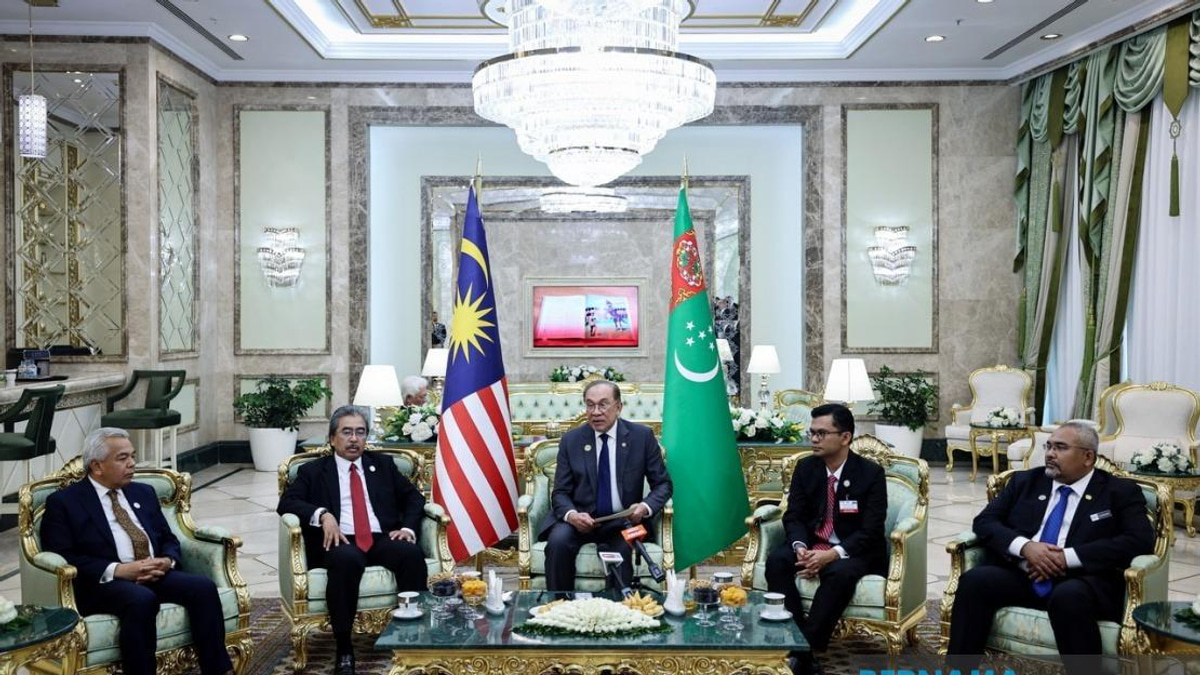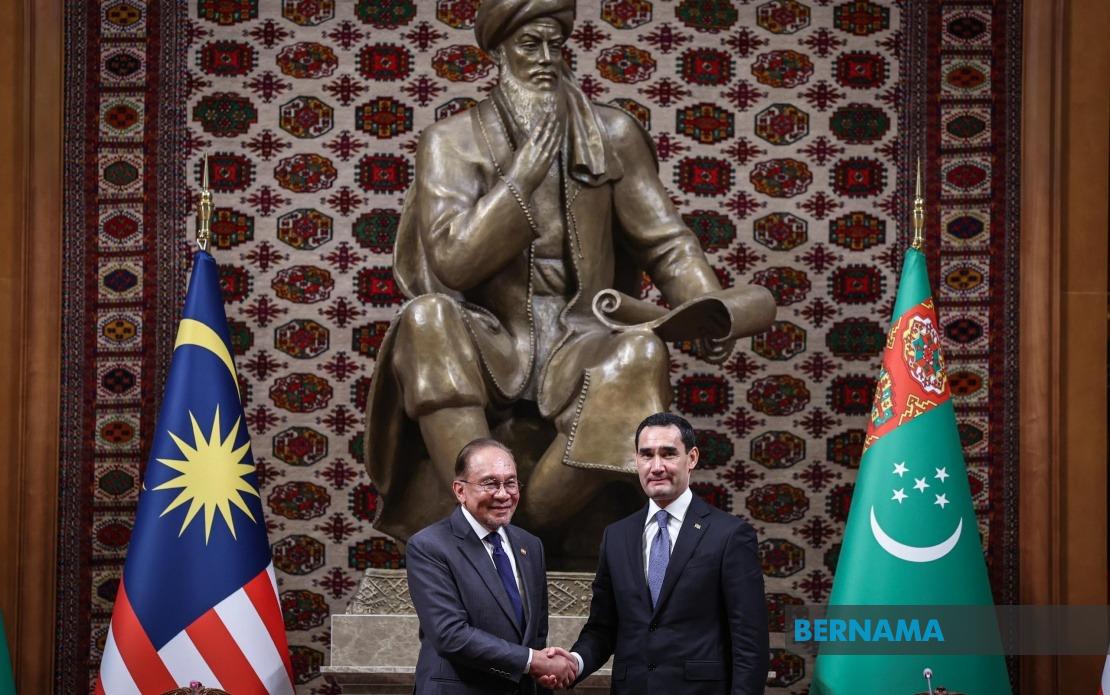
Prime Minister Datuk Seri Anwar Ibrahim has announced a significant upgrade in Malaysia's relationship with Turkmenistan, framing the partnership as a long-term investment in mutual prosperity and shared strategic interests. During his first official visit to the Central Asian nation since assuming office in November 2022, Anwar met with President Serdar Berdimuhamedov at the Presidential Palace in Ashgabat on Friday, where both leaders committed to transforming their bilateral ties into a more structured, progressive and complementary arrangement that benefits their respective populations.
The depth of this renewed engagement became evident through the formal exchange of multiple agreements and memoranda of understanding. Malaysia and Turkmenistan signed an Air Services Agreement that will expand connectivity between the two nations, a crucial step for facilitating people-to-people exchange and business travel. Complementing this aviation pact were three additional institutional MoUs designed to foster cooperation at the diplomatic, governmental and research levels. The Institute of Diplomacy and Foreign Relations under Malaysia's Ministry of Foreign Affairs inked an MoU with Turkmenistan's Institute of International Relations, creating formal channels for sustained dialogue on foreign policy matters. Malaysia's Ministry of Transport established a partnership with Turkmenistan's State Service, while the Academy of Sciences Malaysia signed a cooperation agreement with the Academy of Sciences of Turkmenistan, positioning both nations for enhanced scientific and technological collaboration.
What distinguishes this diplomatic initiative from routine bilateral courtesies is the breadth and ambition of the sectoral cooperation being pursued. The discussions between Anwar and Berdimuhamedov encompassed energy resources, where Turkmenistan's significant hydrocarbon reserves hold potential interest for Malaysia's energy security considerations. Trade and investment frameworks received substantive attention, reflecting both nations' desire to deepen economic interdependence. The halal industry emerged as a particularly promising avenue, given Malaysia's positioning as a global halal hub and Turkmenistan's growing interest in meeting international standards in this space. Islamic banking cooperation was also highlighted, suggesting that financial institutions from both countries will explore avenues for cross-border transactions and product development tailored to Muslim-majority markets.
Education and research figured prominently in the bilateral agenda, underscoring a recognition that human capital development and knowledge transfer will be essential to the partnership's durability. Both governments view science and technology collaboration not merely as technical exercises but as pathways to addressing shared challenges in sustainable development. Tourism promotion was identified as another growth area, with the two nations seeking to attract visitors across Southeast Asia and Central Asia respectively. These sectoral priorities collectively suggest that Malaysia is pursuing a diversified engagement strategy with Turkmenistan rather than relying on any single commodity or relationship dynamic.
The commitment to disciplined, transparent and effective implementation of agreed areas represents an acknowledgment that declarations of intent frequently falter without robust institutional mechanisms. By emphasizing these governance principles, Anwar signalled that Malaysia intends to hold both itself and Turkmenistan accountable to the partnership's objectives. This language is particularly significant given the Central Asian country's historical challenges with institutional transparency, suggesting that Malaysia is attempting to import its own administrative standards into the bilateral relationship.
Anwar's delegation composition reflected the cross-governmental nature of this engagement. The inclusion of Minister of Investment, Trade and Industry Datuk Seri Johari Abdul Ghani and Minister of Economy Akmal Nasrullah Mohd Nasir underscored the economic dimension of the visit, with both officials positioned to translate high-level political commitments into concrete commercial opportunities. Senior government officials accompanying the Prime Minister provided technical expertise across the various cooperation domains being negotiated.
For Malaysia, this engagement with Turkmenistan carries particular strategic significance within the broader Central Asian context. Turkmenistan maintains a policy of permanent neutrality, making it a carefully managed diplomatic partner that balances relationships between regional powers including Russia and China. Malaysia's cultivation of this partnership demonstrates an intent to diversify its international engagement beyond traditional Southeast Asian and Muslim-majority foci, extending Malaysian soft power and commercial reach into a region increasingly important for energy supply chains and emerging market opportunities. The timing of Anwar's visit, coming roughly eighteen months into his premiership, reflects a maturation of his foreign policy approach that emphasizes structured economic partnerships alongside traditional diplomatic courtesy.
The joint statement signed during the visit formalizes the political framework underpinning these various cooperation mechanisms. Rather than remaining aspirational or ceremonial, the structured approach signals that both governments have committed to measurable outcomes and defined timelines for implementation. This contrasts with earlier bilateral relationships that sometimes involved elaborate announcements followed by limited practical follow-through. The emphasis on long-term benefits and strategic interests suggests that both sides view this partnership as extending well beyond the current political administration in either nation.
Turkmenistan's perspective on deepening ties with Malaysia reflects its own strategic diversification away from exclusive reliance on Russian and Chinese partnerships. By engaging Malaysia, Turkmenistan gains access to Southeast Asian markets and opportunities to strengthen its position within Muslim-majority diplomatic forums. The Central Asian nation has historically sought partnerships that enhance its international legitimacy and economic options, making Malaysia's overture particularly valuable. Turkmenistan's vast natural gas reserves and geographic position along Belt and Road corridors create mutual interests that can sustain the bilateral relationship across multiple policy domains.
For Malaysian businesses and investors, the agreements reached during this visit open new opportunities in a relatively underexplored market. Central Asia remains substantially less integrated into regional supply chains and commercial networks compared to Southeast Asia, suggesting substantial potential for Malaysian companies operating in logistics, halal production, Islamic finance and technology sectors. The air services agreement is particularly significant, as it removes transportation barriers that have previously limited commercial engagement between Malaysian and Turkmen enterprises.
The energy sector cooperation warrants particular attention given Malaysia's ongoing need to secure diverse energy supplies and manage its own hydrocarbon resources strategically. While Turkmenistan's vast gas reserves may not immediately fulfill Malaysia's immediate needs, the partnership creates possibilities for technology transfer in extraction and processing, as well as participation in third-country projects where both nations collaborate. This arrangement diversifies Malaysia's energy diplomacy beyond traditional Middle Eastern partnerships.
Looking forward, the success of this partnership will depend substantially on the competence and commitment of implementing institutions. The emphasis on disciplined execution suggests that Anwar's administration recognizes that partnership declarations frequently fail when supporting bureaucratic structures lack clarity, resources or sustained attention. The role of the newly established institutional linkages between foreign ministries, scientific academies and transport authorities will therefore be crucial to translating political commitment into tangible cooperation outcomes.
This engagement with Turkmenistan also reflects broader regional dynamics in which Southeast Asian nations are increasingly establishing direct bilateral relationships with Central Asian counterparts rather than engaging through traditional multilateral frameworks. Malaysia's proactive approach positions it favorably within this evolving diplomatic landscape while simultaneously enhancing its international standing as a nation capable of managing complex, multi-sectoral partnerships across diverse geographical and cultural contexts.
%22%2F%3E%3C%2Fpattern%3E%3C%2Fdefs%3E%3Crect%20width%3D%22100%25%22%20height%3D%22100%25%22%20fill%3D%22url(%23ph3sm85g)%22%2F%3E%3Crect%20width%3D%22100%25%22%20height%3D%22100%25%22%20fill%3D%22url(%23ph3sm85p)%22%2F%3E%3Ctext%20x%3D%2250%25%22%20y%3D%2250%25%22%20text-anchor%3D%22middle%22%20dominant-baseline%3D%22central%22%20fill%3D%22rgba(255%2C255%2C255%2C0.95)%22%20font-family%3D%22Georgia%2C%20'Times%20New%20Roman'%2C%20serif%22%20font-weight%3D%22700%22%20font-size%3D%22226%22%20letter-spacing%3D%22-0.02em%22%3ERussia%3C%2Ftext%3E%3C%2Fsvg%3E)