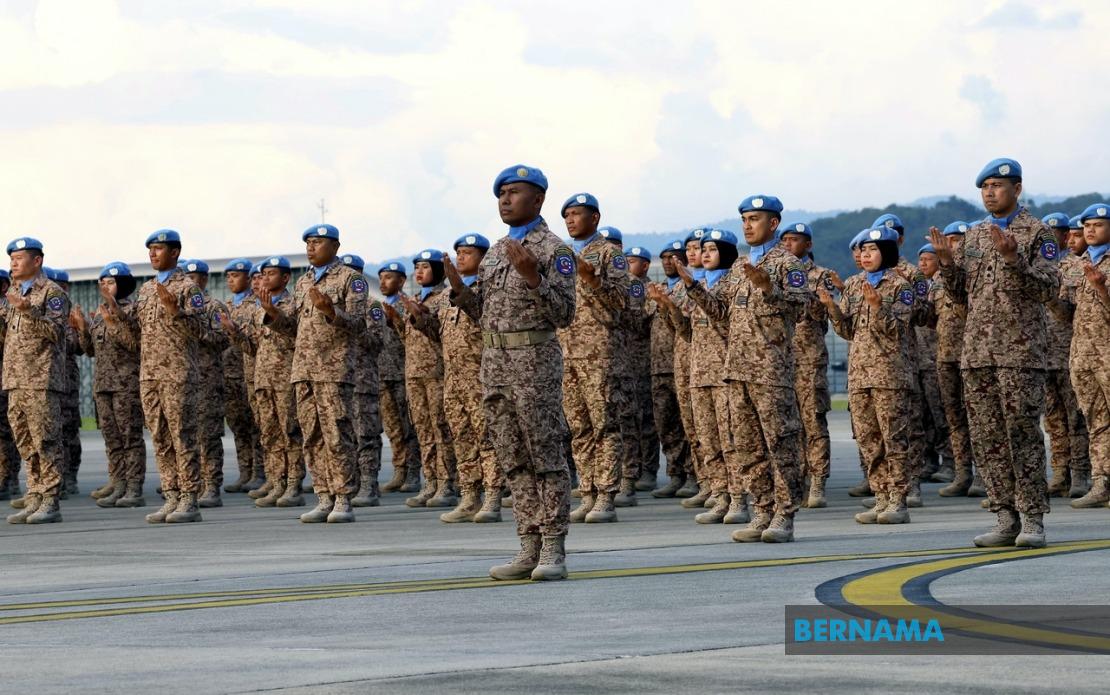
Malaysia's peacekeeping contingent deployed in Lebanon has secured a strategically advantageous position that substantially mitigates the risk of direct involvement in ground-level conflict along the volatile Lebanon-Israel frontier. Defence Minister Datuk Seri Mohamed Khaled Nordin outlined how the Malaysian Battalion (MALBATT) 850-13 operates from a centrally situated base rather than positions closer to the international boundary, fundamentally altering the force's exposure profile amid escalating regional tensions.
The deployment strategy represents a calculated approach to balancing Malaysia's commitment to international peacekeeping with force protection imperatives. Unlike peacekeeping contingents from France and Indonesia, which maintain positions nearer to the demarcation zone between Lebanon and Israel, MALBATT's positioning creates a geographical buffer that would shield personnel from immediate engagement should military operations intensify along the border. This central placement allows the Malaysian contingent to fulfil its mandate while operating from a location that inherently reduces casualty risk from ground-based hostilities.
The tactical rationale reflects lessons learned from decades of United Nations peacekeeping operations across volatile regions. Positioning forces at a distance from active conflict zones while maintaining capacity to respond to humanitarian needs or security emergencies has proven effective in previous deployments. For Malaysia, a country with limited military resources compared to larger peacekeeping contributors, this approach maximises operational effectiveness while conserving personnel and equipment for potential extended commitments.
However, the Defence Minister's acknowledgment of shifting threat vectors reveals a more complex security environment than traditional border conflicts. Aerial capabilities including unmanned drones and fighter aircraft operate according to different spatial logic than ground forces, rendering positional advantages far less relevant. This distinction underscores how modern conflict dynamics have evolved beyond the conventional warfare patterns that historically shaped military deployment strategies in the Middle East and South Asia.
The elevation of aerial threats to primary concern status indicates that Malaysian defence planners are adapting assessment protocols to account for technological capabilities deployed by regional actors. Israel's documented use of advanced aviation assets and the proliferation of drone technology among non-state actors throughout West Asia mean that geographical distance from border installations provides minimal protection against air-launched ordinance. The centrality of MALBATT's position, once a primary advantage, becomes almost irrelevant when adversaries possess the ability to project power across significant distances.
To address these evolved security challenges, MALBATT has implemented comprehensive emergency procedures requiring personnel to maintain heightened situational awareness and utilise hardened bunker facilities as primary refuge during air attack warnings. These standard operating procedures represent the institutional response to an environment where conventional defensive measures—observation posts, barrier systems, vehicle dispersal—offer limited efficacy against airborne threats. The requirement for continuous vigilance acknowledges that protection now depends significantly upon rapid early warning and immediate shelter access rather than static defensive positions.
The deployment carries particular significance for Malaysian defence policy given the nation's broader engagement with United Nations peacekeeping operations. MALBATT's participation demonstrates Malaysia's commitment to international security architecture at a moment when major powers are reassessing their own involvement in multilateral operations. The decision to maintain forces in an increasingly dangerous environment signals confidence in Malaysia's capacity to manage complex security situations while advancing regional stability through diplomatic military presence.
For Malaysian service personnel and their families, the deployment presents both professional opportunity and genuine risk. The Defence Ministry's public acknowledgment of threats—rather than minimisation—suggests an institutional commitment to transparency about operational dangers. This approach contrasts with historical patterns where military establishments downplayed risks to maintain recruitment momentum or political support. Datuk Seri Mohamed Khaled's direct articulation of shifting threat parameters indicates Malaysia's armed forces leadership recognises that personnel deserve accurate threat assessments to make informed career decisions.
The broader regional context intensifies the significance of Malaysia's peacekeeping role. As West Asian tensions escalate and major powers recalibrate their military commitments, smaller nations like Malaysia filling peacekeeping roles become increasingly valuable to international stability efforts. The United Nations Interim Force in Lebanon (UNIFIL), of which MALBATT forms a component, operates as a crucial buffer preventing direct military escalation. Malaysian participation provides diplomatic weight while contributing military capability that international security architecture depends upon.
The positioning strategy also reflects Malaysia's careful navigation of complex regional politics. By maintaining distance from border areas controlled by France and Indonesia, MALBATT avoids positioning that might create domestic political complications or suggest particular alignment with larger peacekeeping contributors. This apparent neutrality through geographical separation allows Malaysia to participate meaningfully while preserving diplomatic flexibility regarding broader Middle Eastern developments.
Looking forward, MALBATT's deployment will likely serve as a testing ground for how Malaysian forces adapt to modern security challenges. The emergency procedures now in place, emphasising aerial threat response, will inform future doctrine development across the Malaysian Armed Forces. As countries globally reassess force posture in response to drone proliferation and advanced aviation capabilities, Malaysia's experience in Lebanon could yield operational insights applicable to other potential deployment scenarios throughout the Indo-Pacific region.
The Defence Minister's emphasis on vigilance and preparedness suggests that while the current positioning arrangement provides tangible benefits regarding ground combat risk, complacency would be strategically dangerous. MALBATT personnel must recognise that technological evolution has created security environments fundamentally different from those their predecessors faced, requiring constant adaptation of protective measures and operational procedures to maintain force effectiveness and personnel safety in an increasingly complex theatre.