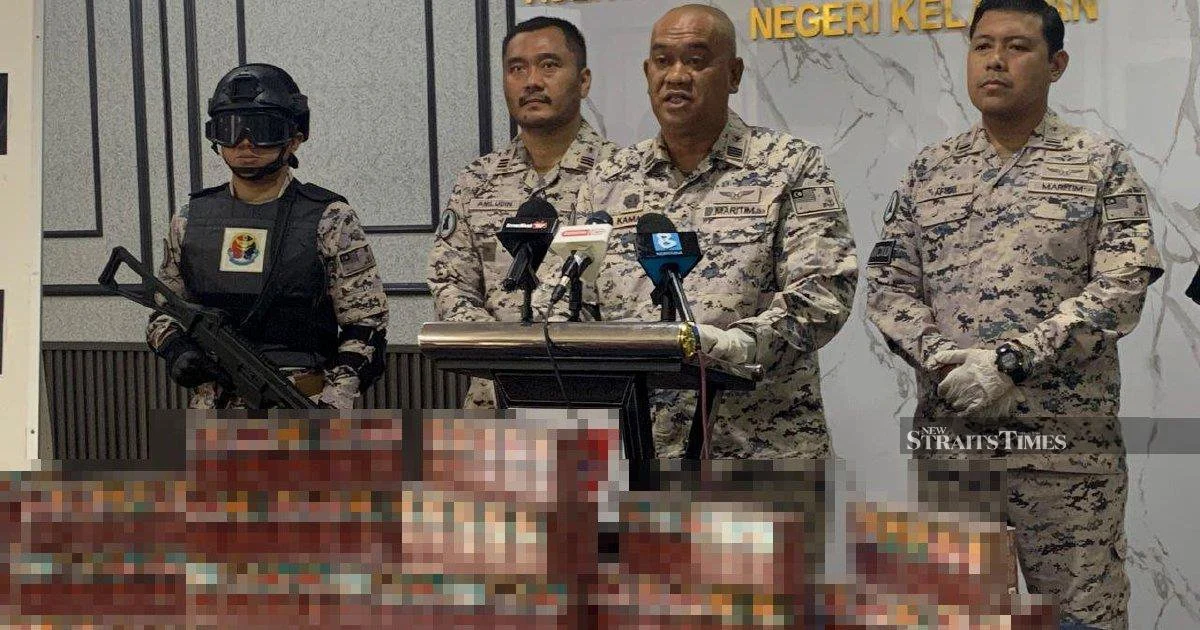
The Malaysian Maritime Enforcement Agency (MMEA) has uncovered a significant haul of illegal cigarettes during a recent patrol operation in Kelantan, confiscating 24 boxes of contraband goods with an estimated market value of about RM212,000. The seizure took place at Kampung Penambang in the Pasir Puteh district, highlighting ongoing efforts to combat smuggling activities in Malaysia's coastal and riverine regions.
The interception marks another successful enforcement action by the MMEA, whose maritime patrols extend beyond traditional ocean boundaries to include river systems and inland waterways that frequently serve as trafficking routes. These operations are critical to disrupting illicit supply chains that channel contraband goods into Malaysian markets, often through less-monitored water corridors that connect to major population centres and commercial hubs across the peninsula.
Contrabanded cigarettes represent a persistent enforcement challenge across Southeast Asia, where the combination of high local taxes, significant price differentials with neighbouring countries, and substantial profit margins creates powerful incentives for smuggling networks. The cigarette black market in Malaysia directly undermines government revenue, with excise duties on tobacco products forming a substantial portion of state income. Each successful seizure by authorities represents not only confiscated contraband but also revenue recovered through preventive action rather than lost permanently to the underground economy.
The Kelantan operation reflects the MMEA's expanded mandate to monitor not only maritime security threats but also customs enforcement along waterways that remain vulnerable to organised smuggling operations. The river systems serving Pasir Puteh and surrounding areas have historically attracted trafficking activity due to their accessibility, multiple entry points, and connections to both urban markets and transit routes extending toward Terengganu and beyond. Smugglers exploit geographical advantages and lower visibility compared to land border checkpoints to move contraband efficiently.
Cigaret smuggling networks typically involve sophisticated distribution chains, from source procurement in countries with lower tax regimes—particularly Singapore, Thailand, and occasionally Vietnam—through middle-man operations, to retail-level street distribution in Malaysian cities. The 24-box seizure suggests either an intercepted shipment heading toward a distribution point or stock destined for multiple retail outlets. The value assessment of RM212,000 indicates these were likely premium or branded cigarettes commanding higher prices in black markets than locally-manufactured alternatives.
Enforcement agencies throughout Malaysia have intensified scrutiny of river and coastal areas where traditional surveillance infrastructure remains limited. The MMEA's success here demonstrates the effectiveness of targeted patrols in high-risk zones, though the volume of contraband still reaching Malaysian streets suggests that interdiction efforts, while valuable, represent only partial solutions to broader smuggling networks. The agency's capacity remains stretched across thousands of kilometres of coastline and multiple river systems simultaneously.
The socioeconomic implications of cigarette smuggling extend beyond lost government revenue. Underground markets enable cheaper access to tobacco products, potentially influencing consumption patterns particularly among price-sensitive demographic groups. Public health authorities link increased accessibility to elevated smoking prevalence, which generates downstream healthcare costs and productivity losses that often exceed the tax revenue forgone through smuggling. This dynamic creates a public policy paradox where enforcement success, though important, requires complementary strategies addressing demand-side factors and taxation policy.
Regional cooperation remains essential for combating cigarette smuggling effectively, given the transnational nature of these networks. Coordinated efforts between Malaysian authorities and counterparts in Thailand, Singapore, and Indonesia have yielded results in disrupting major trafficking routes, though inconsistent enforcement capacity and differing regulatory approaches across borders continue to complicate comprehensive interdiction. The Kelantan seizure occurred within Malaysia's jurisdictional waters, but the original sources and ultimate destinations typically involve multiple countries.
For Malaysian readers and regional observers, this seizure underscores the ongoing security challenges in relatively ungoverned maritime spaces that benefit traffickers. While MMEA operations achieve meaningful successes, the persistence of large-scale contraband movements suggests that even with increased patrols, enforcement gaps remain exploitable. Sustainable solutions require not only more agency resources but also intelligence-led targeting of trafficking network nodes—particularly storage facilities, distribution centres, and retail points—rather than purely tactical interceptions of goods in transit.
Moving forward, the effectiveness of anti-smuggling efforts will depend on whether enforcement agencies can transition from reactive interdiction to proactive disruption of organised networks. The Kelantan operation demonstrates operational capability, but scaling this success requires sustained investment in maritime surveillance technology, intelligence sharing between agencies, and cross-border cooperation mechanisms that remain inconsistently implemented across Southeast Asia.