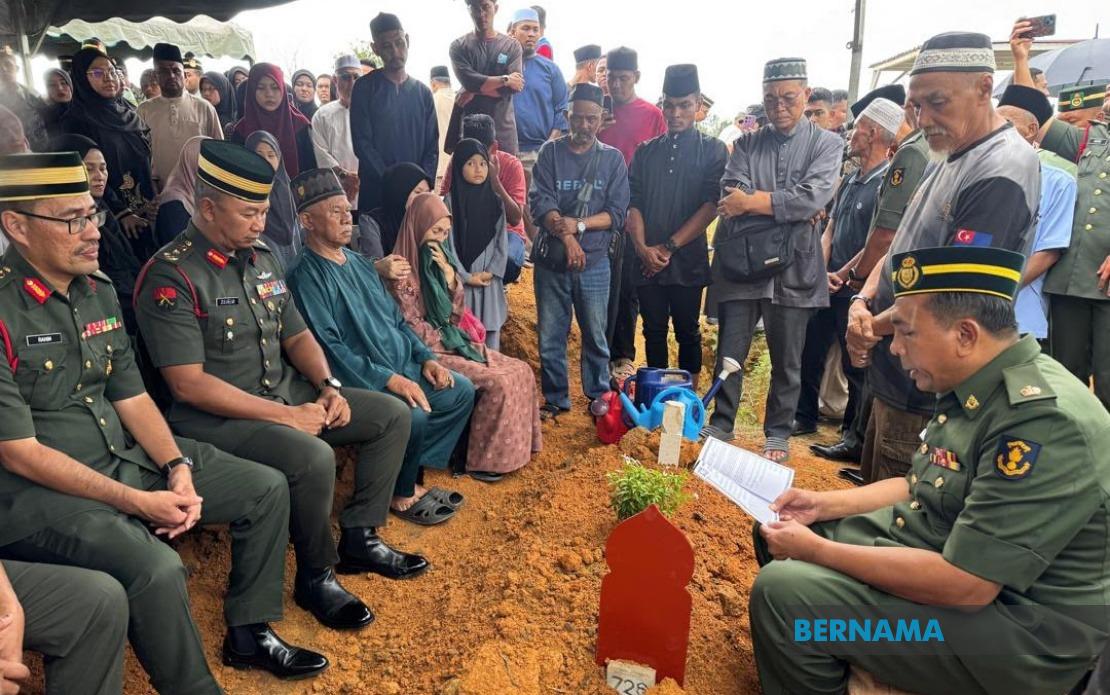
The death of Private Siti Khadijah Sungip during a grenade exercise at Hobart Camp in Gurun, Kedah, has cut short a young soldier's journey to realise a lifelong ambition. The 24-year-old, who had enlisted in the Malaysian Army driven by a deep passion for military service and the desire to honour her family's armed forces heritage, was killed in the training incident yesterday morning alongside Corporal Norazmi Abu Bakar. Both personnel succumbed to their injuries whilst being transported to Sultan Abdul Halim Hospital in Sungai Petani.
For Sungip Jais, her 65-year-old father, the tragedy represents the shattering of a father's hope to witness his youngest child carry forward the family's military tradition. A retired soldier who served with the Royal Artillery Regiment, Sungip had watched his daughter nurture her military aspirations from childhood, observing how she deliberately chose a career path that would echo his own service to the nation. Speaking at his home in Taman Sri Lambak, Kluang, he recounted how Siti Khadijah had explicitly told him she wanted to continue the legacy because of his own military background.
After completing her Diploma in Civil Engineering focusing on Highways and Transportation at Mara Higher Skills College in Sri Gading, Siti Khadijah pursued her military ambitions by applying to join the Malaysian Army. Her father emphasised that she harboured no ordinary interest in soldiering—her commitment to the family's military lineage ran deeper than the typical career choice. She was inseparable from her family and had even expressed a remarkable resolve to postpone marriage indefinitely so that she could devote her time to caring for her parents, a decision that underscores her character and filial piety during what would turn out to be her tragically brief adult life.
The final messages Siti Khadijah sent to her family revealed a soldier content with her chosen path. Her elder sister, Siti Zaihah, 39, recalled receiving a photograph via WhatsApp at midnight on 15 June, an image that has now become the family's last tangible memory of the young private. The photo captured Siti Khadijah during a shooting practice session, which she had indicated was the most fulfilling component of her training regimen since joining the Army the previous year. In her communication with her sister, Siti Khadijah mentioned that she would undergo additional training exercises the following day, with the grenade exercise scheduled to commence around 8 am.
The shock of the tragedy descended upon the family without warning. Around 1 pm that day, Siti Zaihah received an initial telephone call informing her that her sister had experienced an accident. The vagueness of the initial report led her to speculate that it might be a minor incident or perhaps a traffic accident unrelated to military operations. However, a subsequent call brought devastating clarity—the incident had occurred during the grenade training exercise, and Siti Khadijah had been fatally injured. The compressed timeline between the family's last cheerful exchange and the announcement of her death compressed months of normal family life into mere hours.
Just a week before the incident, Siti Khadijah had returned home to celebrate Hari Raya Aidiladha with her family. Her sister recalled that she appeared characteristically cheerful and exhibited no outward signs of distress or apprehension about her upcoming training commitments. This normalcy in her demeanour meant that no family member harboured any premonition of the impending tragedy, making the loss even more difficult for the family to process and accept. The contrast between her vibrant presence during the festive season and her sudden absence has left a permanent void in the family's daily existence.
Siti Khadijah's potential as a soldier had already been formally recognised by her superiors. In January of this year, she received the Best Female Recruit (Academic) Award, an honour that acknowledged her exceptional performance during basic military training at the Army Basic Training Centre in Port Dickson, Negeri Sembilan. Born on 19 September 2002 in Kluang, she had undergone her recruit training with Juliet Company before being assigned to the Royal Army Engineers Regiment, a posting that reflected the Army's confidence in her abilities and commitment. Her academic excellence during the foundational phase of military service suggested that she possessed the intellectual rigour and discipline necessary for advancement within the service.
The circumstances surrounding military training fatalities raise important questions about safety protocols and risk management within armed forces training programmes. Grenade exercises represent one of the more hazardous components of military training, and incidents such as this highlight the inherent dangers that soldiers face during routine preparation for combat duties. While training accidents are acknowledged as occupational risks within military contexts across all nations, each loss represents a family's profound grief and a community's shared sorrow. The Malaysian public has long held its military personnel in high regard, recognising the sacrifices they undertake to maintain national security.
Siti Khadijah's passing resonates particularly because her story embodies the aspirations of many young Malaysians who view military service as both a patriotic duty and a personal calling. Her choice to join the armed forces was not driven by economic necessity but by genuine conviction and family pride. In this sense, her death represents not merely the loss of an individual soldier, but the unfulfilled potential of a young woman who had charted a meaningful course through life based on values of service, duty, and familial honour. The seven siblings she left behind, along with her parents, must now contend with the permanent absence of someone described as close to the family and deeply devoted to their welfare.
The funeral rites were conducted with military honours befitting her status as a serving soldier. Siti Khadijah's remains were laid to rest at Taman Sri Lambak Islamic Cemetery in her hometown this afternoon, allowing her to be buried near her family home and within the community that knew her throughout her life. Her father's grief, held back with visible effort during his recounting of her life and aspirations, reflects the particular pain of a parent who had envisioned a future in which his daughter would continue both the family profession and the household responsibilities he had hoped she would undertake. Instead, her legacy rests in the memory of her dedication, her award for academic excellence, and the respect she garnered during her brief period of service to the nation.