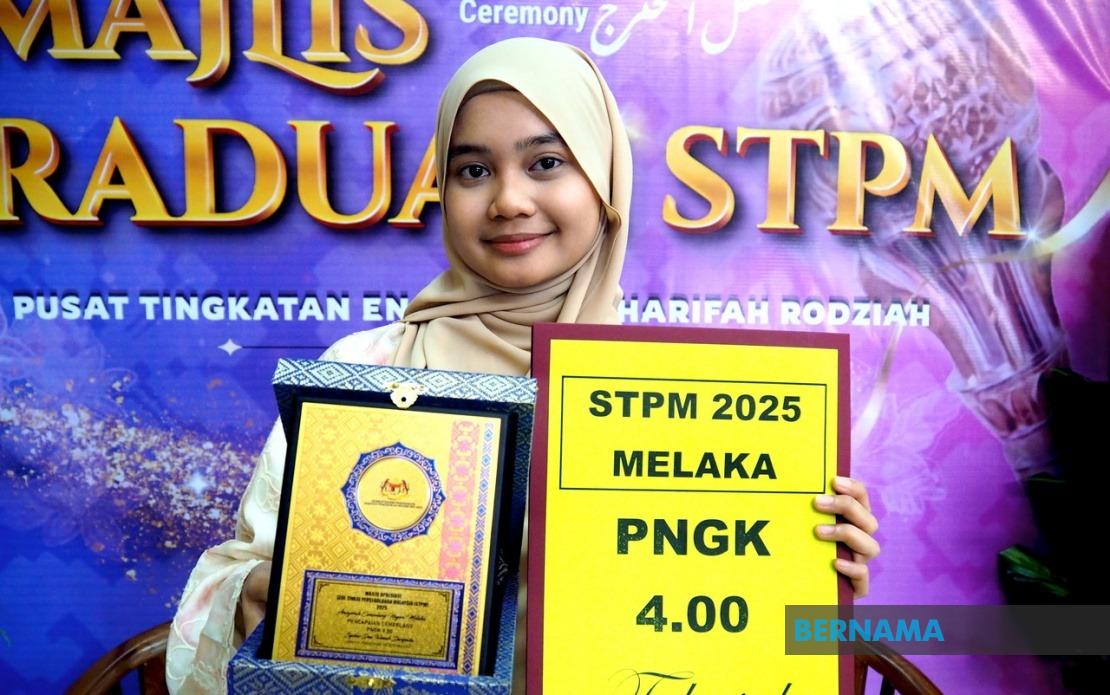
Nurfariesya Nasywa Hamedee's path to academic excellence was forged through personal tragedy and unwavering family dedication. The 21-year-old student from Sekolah Menengah Kebangsaan Agama Sharifah Rodziah in Melaka achieved a flawless Cumulative Grade Point Average of 4.00 in the 2025 Sijil Tinggi Persekolahan Malaysia (STPM) examination, making her achievement a testament to resilience in the face of grief. What distinguishes her success story from countless others is the profound emotional anchor that propelled her forward—her late father's final counsel, delivered through her mother just days before a heart attack claimed his life.
Hamedee Asri's unexpected death at age 43 struck during one of the most critical phases of his daughter's secondary education. The timing was particularly cruel: Nurfariesya was preparing for her Sijil Pelajaran Malaysia trial examination when the tragedy unfolded. Rather than serving as motivation at that moment, the loss initially threatened to derail her academic ambitions entirely. The psychological weight of losing a parent, combined with the financial strain that often accompanies such circumstances in Malaysian families, led the young student to contemplate abandoning her education altogether. The prospect of joining the workforce to alleviate her family's financial burden seemed like the more practical choice.
Yet the words her father had entrusted to her mother before his death proved transformative. Hamedee's insistence that Nurfariesya not squander her intellectual potential became a compass that guided her through the darkest period of her adolescence. This message, simple yet profound, represented her father's final expression of faith in her capabilities and his desire to see her fulfil her dreams. When despair threatened to overwhelm her, Nurfariesya returned to this counsel, finding in it both comfort and responsibility. She recognized that honouring her father's memory meant persevering through her studies, no matter how overwhelming the emotional burden felt.
The perfect CGPA score carries particular significance as a tribute to her father's legacy. Remarkably, even Nurfariesya herself did not anticipate achieving this pinnacle of academic performance. Based on her STPM trial results and preliminary calculations, she had conservatively estimated her final CGPA at approximately 3.92—already an exceptional result by any measure, but short of perfection. The unexpected elevation to a flawless 4.00 transformed what was already a outstanding achievement into something extraordinary. Receiving these results at the 2025 Melaka State STPM Results announcement ceremony, officiated by State Deputy Exco for Education, Higher Education, and Religious Affairs Datuk Rosli Abdullah, made the moment even more poignant for the family present to celebrate the milestone.
Nurfariesya's stellar academic record extends well beyond her STPM results, demonstrating consistency and dedication throughout her secondary education. In her Sijil Pelajaran Malaysia examination, she secured seven A grades, establishing herself as a high-performing student from her early secondary years. Her selection of subjects for STPM—General Studies, Arabic, Usuluddin, History, and Shariah—reflects a deliberate choice aligned with her long-term career aspirations. This subject combination is notably specialized, indicating that her excellence was not achieved through convenience but through sustained commitment to a specific educational pathway.
The intellectual curiosity that sustained Nurfariesya's academic journey appears rooted in genuine passion rather than mere grade-chasing. Since her early school days, she has harboured a particular fascination with Shariah law, a field that combines her interests in Islamic knowledge, legal reasoning, and social justice. This intrinsic motivation proved invaluable during the demanding preparation for STPM examinations. Rather than studying subjects because they are required, Nurfariesya engaged with her curriculum driven by authentic interest in how Islamic jurisprudence operates within the Malaysian legal framework and beyond. This distinction between studying for grades versus studying for understanding typically yields superior long-term retention and problem-solving abilities.
Her ambitions extend naturally from her academic interests and achievements. Nurfariesya aspires to become a Shariah lawyer, a profession that requires both deep knowledge of Islamic law and practical legal training. To realize this goal, she has set her sights on pursuing a Bachelor's degree at Universiti Malaya, Malaysia's premier institution and a natural launching pad for specialized legal studies. Recently, she has navigated the competitive interview process for the university's degree programs, adding another layer of achievement to her impressive portfolio. The combination of her STPM results and demonstrated passion for her field substantially strengthens her candidacy for admission to her preferred institution.
When asked about the secrets to her remarkable achievement, Nurfariesya offered an answer that reflects maturity beyond her 21 years. She emphasized three interconnected principles: diligent study, perseverance in the face of obstacles, and unwavering faith in Allah. Notably absent from her formula for success were claims about special study techniques, tutoring advantages, or any suggestion that her achievement was somehow inevitable or luck-dependent. This humility and spiritual grounding suggest that Nurfariesya understands her success as the product of personal effort combined with factors beyond her complete control, a balanced perspective that many high-achieving students lack. Her willingness to attribute success partly to divine blessing rather than exclusively to personal merit demonstrates the values cultivated in her Islamic education.
Nurfariesya's strategic decision to pursue STPM rather than alternative post-secondary pathways reveals pragmatic thinking about her educational trajectory. Having completed her SPM examinations years earlier, she faced the choice between pursuing Form Six or enrolling directly in pre-university programmes such as matriculation. Her selection of STPM was motivated by two practical considerations: the pathway's relative brevity compared to certain alternatives, and its proven effectiveness in opening doors to prestigious universities both domestically and internationally. This decision-making process illustrates how successful students often combine both aspirational thinking about their ultimate goals with practical assessment of the most efficient routes to achieve them.
Nurfariesya was not alone in bringing distinction to Melaka's 2025 STPM cohort. Ng Zhen Hong, a 20-year-old student from Kolej Tingkatan Enam Tun Fatimah, earned national recognition by winning the Best Student Award for the Science Stream at the national level. Ng's achievement, while different in its focus and recognition, shares several characteristics with Nurfariesya's journey. Both students benefited immensely from parental support and teacher mentorship, suggesting that the quality of guidance available to students remains critical even in an era of abundant online educational resources. Ng, the eldest of two siblings, devoted between one and two hours daily to revision and approached challenges in science subjects—particularly those requiring calculation and problem-solving—as opportunities rather than obstacles.
Ng's path to achieving the national science award was also marked by consistent excellence throughout secondary education, having earned ten A grades in his SPM examination. His planned pursuit of either Chemical Engineering or Electrical Engineering at Universiti Malaya demonstrates how top-performing science students in Malaysia continue to concentrate their talents in engineering disciplines that promise strong employment prospects and competitive remuneration. Like Nurfariesya, Ng expressed surprise at his national-level recognition, indicating that even high-achieving students often cannot fully predict how their performance will rank relative to their peers across the entire nation. This shared humility among Malaysia's top STPM performers suggests a culture of achievement grounded in genuine learning rather than in competitive ego.
The achievements of both Nurfariesya and Ng carry broader implications for Malaysian secondary and higher education. Their success stories demonstrate that excellence remains accessible to students who combine intellectual ability with sustained effort, family support, and personal motivation. The diversity of their paths—Nurfariesya's focus on Islamic studies and law, Ng's concentration on science—shows that Malaysia's educational system continues to produce top-tier graduates across different disciplinary domains. For younger students currently in secondary education, these narratives offer evidence that dedication to studies yields measurable rewards in terms of university admission opportunities and future career prospects. Furthermore, both students' willingness to acknowledge the roles of family members and teachers underscores the importance of supportive learning environments in nurturing academic excellence across Malaysian schools.