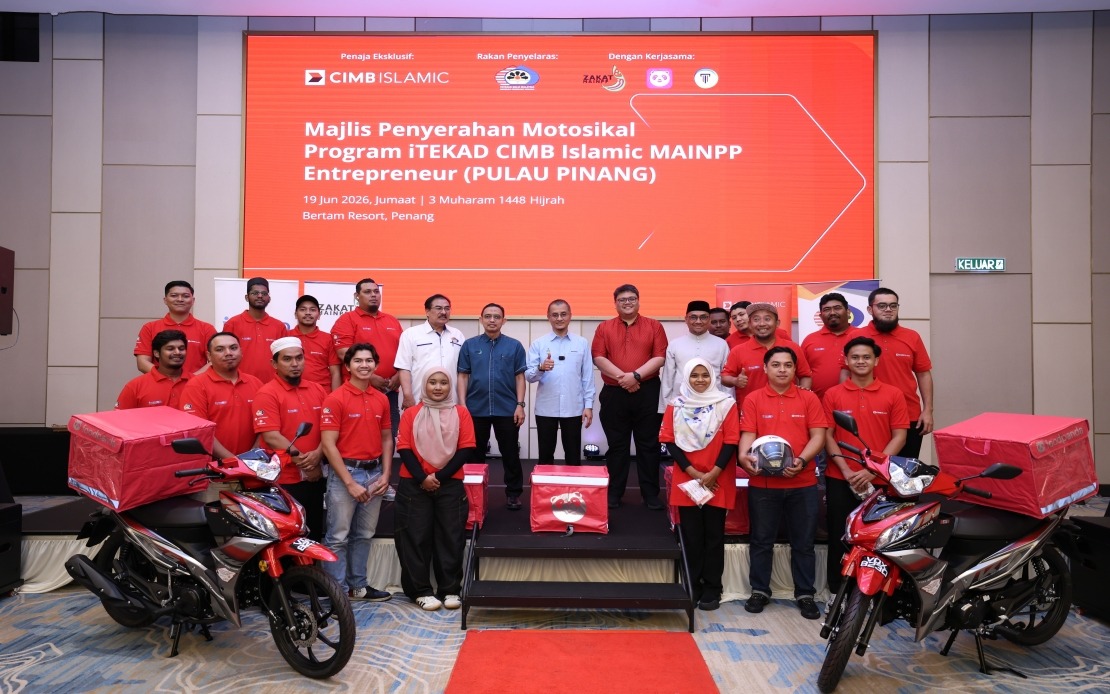
Twenty carefully selected participants have been awarded motorcycles and delivery equipment as part of the iTEKAD CIMB Islamic-MAINPP Entrepreneur programme, a collaborative initiative designed to expand economic opportunities within Penang's asnaf communities. The handover ceremony, held at Bertam Resort in Kepala Batas, marks a significant milestone in efforts to provide vulnerable populations with productive assets and the knowledge required to establish independent income streams. The initiative reflects growing recognition among Malaysian financial and religious institutions that poverty alleviation demands more than material support alone—it requires integrated training, mentorship and sustained oversight.
The programme operates through a carefully structured partnership between CIMB Islamic Bank Berhad and Zakat MAINPP, the charitable arm of the Penang Islamic Religious Council, alongside implementation partners including the Malaysian Youth Foundation (YBM), Taylor's Community and foodpanda Malaysia. This multi-stakeholder approach proves particularly valuable as it channels diverse expertise and resources toward a unified objective. Penang Deputy Chief Minister I Datuk Dr Mohamad Abdul Hamid, who also chairs MAINPP, underscored that effective asnaf development demands institutional collaboration rather than isolated efforts by single organisations. The combination brings financial resources, religious governance frameworks, youth development experience and established delivery networks into a cohesive programme.
The initiative draws upon a seed fund totalling RM400,000, structured as a matching grant with equal contributions from two sources. CIMB Islamic Bank Berhad committed RM200,000 from its Wakalah Zakat fund, while Bank Negara Malaysia provided the remaining RM200,000. This dual-funding arrangement demonstrates how public and private sector financial institutions can mobilise resources toward social objectives while maintaining compliance with Islamic banking principles. The involvement of Malaysia's central bank signals official endorsement of the programme's approach and suggests potential replicability across other states seeking to implement comparable asnaf empowerment initiatives.
The selection process proved rigorous, reflecting the programme's commitment to identifying genuinely motivated participants capable of sustaining business operations. Zakat MAINPP initially received 151 applications, indicating substantial demand for such opportunities within the target community. Shortlisted candidates progressed through formal interviews and attended an intensive Entrepreneurship Camp held from May 31 to June 3, 2026. This residential bootcamp component—extending across multiple days—allowed evaluators to assess not merely entrepreneurial knowledge but also work discipline, interpersonal capabilities and commitment levels under immersive conditions. The final selection of 20 participants represents approximately 13 percent of applicants, confirming that recipients represent a carefully vetted cohort with demonstrated potential.
Beyond the motorcycles themselves, selected participants receive comprehensive support extending across financial management, business discipline and practical entrepreneurship training. Delivery equipment provided alongside the vehicles enables participants to immediately commence income-generating activities, particularly through partnerships with foodpanda Malaysia. This integration with an established logistics platform proves strategically significant, as it provides guaranteed income channels while removing initial barriers to customer acquisition. Rather than launching entirely independent enterprises, participants gain access to proven delivery marketplaces, substantially reducing startup risk and enabling faster revenue generation.
Datuk Dr Mohamad Abdul Hamid emphasised that the programme transcends mere asset transfer, functioning instead as a comprehensive life transformation initiative. Participants acquire structured training in basic financial management, work discipline protocols and entrepreneurial fundamentals—knowledge gaps that frequently constrain asnaf advancement despite possession of material resources. By combining physical assets with capability development, the programme addresses root causes of poverty rather than merely addressing symptoms. This holistic methodology reflects international best practices in microfinance and development economics, where cash or asset transfers without accompanying training frequently yield limited long-term impacts.
Alignment with the Penang Islamic Religious Development Agenda 2030 (APAI2030) provides strategic context for this initiative. The agenda commits to comprehensive ummah development spanning education, economic opportunity, family stability and youth empowerment. The iTEKAD programme directly advances economic pillars of this broader vision while simultaneously demonstrating institutional commitment to systematic uplift. By embedding asnaf empowerment within state-level religious development frameworks, Penang positions such initiatives as non-discretionary components of Islamic governance rather than charitable afterthoughts. This institutional integration enhances programme sustainability and creates pathways for expansion as APAI2030 progresses toward 2030.
The programme represents a meaningful evolution in zakat utilisation philosophy. Rather than limiting zakat funds to direct welfare assistance addressing immediate consumption needs, the iTEKAD initiative channels these religious charitable resources toward productive investments generating sustainable incomes. This application aligns with contemporary Islamic finance theory emphasizing zakat's potential role in economic development and inequality reduction. By providing motorcycles and training enabling participants to access delivery work markets, the programme transforms zakat from consumption support into capital provision—a distinction that may establish models for broader sector transformation.
For Malaysian policymakers and development practitioners, the iTEKAD programme offers instructive lessons regarding multi-sector collaboration in poverty reduction. The convergence of Islamic banking, religious governance institutions, youth development organisations and delivery commerce platforms demonstrates how entities with apparently disparate objectives can align around shared development goals. Bank Negara Malaysia's participation particularly signals willingness from financial regulators to actively support asnaf initiatives, suggesting potential for expanded central bank involvement in development financing beyond traditional monetary policy domains.
The immediate beneficiaries—20 selected participants—now possess enhanced capacity to generate structured incomes through formalised delivery work while simultaneously building entrepreneurial capabilities applicable across sectors. However, broader implications extend to communities within which these participants operate. Successful outcomes will likely attract additional applicants to subsequent programme cohorts, creating demonstration effects that motivate engagement with institutional support mechanisms. For Penang particularly, accumulation of successful asnaf entrepreneurs may gradually strengthen economic resilience within vulnerable communities while generating employment opportunities for non-participating residents.
Sustainability remains central to programme design. By focusing on delivery work through established platforms rather than directing participants toward novel ventures with uncertain demand, the programme reduces failure risks that plague many entrepreneurship initiatives. Continued partnership with foodpanda Malaysia ensures ongoing income opportunities as participant capabilities mature. The combination of short-term income generation with simultaneous capability building creates conditions for long-term graduation from asnaf classifications—the ultimate programme objective and genuine measure of success.
%22%2F%3E%3C%2Fpattern%3E%3C%2Fdefs%3E%3Crect%20width%3D%22100%25%22%20height%3D%22100%25%22%20fill%3D%22url(%23ph3sm85g)%22%2F%3E%3Crect%20width%3D%22100%25%22%20height%3D%22100%25%22%20fill%3D%22url(%23ph3sm85p)%22%2F%3E%3Ctext%20x%3D%2250%25%22%20y%3D%2250%25%22%20text-anchor%3D%22middle%22%20dominant-baseline%3D%22central%22%20fill%3D%22rgba(255%2C255%2C255%2C0.95)%22%20font-family%3D%22Georgia%2C%20'Times%20New%20Roman'%2C%20serif%22%20font-weight%3D%22700%22%20font-size%3D%22226%22%20letter-spacing%3D%22-0.02em%22%3ERussia%3C%2Ftext%3E%3C%2Fsvg%3E)