An early morning fire at a high-rise residential block in Singapore's Jurong West district resulted in a dramatic rescue operation and renewed warnings about household electrical hazards that resonate across Southeast Asia. The Singapore Civil Defence Force responded to the blaze in a 13th-storey unit at Block 842 Jurong West Street 81 at approximately 3.35am on June 17, where firefighters navigated through smoke-filled corridors to locate and extract two residents who required immediate medical attention.
The incident unfolded with the family of four occupants sleeping when the fire suddenly erupted in their living room. Preliminary investigations point to an electrical origin as the cause, highlighting how such seemingly routine appliances and power systems pose significant fire risks in densely populated urban housing across the region. The speed and intensity of the blaze underscored the danger of residential electrical fires, which can spread rapidly through confined spaces before occupants fully awaken to the threat.
The successful rescue owed much to the alertness of an 18-year-old neighbour living directly above the affected unit. The student, who had been awake playing games late into the night, detected smoke drifting from below and immediately took action rather than remaining passive. Upon noticing the thick smoke through windows, he descended the stairs and found the affected unit's door extremely hot to the touch, prompting him to knock loudly on nearby doors to alert neighbours. His decisive warning system potentially saved multiple lives by providing residents with crucial evacuation time before conditions deteriorated further.
Descriptions from the young rescuer painted a harrowing picture of the conditions inside the burning flat. A young woman from the household appeared at his family's door requesting towels, her appearance already bearing the marks of the inferno—singed hair and soot-blackened face revealing how quickly the fire had affected inhabitants. He also observed a man from the unit with severe thermal burns across his back and arms, the bright red colouration indicating fresh and serious injury requiring emergency medical intervention. These observations underscore how rapidly fire victims can sustain life-altering injuries in residential settings.
The SCDF's response involved sophisticated firefighting operations, with crews entering the smoke-logged unit to directly confront the blaze and extinguish it using water jets. The family of four, including the two who required rescue, were transported to Singapore General Hospital for treatment of their injuries. Beyond the immediate victims, approximately 40 other residents in the block were evacuated as a precautionary measure, reflecting standard safety protocols that prioritize protecting all occupants when structural integrity or smoke spread cannot be immediately assessed.
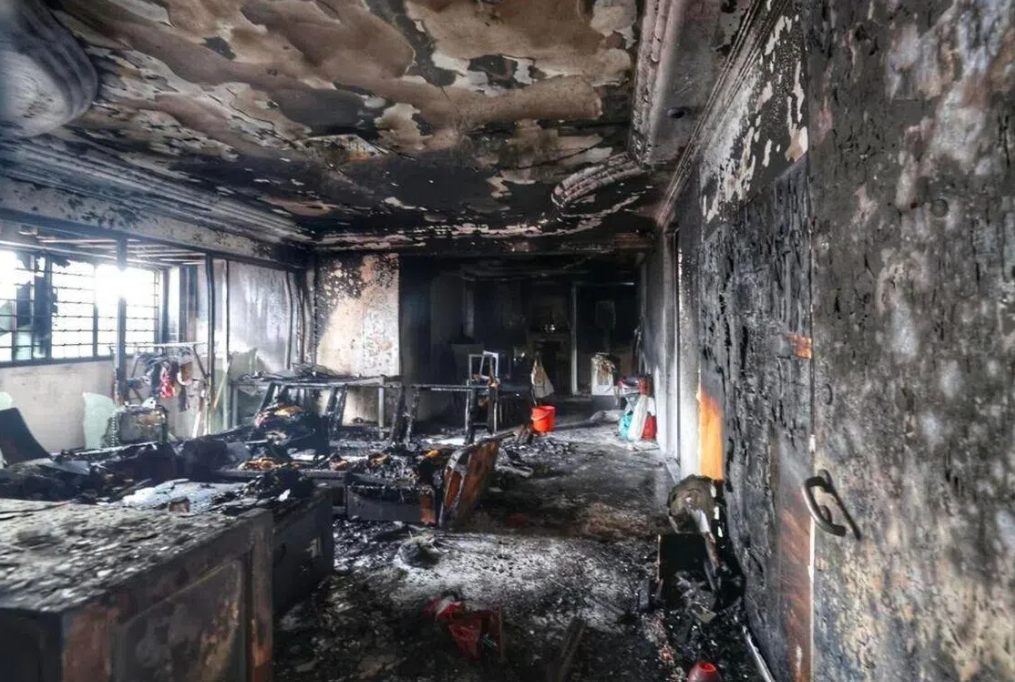
Media representatives who visited the site several hours after firefighters extinguished the flames documented the extent of damage characteristic of residential electrical fires. The unit's interior presented a blackened landscape, with walls and ceiling surfaces charred beyond recognition and windows shattered from the intense heat. Such visual evidence highlights how concentrated the fire's destructive force had been, confined largely to the single unit but intense enough to create structural damage that would require extensive renovation before the space could again be safely inhabited.
The incident occurred within a troubling trend affecting Singapore's residential landscape. According to the SCDF's latest annual statistics released in February, total fire incidents rose by 3 per cent year-on-year, climbing from 1,990 documented cases in 2024 to 2,050 in 2025. Notably, residential buildings accounted for more than half of these fires, with 1,051 occurring within homes and apartment blocks. This statistical pattern underscores that electrical fires represent an ongoing and escalating challenge in urban residential environments throughout Singapore and comparable Southeast Asian cities.
In response to mounting fire risks, the SCDF has issued comprehensive guidance aimed at preventing similar incidents. The agency emphasizes the importance of avoiding overloaded electrical outlets, which represent one of the most common ignition sources in residential fires. Equally critical is the habitual switching off of appliances when they are not actively in use, a practice that reduces the duration of electrical exposure and associated risks. The SCDF also strongly advocates for the exclusive use of appliances and electrical plugs bearing the Safety Mark certification, a designation issued by Singapore's Consumer Product Safety Office following rigorous testing protocols.
Battery-powered devices and rechargeable equipment pose particular risks that warrant special attention. The SCDF's guidance explicitly warns against leaving batteries and devices charging unattended overnight or for extended periods, as such practices create conditions under which thermal runaway—a process where internal resistance causes rapid heat generation—can occur without immediate human intervention. This warning carries particular weight in Southeast Asia, where the prevalence of multiple mobile devices per household and increasingly powerful battery technologies creates cumulative charging risks.
The Jurong West incident serves as a cautionary reminder for Malaysian and broader Southeast Asian residents living in high-density residential environments. While building codes and safety standards differ across the region, electrical fire prevention principles remain universal and applicable to HDB-equivalent housing in Malaysia and beyond. The integration of early warning systems—whether through smoke detectors or alert neighbours—with proper electrical maintenance practices and appropriate appliance selection creates multiple defensive layers against such catastrophic events.
For policymakers and safety advocates across Southeast Asia, the statistical acceleration in residential fires demands urgent attention to public education campaigns and enforcement of electrical safety standards. The Jurong West fire demonstrates that even well-developed urban systems remain vulnerable to electrical hazards when residents lack consistent awareness of proper practices. Building management authorities, utility companies, and fire safety agencies throughout the region should view such incidents not merely as isolated occurrences but as indicators of systemic challenges requiring comprehensive, coordinated responses across multiple stakeholder groups.