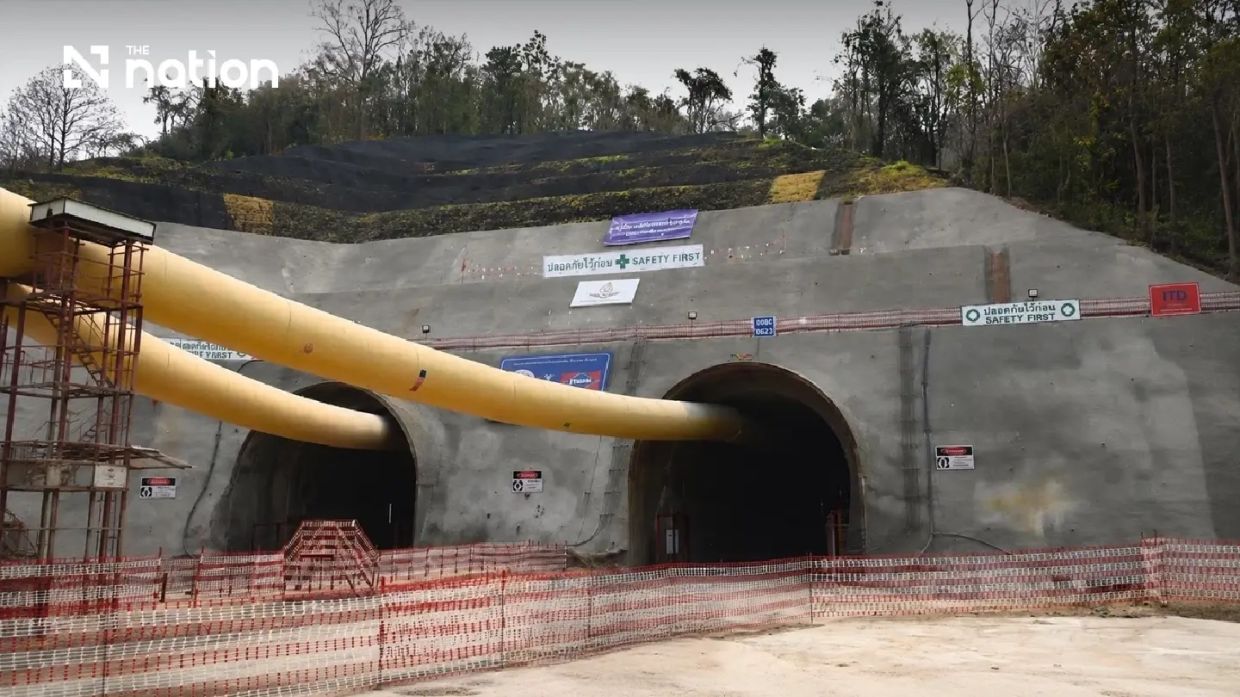
A construction accident at a major Thai railway project claimed two lives and left seven workers injured on Saturday evening when scaffolding gave way inside a tunnel in Chiang Rai province. The incident unfolded at approximately 8:35pm at the Doi Luang railway tunnel, which forms part of the ambitious Den Chai-Chiang Rai-Chiang Khong railway line being developed by Thailand's State Railway organization. Initial reports suggest that rocks dislodged from the tunnel wall struck workers who were engaged in installing a waterproofing system, triggering the structural failure and subsequent collapse.
Deputy Transport Minister Siripong Angkasakulkiat provided authorities' first assessment of the disaster, noting that preliminary investigations had identified falling rock material from tunnel walls as the probable trigger. Earlier accounts had suggested the collapse occurred within the shotcrete work zone, though officials cautioned that full details were still emerging as investigators processed the scene. The severity of injuries varied considerably among those affected; whilst two workers sustained fatal injuries, three others required treatment for serious conditions and a further four sustained minor wounds. All casualties were evacuated promptly to medical facilities for care.
At the time of the deputy minister's statement, officials confirmed that immediate emergency response procedures had been executed successfully. The accident site was secured and cordoned off to prevent further incidents, with the project's dedicated safety division assuming operational control and establishing continuous monitoring protocols. Investigators from Thailand's State Railway Special Projects and Construction Department moved quickly to the location to conduct detailed examinations of the circumstances leading to the collapse. The authorities emphasized that whilst the emergency had been contained, comprehensive investigation would take considerable time to establish the full sequence of events and underlying causes.
The Doi Luang tunnel represents a significant engineering undertaking in its own right. Located in the Chiang Saen district of Chiang Rai, this 3.4-kilometre passage has been successfully bored through the mountain, though interior finishing work remains incomplete. The tunnel forms one component of Contract 3 within the broader Chiang Rai-Chiang Khong section of the railway development, a contract valued at approximately 19.385 billion Thai baht. This particular segment encompasses not merely the tunnel itself but an expansive suite of associated infrastructure works spanning roughly 87 kilometres, including both ground-level and elevated track installations, three full stations, three stopping points, telecommunications and signalling systems, and numerous supporting facilities.
The construction enterprise behind this project involves a substantial consortium designated as the CKST-DC3 Joint Venture. This three-member partnership combines the capabilities of CH. Karnchang Public Company Limited, one of Thailand's major construction firms; Sino-Thai Engineering & Construction Public Company Limited, which brings international technical expertise; and Chiangmai Construction Co., Ltd., contributing regional knowledge and resources. The scale of this undertaking reflects Thailand's broader strategic initiative to enhance regional rail connectivity throughout northern provinces, with Chiang Rai serving as a crucial nodal point.
The Den Chai-Chiang Rai-Chiang Khong railway project carries significant implications for regional development and transport integration. As a cross-border initiative, the railway is designed to strengthen connectivity between Thailand's interior and the Mekong region, potentially facilitating increased trade and mobility across Southeast Asia. For Malaysia and other ASEAN nations, such infrastructural developments underscore the regional shift toward enhanced physical integration and the emphasis major regional economies are placing on transport corridor development.
Working conditions within confined spaces like the Doi Luang tunnel present inherent challenges that require rigorous safety protocols and constant vigilance. Tunnel construction involves multiple simultaneous operations—boring, concrete spraying, waterproofing, and structural reinforcement—each introducing specific hazards. The waterproofing installation that workers were executing at the time of the collapse is a critical phase that protects the tunnel from water infiltration over its operational lifetime. The natural geological conditions of Chiang Rai, whilst navigable through modern tunnelling techniques, can present unstable zones where rock support becomes essential.
This incident will likely trigger comprehensive reviews of safety procedures across the entire project and potentially influence practices on similar undertakings throughout Thailand. The State Railway organization faces mounting scrutiny regarding contractor oversight and worker protection measures, particularly given Thailand's ongoing efforts to maintain high construction standards on major infrastructure projects. Construction accidents of this magnitude, though not uncommon in the region, continue to raise questions about the adequacy of safety investment relative to project scale and complexity.
For the consortium executing this contract, the accident represents both an immediate operational setback and a reputational challenge. Work suspensions for investigation typically extend across related activities, potentially affecting project timelines and completion schedules. The consortium will need to demonstrate not only technical competence in resuming operations but also commitment to enhanced safety practices that exceed regulatory minimums.
The broader Den Chai-Chiang Rai-Chiang Khong railway initiative remains strategically important to Thailand's northern development agenda, and this setback, whilst tragic, is unlikely to derail the overall project objectives. However, it underscores the ongoing tension in large-scale infrastructure development between cost containment, schedule adherence, and worker safety. The lessons emerging from this investigation will reverberate through the Thai construction industry and may influence how similar projects are managed throughout Southeast Asia, where comparable tunnelling initiatives are underway or in planning stages.
%22%2F%3E%3C%2Fpattern%3E%3C%2Fdefs%3E%3Crect%20width%3D%22100%25%22%20height%3D%22100%25%22%20fill%3D%22url(%23ph1d5l8g)%22%2F%3E%3Crect%20width%3D%22100%25%22%20height%3D%22100%25%22%20fill%3D%22url(%23ph1d5l8p)%22%2F%3E%3Ctext%20x%3D%2250%25%22%20y%3D%2250%25%22%20text-anchor%3D%22middle%22%20dominant-baseline%3D%22central%22%20fill%3D%22rgba(255%2C255%2C255%2C0.95)%22%20font-family%3D%22Georgia%2C%20'Times%20New%20Roman'%2C%20serif%22%20font-weight%3D%22700%22%20font-size%3D%22151%22%20letter-spacing%3D%22-0.02em%22%3EPerikatan%3C%2Ftext%3E%3C%2Fsvg%3E)