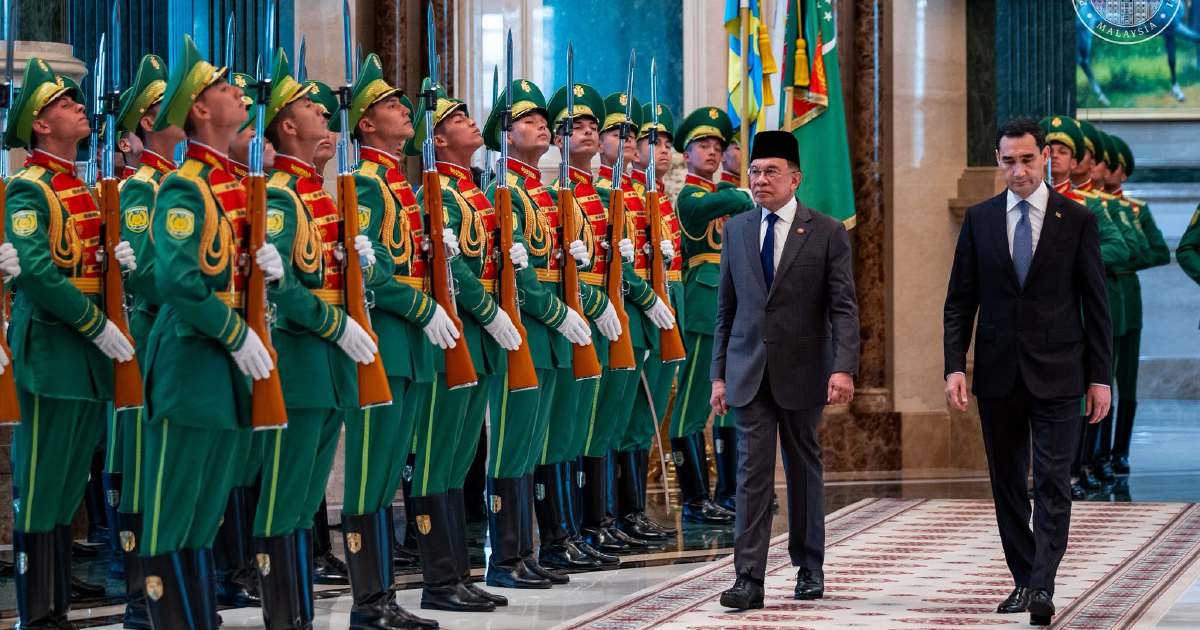
Prime Minister Datuk Seri Anwar Ibrahim has been formally received at Turkmenistan's Presidential Palace in Ashgabat, with the Central Asian nation extending full ceremonial honours befitting the visit. The reception marks his first official trip to the gas-rich nation since becoming Prime Minister, signalling Malaysia's commitment to broadening diplomatic engagement beyond its traditional spheres of influence in Southeast Asia.
The official welcome ceremony represents a significant moment in bilateral relations between Malaysia and Turkmenistan, two nations with complementary interests spanning energy, trade, and cultural cooperation. By extending state-level protocol to the Malaysian delegation, Turkmenistan has signalled its openness to strengthening institutional ties with a major Southeast Asian economic and political player.
Turkmenistan, situated at the crossroads of Central and South Asia, holds strategic importance as one of the world's largest natural gas reserves holders. For Malaysia, engagement with such resource-rich nations aligns with the government's broader strategy to diversify economic partnerships and secure alternative energy sources beyond traditional Middle Eastern suppliers. This visit creates opportunities to explore mutually beneficial arrangements in energy cooperation and trade.
Anwar's journey to Central Asia reflects Malaysia's evolving foreign policy orientation under his leadership. Since taking office, he has emphasised expanding Malaysia's diplomatic footprint globally while maintaining core relationships in Southeast Asia. The Turkmenistan visit underscores this philosophy, positioning Malaysia as an engaged player willing to forge connections across geographical boundaries and civilisational spheres.
The reception accorded to Anwar demonstrates Turkmenistan's recognition of Malaysia's status as a significant Muslim-majority nation with considerable economic and diplomatic influence. Malaysia's experiences in regional integration through ASEAN, its role in international forums, and its positioning as a bridge between the Islamic world and the broader international community make it an attractive partner for Central Asian states seeking to strengthen ties with the Global South.
Central Asia remains an underdeveloped frontier for most Southeast Asian nations, including Malaysia. The region presents untapped potential for Malaysian businesses, particularly in sectors where Southeast Asian expertise can add value—including logistics, Islamic finance, and professional services. Official diplomatic visits at the prime ministerial level typically pave the way for sustained commercial engagement beyond ceremonial exchanges.
Turkmenistan's largely authoritarian governance model stands in contrast to Malaysia's more pluralistic political system, yet bilateral relations transcend ideological differences. This pragmatic approach to diplomacy reflects the realities of international relations, where nations pursue national interests while maintaining respectful diplomatic protocols regardless of systemic differences.
The timing of Anwar's first official Central Asian visit carries symbolic weight domestically. It signals to Malaysia's international partners and domestic constituencies that the government is actively pursuing sophisticated foreign policy objectives. For business communities in Malaysia, such high-level diplomatic missions often precede trade and investment initiatives that can yield tangible economic returns.
The Presidential Palace reception also reflects Turkmenistan's desire to expand partnerships beyond its traditional Russian and Chinese relationships. Central Asian nations increasingly recognise the importance of diversifying their international engagement, and Malaysia offers an alternative voice from a thriving democratic and market-oriented system within the Islamic world.
Looking forward, this visit likely encompasses discussions on specific cooperation frameworks spanning energy security, trade partnerships, educational exchanges, and people-to-people connections. Such bilateral foundations, established through official state visits, typically translate into concrete agreements and institutional mechanisms that benefit both nations over extended periods.
For Malaysia, strengthening ties with Central Asia serves multiple strategic objectives: securing potential energy diversification, expanding export markets for Malaysian goods and services, and positioning the nation as a natural bridge connecting Southeast Asia with the broader Eurasian economic space. Turkmenistan, for its part, benefits from access to Malaysian expertise in Islamic finance, maritime commerce, and regional integration models.
The visit underscores a broader trend of Southeast Asian nations, particularly major economies like Malaysia, reaching beyond their traditional regional circles. This approach reflects both the multipolar nature of contemporary international relations and the practical imperatives facing developing nations to build diversified partnerships that enhance economic resilience and political relevance.
As Anwar's tenure continues, such diplomatic missions will likely define Malaysia's international posture—one characterised by active engagement, pragmatic partnership-building, and strategic positioning in an increasingly multipolar world where relationships with nations across diverse regions prove essential for national prosperity and influence.
%22%2F%3E%3C%2Fpattern%3E%3C%2Fdefs%3E%3Crect%20width%3D%22100%25%22%20height%3D%22100%25%22%20fill%3D%22url(%23ph20rdog)%22%2F%3E%3Crect%20width%3D%22100%25%22%20height%3D%22100%25%22%20fill%3D%22url(%23ph20rdop)%22%2F%3E%3Ctext%20x%3D%2250%25%22%20y%3D%2250%25%22%20text-anchor%3D%22middle%22%20dominant-baseline%3D%22central%22%20fill%3D%22rgba(255%2C255%2C255%2C0.95)%22%20font-family%3D%22Georgia%2C%20'Times%20New%20Roman'%2C%20serif%22%20font-weight%3D%22700%22%20font-size%3D%22320%22%20letter-spacing%3D%22-0.02em%22%3EPKR%3C%2Ftext%3E%3C%2Fsvg%3E)