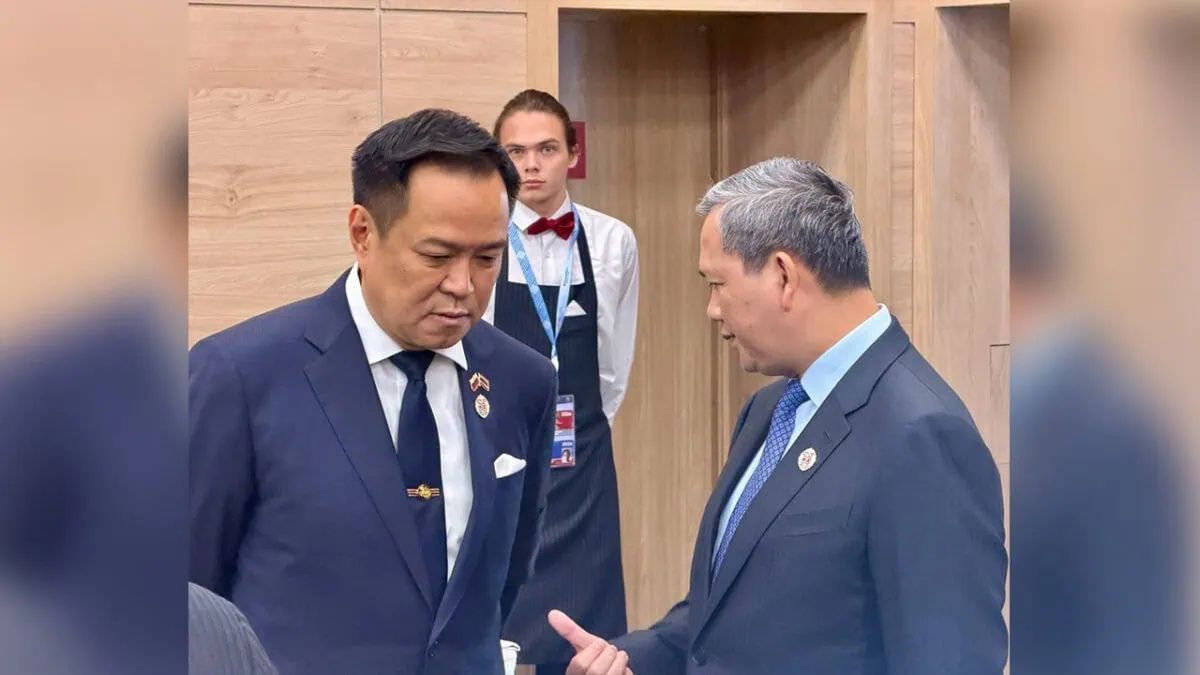
Cambodia's Prime Minister Hun Manet has intensified pressure on Thailand to fill a vacant leadership position within their bilateral border commission, using a brief encounter with Thai Prime Minister Anutin Charnvirakul at an Asean-Russia gathering in Kazan to underline Phnom Penh's frustration with the stalled demarcation process. The appeal reflects mounting regional concern that the protracted absence of formal boundary work could undermine stability along one of Southeast Asia's most sensitive frontiers, where territorial disagreements have periodically sparked public tension and military mobilisation on both sides.
During their informal conversation on the sidelines of the Kazan meetings, Hun Manet specifically referenced a December 2025 bilateral statement committing both nations to resume joint survey and demarcation operations. His public articulation of this demand, shared across social media platforms on Friday, signals that Cambodia views Thailand's failure to appoint a Joint Boundary Commission chief as a deliberate delay rather than administrative oversight. The timing of this intervention carries weight within Asean corridors, where interstate disputes over undefined or contested borders remain a persistent vulnerability for the ten-member bloc's regional stability narrative.
The Cambodian premier's position reflects a carefully calibrated strategy that distinguishes between maritime and terrestrial territorial challenges. For offshore disputes governed by the United Nations Convention on the Law of the Sea, Cambodia has committed to a compulsory conciliation process already underway with Thailand—a mechanism that removes negotiation discretion and forces binding third-party assessment. On land boundaries, however, Hun Manet continues advocating for bilateral resolution through the Joint Boundary Commission, a preference rooted in both countries' desire to maintain direct control over sensitive boundary outcomes. This dual-track approach suggests Cambodia believes it can leverage international maritime law while preserving negotiating flexibility on terrestrial demarcation.
Thai Prime Minister Anutin's characterisation of the encounter differed subtly in emphasis, describing it as merely a brief encounter where the two leaders "pulled each other aside by the elbow" amid crowded conference schedules. His reluctance to engage deeper discussions—and his candid admission that discussing border checkpoint reopenings would provoke domestic fury—reveals the political constraints both governments face when addressing territorial matters. Public opinion in Thailand remains volatile on border issues, with nationalist sentiment capable of rapidly mobilising against perceived territorial concessions, a dynamic that limits prime ministerial flexibility in bilateral negotiations.
The divergent public narratives offered by Phnom Penh and Bangkok mask a shared consensus that neither country wishes open conflict, yet both leaders' statements carefully avoided commitments to concrete timelines. Anutin affirmed Thailand's commitment to international frameworks including UNCLOS and the General Border Committee, but declined to signal movement on appointing a new JBC chief. This studied ambiguity permits both governments to maintain domestic political cover while demonstrating cooperative intent to regional observers and Asean peers. For Malaysia and other Southeast Asian states concerned about border stability contagion, the managed dialogue at least prevents escalation.
Cambodia's renewed emphasis on bilateral mechanisms represents a deliberate choice that privileges direct negotiations over internationalised dispute resolution. By insisting the JBC remain the primary land boundary instrument, Hun Manet preserves Cambodia's agency in any eventual settlement while avoiding scenarios where international adjudication might produce outcomes unfavourable to Phnom Penh's territorial claims. This posture aligns with broader Southeast Asian preferences for settlement through negotiation rather than litigation, a principle embedded in the Asean Charter and consistent with the bloc's conflict-avoidance culture.
The December 2025 Joint Statement referenced by Hun Manet establishes binding expectations about survey and demarcation work, yet Thailand's apparent foot-dragging in appointing JBC leadership suggests Bangkok may lack internal consensus on boundary outcomes. Thai military and civilian bureaucratic entities may harbour differing views on which boundary configurations best serve national interests, creating internal friction that surfaces as negotiating delays. Similar dynamics characterise Cambodia's own institutional landscape, where military, civilian, and political leadership occasionally diverge on strategic priorities, yet Hun Manet's willingness to publicly name the appointment issue indicates Phnom Penh has resolved its internal position.
For Malaysia and other regional stakeholders, the Cambodia-Thailand border management approach offers instructive lessons in crisis prevention. Both nations maintain working relationships through multiple institutional channels—the JBC, the General Border Committee, and now compulsory maritime conciliation—creating redundancy that prevents single-mechanism failure from triggering escalation. Malaysia's own border management with neighbouring states, including unresolved maritime jurisdiction questions in the South China Sea, might benefit from similarly layered institutional architecture that maintains dialogue even when specific mechanisms stall.
The Kazan encounter underscores how Asean gatherings function as crucial backchannels for bilateral diplomacy, permitting leaders to address sensitive issues away from hostile domestic media scrutiny. Yet the informality of these conversations, while politically useful, also enables ambiguity about commitments and timelines. Hun Manet's decision to publicise his position through social media suggests frustration with informal understandings and a desire to create documented evidence of Cambodia's cooperative posture for regional and international audiences.
Thai public opinion constraints represent a genuine complication for accelerated border resolution. Anutin's off-hand remark about Thai people becoming furious over checkpoint reopening discussions reveals how territorial nationalism intersects with practical governance in Southeast Asia. Any Thai government that appears to concede border territory or privileges risks domestic political backlash that could destabilise the coalition government, itself a fragile arrangement requiring careful management of military and civilian factions. This domestic political reality may explain Thailand's deliberate pacing of JBC work regardless of bilateral agreements.
Looking forward, the stalled appointment of a Thai JBC chief will likely remain a flashpoint in bilateral relations until Bangkok signals its readiness to engage substantive demarcation work. Cambodia's public pressure—channelled through Asean forums and social media—attempts to internationalise what might otherwise remain a bilateral administrative matter, thereby raising costs for Thai inaction. Whether this strategy yields results depends partly on broader geopolitical factors and Thailand's assessment of its strategic interests relative to border finalisation. For regional observers, the situation warrants monitoring given potential contagion effects on other Asean border disputes.