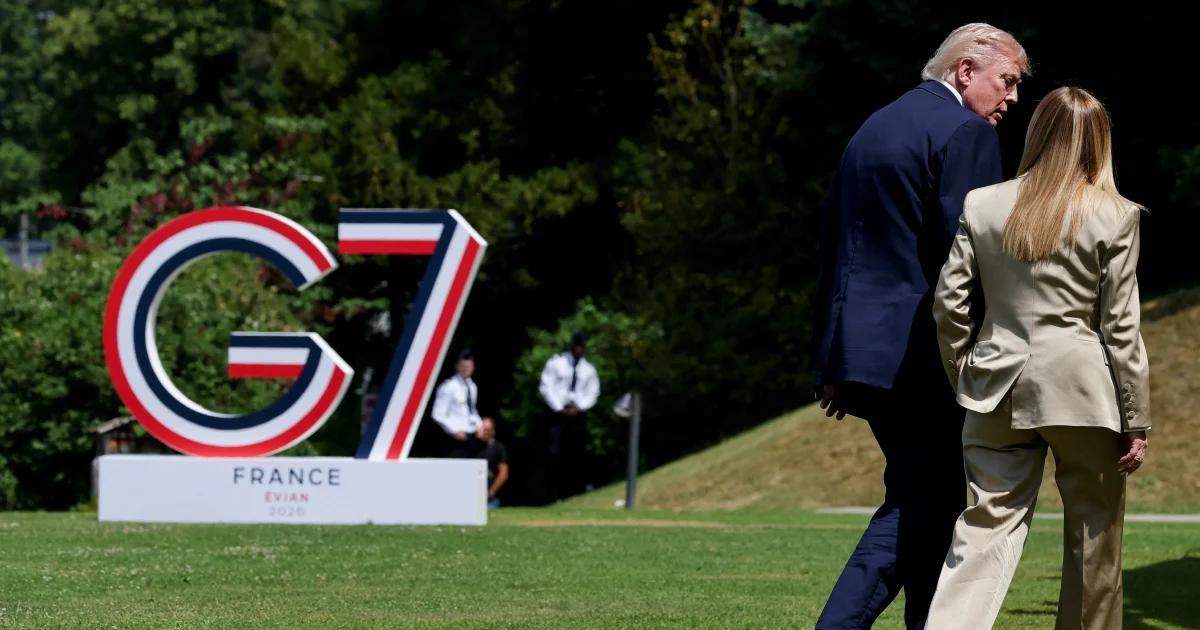
Italy's government has responded with considerable displeasure to remarks attributed to US President Donald Trump that appeared to diminish Prime Minister Giorgia Meloni's diplomatic standing by suggesting she sought photo opportunities with undue eagerness. The reported statements triggered swift and pointed reactions across Rome's political establishment, with the Italian Foreign Ministry taking the unusual step of cancelling a planned visit to the United States in a clear show of official disapproval.
Foreign Minister Antonio Crosetto announced the postponement of his intended travel to Washington, a decision that underscores the seriousness with which the Italian government has chosen to address the incident. This type of high-level cancellation represents a deliberate diplomatic message, signalling that Rome will not overlook comments perceived as dismissive of its prime minister's authority and international standing. The timing of the announcement—coming on Friday—ensured maximum visibility and reinforced Italy's determination to register its objection publicly.
The tension between Rome and Washington reveals a deeper complexity in transatlantic relations during Trump's second administration. Italy, as a member of the European Union and NATO, has traditionally maintained strong ties with the United States, yet Italian leaders have also sought to establish independent foreign policy positions. Meloni's government, which has positioned itself as a centre-right administration navigating between European obligations and national interests, appears particularly sensitive to any suggestion that it lacks substantive influence or operates from a position of supplication to American power.
Meloni's political coalition has worked to reinforce Italy's role as a significant Mediterranean and European player rather than a subordinate partner in the transatlantic relationship. The reported Trump comments, which frame her diplomatic engagement as mere self-promotion rather than serious statecraft, directly contradict the narrative her government has cultivated. This explains the visceral nature of Italy's reaction—it is not merely about personal honour, but about the standing and credibility of the Italian state in international affairs.
The incident must be understood within the context of evolving European attitudes towards the current American administration. Multiple European nations have expressed concerns about Trump's approach to traditional alliances and commitment to shared security arrangements. Italy's swift response demonstrates that even nations traditionally aligned with Washington are prepared to signal displeasure when they perceive disrespect from the White House, particularly when such comments target elected leaders personally.
From a regional perspective, Italy's reaction carries implications for Southeast Asian observers monitoring transatlantic dynamics. Nations in this region frequently navigate their own relationships with multiple great powers and understand the delicate balance required to maintain diplomatic dignity while engaging with larger powers. Italy's decision to cancel Crosetto's visit illustrates that even established allies have redlines regarding how their leadership will be treated in public discourse.
The broader ramifications extend to questions about how the Trump administration intends to manage relationships with European partners during its tenure. Early friction with Italy, a Group of Seven member and NATO ally, suggests potential complications ahead for coordinated Western responses to regional challenges, from Ukraine to Middle Eastern stability. European capitals will be watching closely to see whether such tensions escalate or whether diplomatic channels can restore routine relations.
Meloni herself has cultivated a carefully crafted image as a strong leader capable of advancing Italian interests on the international stage. She has emphasised Italy's historical significance and its role as a crucial player in European security and economic matters. Any suggestion that her international engagement is performative or that she operates from a position of weakness directly contradicts this carefully constructed political identity. The Italian government's response reflects the importance of this image to her administration's domestic and international credibility.
The cancellation decision also sends a signal to Italian voters that their government will defend national dignity against what it perceives as foreign disrespect. In a political environment where nationalist sentiments carry considerable weight, Meloni's government must demonstrate that it will not tolerate being treated as subordinate to foreign powers, regardless of their size or military capacity. This domestic political dimension helps explain why the response was swift and public rather than handled through quiet diplomatic channels.
Moving forward, the question remains whether this rupture will be temporary or whether it signals a more fundamental shift in Italy-US relations. Diplomatic relations between long-standing allies rarely break down entirely over single incidents, but patterns of discord can accumulate and reshape the relationship over time. Both Rome and Washington have strong incentives to restore functional working relationships, but the incident highlights existing tensions about respect, equality, and the nature of the transatlantic partnership during this particular American administration.
For observers tracking global diplomatic patterns, the Italy-Trump row demonstrates that traditional alliance relationships are undergoing recalibration in the current geopolitical environment. Even nations with deep historical ties to the United States are asserting boundaries and demonstrating willingness to register public objections to perceived slights. This shift reflects broader changes in how countries—both large and small—are approaching their international relationships in an era of greater competition and flux.