Vietnamese police have brought charges against two women accused of masterminding one of the country's largest food smuggling operations, involving hundreds of containers of frozen chicken feet valued at more than US$13 million that were diverted from legal re-export channels into the domestic market. Hanoi police announced on Friday, June 19, that Nguyen Thi To Loan, 47, and Trang Tuyet Ngoc, 45, had confessed to all charges related to the sprawling scheme, which exploited regulatory loopholes to circumvent import restrictions on poultry products sourced from countries grappling with active disease outbreaks.
Loans role as the managing director of ABF Food Import-Export JSC in Ninh Binh Province proved central to the operation, with Ngoc, serving as head of an assistant department at An Binh Group, coordinating the illegal distribution network. The investigation spanning the period between 2023 and 2026 revealed a carefully orchestrated system in which the company imported 339 shipping containers of frozen chicken feet while falsely declaring them on customs documents as materials intended solely for processing and subsequent re-export. This misrepresentation bypassed critical safety measures designed to protect Vietnamese consumers from foodstuffs originating in regions where avian influenza and other poultry diseases pose genuine public health risks.
Vietnamese law explicitly prohibits the domestic sale of frozen poultry products sourced from countries with confirmed active poultry disease cases, permitting only processing and re-export activities under strict oversight. Instead of honouring this legal requirement, Loan directed Ngoc to systematically distribute the imported chicken feet throughout Vietnam's food service sector, reaching restaurants, processors, and other commercial establishments across multiple provinces including Hanoi, Cao Bang, Ninh Binh, and Quang Ninh. This nationwide distribution network involved over 10,000 metric tonnes of contaminated poultry products, potentially exposing thousands of consumers to serious health hazards without their knowledge or consent.
The financial scope of the smuggling operation underscores its sophistication and long-term planning. Police estimated the total value of imported goods at VNĐ347 billion, equivalent to approximately US$13 million, yet the perpetrators avoided paying a single dong in import duties by misclassifying their shipments. This tax evasion component compounds the charges beyond simple smuggling, representing a direct loss to the Vietnamese state while effectively subsidizing the criminal network through regulatory non-compliance.
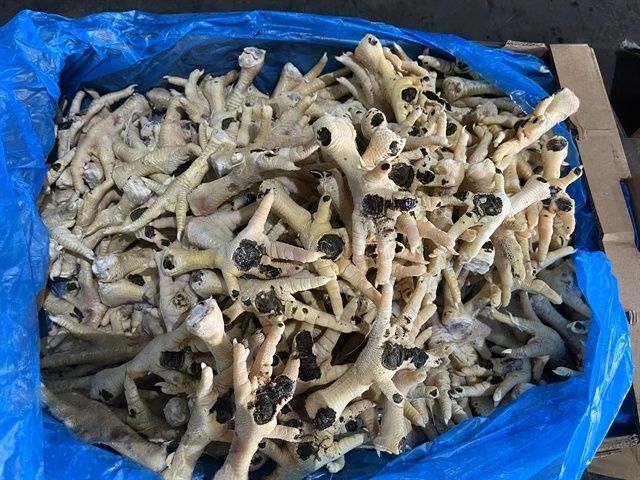
Authorities uncovered the operation following coordinated raids on multiple cold-storage facilities operated in connection with the smuggling ring. The An Viet 2 freezer facility located in Hanoi's Quang Minh Industrial Zone yielded particularly disturbing evidence of the operation's disregard for public health standards. Police recovered over 1,000 metric tonnes of frozen chicken feet at this location, including approximately 260 metric tonnes that had expired well past acceptable consumption dates and displayed visible signs of mold contamination and severe odour deterioration, yet appeared prepared for distribution nonetheless. The discovered condition of these products suggests the operation had continued despite obvious spoilage, indicating either gross negligence or deliberate indifference to the health consequences for consumers.
A second major warehouse raid at the THL cold-storage facility in Lang Son Province in the northern region produced an additional 1,030-plus metric tonnes of confiscated frozen chicken feet, demonstrating the scale of inventory maintained across the smuggling network's infrastructure. The presence of such substantial quantities in storage facilities indicates this operation had been accumulating illegal inventory over an extended period, likely positioning stock for sustained distribution campaigns that would have continued undetected absent police intervention.
Both suspects now face prosecution under Article 188 of Vietnam's 2015 Penal Code, which addresses smuggling offences. The severity of charges reflects the operation's brazen nature and the multiple legal violations committed. Beyond the primary smuggling charges, authorities are investigating tax evasion, document fraud, and potential violations of food safety regulations, building a comprehensive case against the network's core operatives.
The scope of the investigation continues expanding as police work systematically to identify and apprehend additional individuals and organisations potentially complicit in operating the smuggling network. Evidence suggests this operation likely required cooperation from customs officials, warehouse operators, logistics providers, and restaurant owners throughout the supply chain, indicating the investigation may eventually ensnare considerably more suspects. Establishing the full extent of institutional involvement and determining accountability across multiple levels of the distribution hierarchy remains an ongoing priority for authorities.
For Malaysian and Southeast Asian food safety officials, this case represents a cautionary example of how import restrictions designed to protect public health can be systematically circumvented through false documentation and coordination between multiple actors across the supply chain. The discovery of mouldy, expired poultry products staged for distribution illustrates the minimal protection consumers receive once such products enter informal distribution networks. Vietnamese authorities' investigation also highlights how transnational food safety risks can impact broader regional food systems when enforcement mechanisms prove inadequate, a concern directly relevant to ASEAN nations sharing open trade relationships and supply chain integrations.