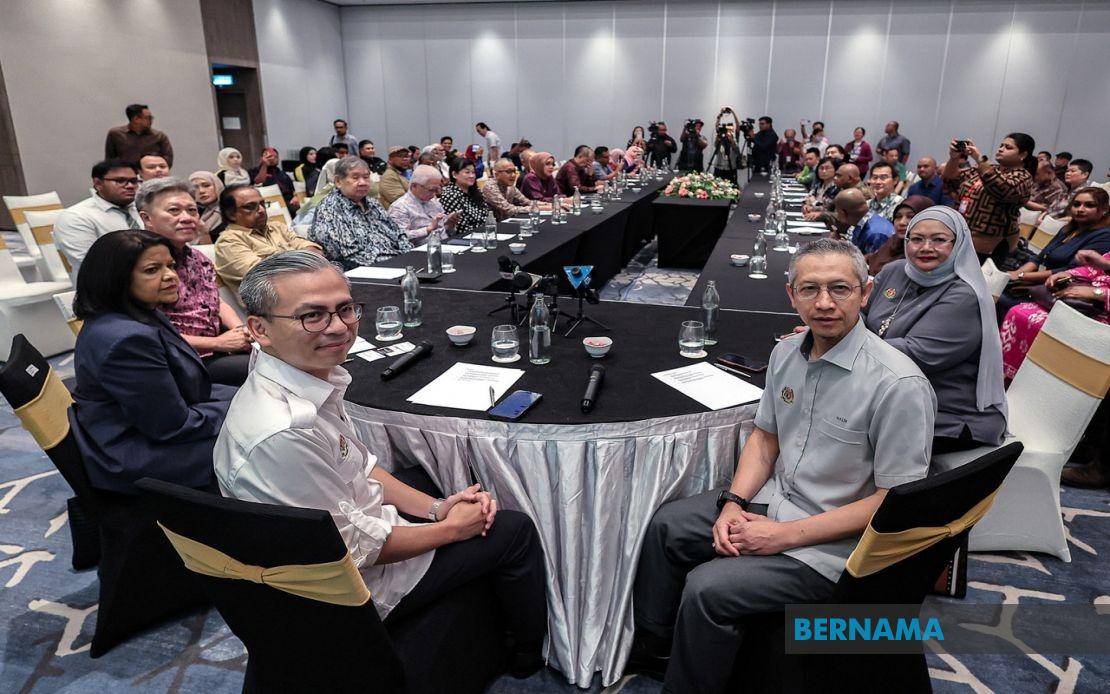
Communications Minister Datuk Fahmi Fadzil has unveiled plans to institutionalise dialogue between government and media professionals by incorporating dedicated retreat sessions into the annual National Journalists' Day (HAWANA) celebrations. Announced during a two-hour engagement with industry representatives at HAWANA 2026 in Butterworth on June 20, the proposal represents an effort to create systematic channels for direct communication between policymakers and newsroom practitioners.
The initiative emerged from dialogue sessions held during the celebration, attended by senior government officials including Communications Ministry secretary-general Datuk Abdul Halim Hamzah and deputy secretary-general Datuk Bahria Mohd Tamil. Industry leaders participating in the discussions included Malaysian National News Agency (Bernama) chairman Datuk Seri Wong Chun Wai, Malaysian Media Council chairman Tan Sri Nallini Pathmanathan, and senior management representing Malaysia's major media organisations. The breadth of attendance underscored the significance being attached to the proposal by both government and industry stakeholders.
Under the proposed framework, the Malaysian Media Council would assume responsibility for coordinating and facilitating these annual retreat sessions. By delegating organisational duties to the MMC rather than handling arrangements directly through the ministry, the structure aims to ensure independence and credibility in how sessions are structured and conducted. This approach potentially addresses concerns about government control over media engagement by positioning the council as an intermediary body.
Fahmi characterised the retreat sessions as platforms designed to systematically gather insights and recommendations from media professionals. The feedback mechanism would encompass industry views on current challenges, policy suggestions, and proposals for legislative amendments affecting the sector. By formalising these consultation pathways, the government signals openness to industry input on regulatory matters and recognises the value of practitioner experience in shaping communications policy.
The Communications Minister identified economic sustainability as a critical industry challenge warranting immediate attention. He highlighted a fundamental market failure affecting Malaysian media organisations: the migration of journalistic content to social media platforms where original reporting generates no direct revenue for newsrooms. This structural problem has intensified pressures on media business models already strained by declining traditional advertising revenues and shifting audience consumption patterns.
Fahmi's acknowledgment of content piracy on social platforms represents implicit government recognition of how digital disruption has undermined traditional business models across Southeast Asian media markets. Malaysian newsrooms face identical pressures to counterparts in Singapore, Indonesia, and Thailand, where high-quality journalism struggles to monetise adequately when aggregators and social networks distribute articles without compensating original publishers. The problem particularly affects smaller regional outlets lacking resources to develop proprietary digital revenue streams.
In response to this market challenge, Fahmi signalled government willingness to facilitate negotiations between domestic media organisations and international social media platforms. While such intermediation might appear to offer limited direct solutions, government engagement could potentially strengthen Malaysia's collective negotiating position—particularly if coordinated with regional media councils. Comparable efforts in Europe, where regulators intervened to establish news licensing arrangements with platforms, demonstrate potential models for addressing content value extraction.
The proposal to institutionalise annual retreat sessions reflects broader regional trends toward formalising government-media relations. Throughout Southeast Asia, governments increasingly recognise that legitimate grievances within professional journalism communities—whether economic or regulatory—left unaddressed can undermine media credibility and erode public trust. By creating structured feedback mechanisms, policymakers attempt to demonstrate responsiveness while simultaneously gaining industry perspectives on implementation challenges with existing regulations.
For Malaysian newsrooms, the annual retreat format could provide valuable opportunities to collectively address industry-wide concerns that individual organisations might hesitate to raise independently. Issues affecting media sustainability—from equipment tariff structures to digital tax treatment—often require coordinated advocacy that becomes possible through formal industry platforms. The Malaysian Media Council's coordinating role suggests participation across competing news organisations, potentially enabling unprecedented sectoral cooperation on non-competitive matters.
However, the proposal's effectiveness will depend substantially on whether government commitments emerging from retreat discussions translate into concrete policy action. Past consultation exercises between communicators and industry groups have occasionally produced recommendations subsequently shelved when political priorities shifted. Success metrics should include tracking whether specific proposals advanced during retreat sessions subsequently appear in government policy documents or legislative initiatives.
The timing of this announcement—during HAWANA 2026 celebrations specifically designed to commemorate journalism's professional standards—underscores messaging about valuing media practitioners' contributions to democratic discourse. By framing retreat sessions within the context of the profession's annual recognition ceremony, organisers position feedback mechanisms as reflecting genuine respect rather than perfunctory consultation. This rhetorical framing matters significantly for industry perception of government intentions.
Looking forward, the retreat structure could establish precedents for regional media cooperation, particularly if Malaysian initiatives are shared across ASEAN professional networks. Challenges affecting Malaysian journalism—platform economics, content monetisation, regulatory adaptation—manifest across the region with varying intensities. Should Malaysia's structured retreat model prove effective at driving policy responsiveness, neighbouring countries might adopt comparable mechanisms, collectively strengthening media sector advocacy capacity throughout Southeast Asia and demonstrating how systematic government engagement can address legitimate industry concerns without compromising editorial independence.